According to roboticsandautomationnews.com, NūMove Robotics & Vision has deployed 22 semi-automatic mixed load palletizers across nine U.S. states, surpassing its previously reported threshold of 20 units. The deployments—completed as of May 22, 2026—target wholesale alcoholic beverage distributors, with the first system installed in 2021. Most installations occurred jointly with integration partner DMW&H as part of large-scale automation projects.
Operational Scale and Throughput Metrics
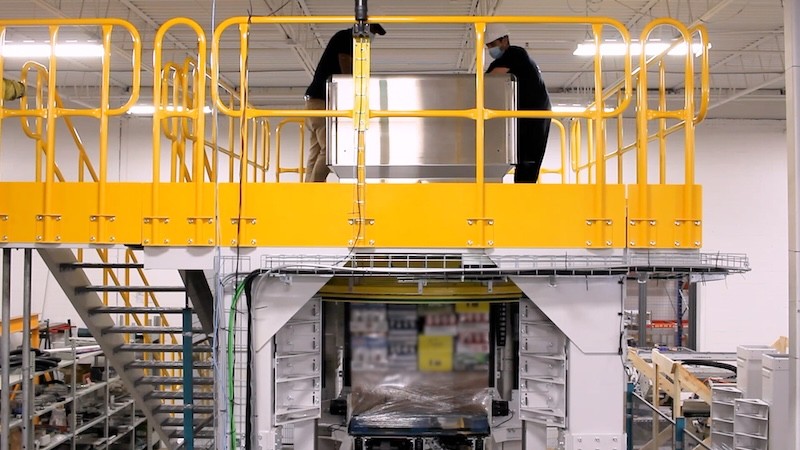
The systems are fully operational at distribution centers serving the U.S. beverage logistics sector. Facilities in California, Texas, Florida, Ohio, Pennsylvania, Illinois, Georgia, Colorado, and Washington host at least one unit, with several sites installing multiple units to scale throughput. Each Semi-Automatic Mixed Load Palletizer achieves a rated capacity of up to 1,000 products per hour, automating pallet handling and ring wrapping while retaining human operators for mixed-item layer building. The solution’s compact footprint allows deployment in space-constrained facilities common among regional beverage distributors.
Collaborative Deployment Model
NūMove delivers the system either directly to end customers or through its strategic integration partner, DMW&H. According to Robert Lampone, vice president of project delivery at DMW&H, “The palletizer solutions have delivered strong value to our customers by increasing throughput compared to traditional manual palletizing stations while also improving ergonomics for workers.” He added: “These improvements contribute to greater overall productivity and operational efficiency.” Lampone also cited NūMove’s technical responsiveness, noting that issues are addressed quickly to maximize machine uptime—a critical factor given typical distribution center shift schedules operating 24/7.
Engineering and Scalability Features
The system’s modular architecture supports phased expansion: additional units can be installed as production volumes grow. Key hardware components include automated pallet dispensers, ergonomic operator workstations with height-adjustable conveyors, and integrated ring-wrapping systems that improve load stability for transport. Maintenance access is designed for <30-minute service intervals on major subsystems, per NūMove’s published maintenance documentation. The solution complies with ANSI/RIA R15.06–2012 safety standards and integrates with existing warehouse management systems (WMS) via standard OPC UA protocols.
Industry Context and Market Alignment
This deployment wave aligns with broader trends in U.S. beverage logistics: a 2025 MHI Annual Industry Report found that 68% of beverage distributors with >$250M annual revenue had initiated warehouse automation projects since 2022, citing labor shortages and rising same-day delivery expectations. Competitors including Locus Robotics and Honeywell Intelligrated have reported similar adoption curves—Locus deployed 142 autonomous mobile robots across 12 beverage DCs in 2025, while Honeywell launched its SmartPalletizer Pro system in Q4 2025 targeting mixed-SKU environments. Unlike fully autonomous robotic palletizers requiring $1.2–$2.4 million per cell (per ARC Advisory Group 2025 data), NūMove’s semi-automatic model carries an average installed cost of $385,000 per unit, making it accessible to mid-tier distributors with 150–400 employees.
Source: Robotics & Automation News
Compiled from international media by the SCI.AI editorial team.