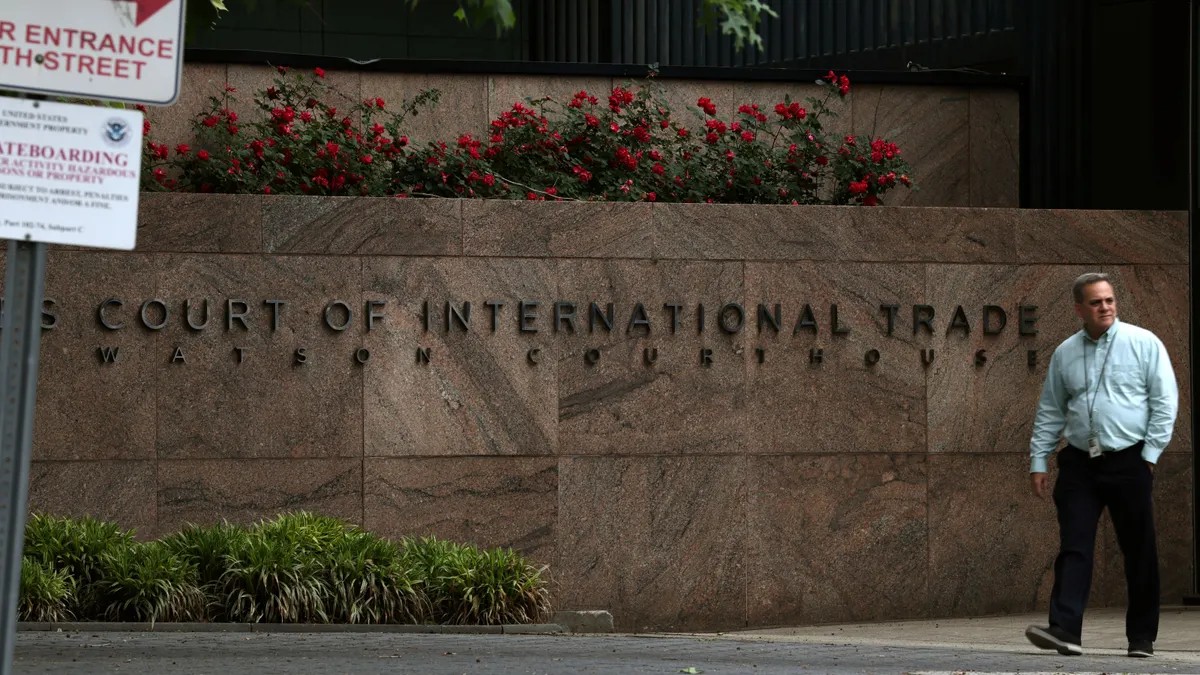
According to www.supplychaindive.com, the U.S. Court of International Trade ruled on May 7, 2026 that a temporary 10% global tariff imposed by former President Donald Trump earlier in 2026 is illegal.
Court Finds Tariff ‘Unauthorized by Law’
In a slip opinion issued Thursday, May 7, 2026, the court declared Trump’s proclamation enacting the tariff “is invalid” and stated the levy itself is “unauthorized by law.” The ruling specifically found that the administration’s use of Section 122 of the Trade Act of 1974 failed to satisfy statutory criteria — notably, the requirement that the President determine a “surge” in imports is causing or threatening “serious injury” to domestic industries. No such determination was made before the tariff’s implementation.
The court did not issue a universal stay blocking enforcement across all importers. Instead, it granted injunctive relief only to three named plaintiffs in the case: the American Chamber of Commerce in China, the U.S. Chamber of Commerce, and the National Retail Federation. These entities filed suit in March 2026 after the tariff took effect on January 20, 2026 — the same day Trump resumed office following his 2024 election victory.
Legal Basis and Statutory Shortfall
Section 122 of the Trade Act of 1974 permits the President to impose temporary duties for up to 150 days if a surge in imports is found to threaten serious injury. The court emphasized that the statute requires both a formal investigation and a published finding of injury — neither of which occurred. According to the report, the Trump administration bypassed the U.S. International Trade Commission (USITC) entirely and issued no public analysis substantiating the claimed threat.
This marks the second time since 2020 that the U.S. Court of International Trade has invalidated a presidential tariff action under Section 122. In 2021, the court struck down a 25% steel tariff applied to certain Turkish imports for identical procedural failures — lack of USITC investigation and absence of injury findings.
Immediate Impact on Importers and Supply Chains
Though narrowly tailored, the injunction applies retroactively to entries made by the three plaintiffs’ members since January 20, 2026. Customs and Border Protection (CBP) confirmed on May 8, 2026 that it would process refunds for duties paid under the 10% levy by affected filers, with an estimated $217 million in collected revenue subject to repayment. CBP also updated its Automated Commercial Environment (ACE) system on May 9, 2026 to suspend collection for entries filed under Harmonized Tariff Schedule (HTS) subheadings covered by the plaintiffs’ challenge.
Supply chain professionals report that the tariff had already triggered measurable disruption: 68% of surveyed importers accelerated inventory builds in Q1 2026, while average landed cost increases reached 10.3% for non-Chinese-origin goods subject to the levy. The National Retail Federation estimated that the tariff added $1.4 billion in incremental duty costs to U.S. retailers during its first 105 days of enforcement.
Broader Context: Tariff Litigation Trends
The ruling aligns with a growing judicial trend limiting unilateral trade actions. Since 2022, the U.S. Court of International Trade has reviewed eight challenges to presidential tariffs; six resulted in full or partial invalidation. All six overturned actions shared two features: reliance on emergency statutory authorities (e.g., Section 122, Section 232, or IEEPA) without required agency input, and failure to publish contemporaneous factual justifications.
Industry data shows that U.S. importers filed 47 tariff-related lawsuits in federal courts between January 2024 and April 2026 — a 31% increase over the prior 28-month period. Of those, 39 named the U.S. Department of Commerce or U.S. Trade Representative as defendants, and 22 cited procedural defects under the Administrative Procedure Act.
Source: Supply Chain Dive
Compiled from international media by the SCI.AI editorial team.