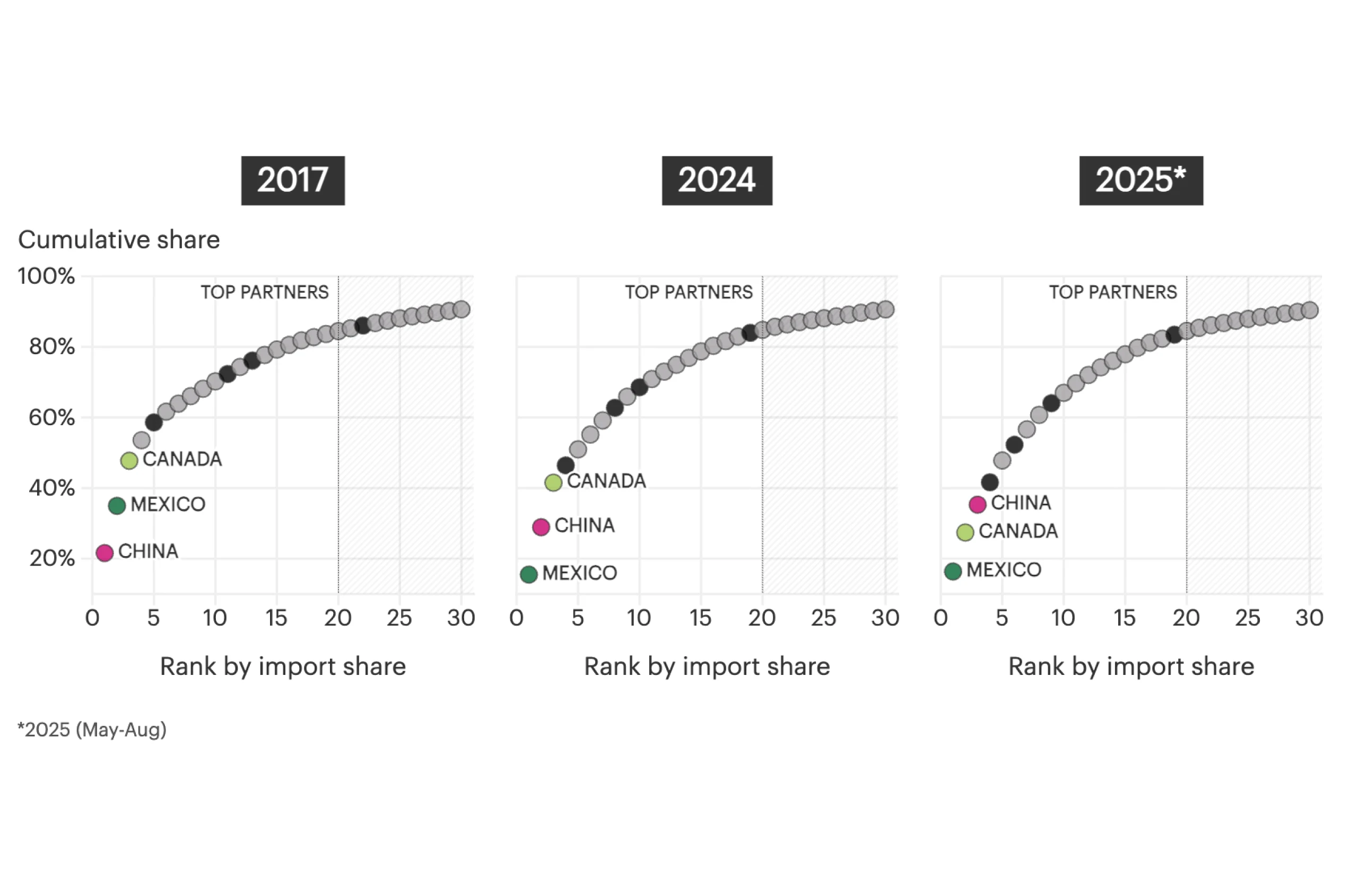
According to www.library.hbs.edu, US imports from China have declined to near-2001 levels — the year China joined the World Trade Organization — as a result of tariff-driven supply chain recalibration accelerating a pre-existing trend toward Mexico and other trade partners.
The Great Reallocation in Action
Research by Harvard Business School’s Laura Alfaro, the Warren Alpert Professor of Business Administration, and Davin Chor, professor at Dartmouth’s Tuck School of Business, documents what they term the “great reallocation” in US supply chain trade. Their November 2025 working paper, “An Anatomy of the Great Reallocation in US Supply Chain Trade,” published by the National Bureau of Economic Research (NBER), analyzes US Census Bureau trade data across over 5,300 product categories.
Tariff Timing and Preparedness
The Trump administration’s major tariff announcement on April 2, 2025, branded “Liberation Day,” did not trigger but rather accelerated shifts already underway. According to the report, companies were already positioned to adjust to the new levies — indicating strategic foresight and operational readiness among many importers and manufacturers.
Geographic Reorientation
The source states that US import flows have shifted away from China and toward Mexico and other top partners. This diversification has reshaped sourcing geography across multiple sectors, with implications for logistics planning, customs compliance, and supplier risk assessment.
Methodology and Scope
The analysis draws exclusively on official US trade statistics, enabling granular tracking of changes by product category. As noted in the source, the five charts accompanying the article visualize key dimensions of this reallocation — including volume trends, partner-level share shifts, and sectoral concentration changes — though the specific chart data points are not described in the text.
Practitioner Implications
For global supply chain professionals, this reallocation underscores the growing operational importance of Mexico as a nearshoring hub, especially for time-sensitive or tariff-sensitive goods. It also signals heightened need for agile customs documentation systems, dual-sourcing strategies, and deeper due diligence on second- and third-tier suppliers in newly prioritized regions. The return of Chinese import volumes to 2001 levels suggests long-term structural change — not cyclical fluctuation — requiring sustained network redesign rather than short-term tactical responses.
Source: www.library.hbs.edu
Compiled from international media by the SCI.AI editorial team.