The Middle East Supply Chain Crisis Context
The Strait of Hormuz, as the world’s most critical oil transit chokepoint, handles approximately 21 million barrels of crude oil daily, representing 21% of global petroleum trade. However, with the escalating Iran war, this strategic waterway has been effectively closed. Iran’s attacks on passing vessels and threats to lay sea mines across the Persian Gulf have paralyzed traditional trade routes. For Gulf countries that depend on the Strait of Hormuz for over 80% of their goods imports and exports, this disruption represents a severe supply chain crisis. Global energy prices have surged accordingly, with Brent crude rising 18% in just one week to reach a historic high of $98 per barrel.
The impact of supply chain disruption extends beyond the energy sector. Transportation of essential goods including food, pharmaceuticals, and industrial raw materials has been severely affected. Approximately 70% of food imports for Gulf Cooperation Council (GCC) countries rely on the Strait of Hormuz, with current blockades already causing food supply tensions in some areas. International shipping giants Maersk and MSC have suspended all routes through the Strait of Hormuz, seeking longer alternative routes instead. This shift has increased Asia-Europe shipping times by an average of 10-14 days, with transportation costs rising 35-40%.
In this context, building regional supply chain resilience has become imperative. The UAE and Saudi Arabia, as the Middle East’s two largest economies, collectively account for over 65% of the Gulf region’s GDP. Both countries possess relatively well-developed port infrastructure and logistics networks, providing conditions for establishing alternative trade routes. This collaboration represents not only an emergency response to the current crisis but also a crucial component of long-term supply chain strategy. By reducing dependence on a single waterway, both nations aim to build a more diversified and resilient trade ecosystem.
Strategic Layout of the New Trade Corridor
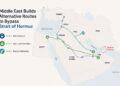
The core of the new trade corridor is a land-sea transport system connecting Sharjah in the UAE with Dammam in Saudi Arabia. This system fully utilizes existing port infrastructure in both countries: the Khorfakkan Commercial Terminal on the UAE’s east coast and Sharjah’s Sajaa Dry Port, along with Saudi Arabia’s Dammam Port. The strategic advantage of Khorfakkan Terminal lies in its complete bypass of the Strait of Hormuz, providing direct access to the Gulf of Oman and offering a safe passage for goods. The terminal has an annual handling capacity of 4 million TEUs, equipped with advanced automation facilities and deep-water berths capable of accommodating the largest container vessels.
Sajaa Dry Port functions as a critical inland logistics hub for consolidation and distribution. Through rail and road networks, goods can be rapidly transferred from Khorfakkan Terminal to Sajaa for further distribution or direct transport to Saudi Arabia. This “port-dry port” linkage model significantly improves logistics efficiency and reduces cargo dwell time at ports. According to Gulftainer, the new corridor can reduce Sharjah-Dammam cargo transit time from the original 7-10 days to just 3-4 days, representing an efficiency improvement exceeding 50%.
On the Saudi side, Dammam Port, as a crucial gateway on the western shore of the Persian Gulf, is undergoing major expansion. Upon completion of its third-phase expansion project, the port’s annual handling capacity will increase to 7.5 million TEUs. The collaboration between Mawani and Gulftainer extends beyond physical infrastructure connectivity to include integration of digital logistics platforms. Both parties will share real-time cargo tracking data, customs clearance information, and transportation scheduling systems, achieving “one-stop” logistics services. This deep cooperation model provides a template for future logistics integration across the Gulf region.
Supply Chain Resilience Professional Analysis
From a supply chain management perspective, the new trade corridor construction embodies multiple resilience strategies. First is route diversification, avoiding “putting all eggs in one basket.” Research indicates that supply chains with at least two main transportation routes demonstrate over 70% greater risk resistance compared to single-route systems. The new corridor provides a critical alternative for the Gulf region, particularly given the long-term instability of the Strait of Hormuz.
Second is infrastructure redundancy design. Both Khorfakkan Terminal and Sajaa Dry Port possess capacity to handle sudden surges in cargo volume. According to supply chain resilience theory, critical nodes should maintain 20-30% idle capacity to respond to emergencies. The new corridor’s design fully considers this requirement, ensuring rapid scalability during crises. Furthermore, the land-sea transport model itself offers flexibility advantages, allowing quick adjustments to capacity allocation in other segments when one segment faces disruption.
Third is information transparency and collaboration. Integration of digital logistics platforms enables real-time information sharing among all supply chain participants, facilitating rapid response to changes. Studies show that supply chains with high information transparency recover 40% faster from disruptions than those with poor information flow. The cooperation agreement between Mawani and Gulftainer specifically emphasizes data sharing and joint decision-making mechanisms, establishing a foundation for collaborative supply chain management.
Impact on Global Supply Chains
The construction of the new trade corridor will have profound implications for global supply chain patterns. First, it may alter the Middle East’s logistics hub landscape. Traditionally, Dubai’s Jebel Ali Port has been the Gulf region’s primary transshipment center, but the new corridor positions the Sharjah-Dammam combination as a strong competitor. This competition will drive improvements in port services and cost optimization across the region, ultimately benefiting global traders.
Second, the new route provides additional options for Asia-Europe trade. While the Cape of Good Hope route is longer, the Sharjah-Dammam corridor complements existing “Northern Corridor” (via Russia) and “Middle Corridor” (via the Caspian Sea) options. Goods can be unloaded in Sharjah, transported overland to Mediterranean ports, and then transshipped to Europe. Although this multimodal transport model is complex, it provides valuable alternatives in extreme situations.
Third, the new corridor may accelerate Gulf economic integration. UAE-Saudi cooperation could expand to other areas, such as unified customs procedures, coordinated trade policies, and joint logistics standards development. This deep collaboration will inject new momentum into the Gulf common market, enhancing the region’s voice in global supply chains. Long-term, a more integrated Gulf economy will attract increased international investment, driving development of supply chain-related industries.
Challenges and Risks
Despite promising prospects, the new trade corridor faces numerous challenges. First is infrastructure compatibility. Differences exist between the UAE and Saudi Arabia in railway gauges, truck standards, and warehousing specifications, requiring time for coordination. Initial estimates suggest a 6-12 month technical adjustment period is needed to achieve seamless integration, during which transportation efficiency may not reach expected levels.
Second is security risk. Although the new corridor bypasses the Strait of Hormuz, the overall security situation in the Persian Gulf remains tense. Iran’s threat to lay mines could expand to cover the entire Persian Gulf, affecting operations at all Gulf ports. Additionally, regional conflict escalation could jeopardize overland transport. Supply chain security experts recommend purchasing war risk insurance for critical cargo and developing emergency evacuation plans.
Third is economic viability. Operating costs for the new corridor exceed those of traditional sea routes, particularly during initial stages. While the current crisis makes higher costs acceptable, the corridor may face competitiveness issues if the Strait of Hormuz reopens. Accordingly, both governments are considering subsidies and tax incentives to ensure long-term sustainability. Simultaneously, differentiated service strategies are being developed, such as premium services for high-value, time-sensitive goods.
Future Outlook and Recommendations
Looking ahead, the new trade corridor has potential to develop into the Gulf region’s “supply chain backbone network.” As infrastructure improves and operational experience accumulates, its efficiency and reliability will continuously increase. Experts predict that within 3-5 years, the new corridor could handle 15-20% of the Gulf region’s container cargo volume, becoming an indispensable component of regional supply chains.
For international supply chain managers, we recommend: first, closely monitoring the new corridor’s development and assessing its potential integration into existing supply chain networks; second, establishing direct contact with Mawani and Gulftainer to understand specific service details and pricing; third, considering establishing regional distribution centers along the corridor to leverage its strategic position for serving Middle Eastern, African, and South Asian markets; fourth, participating in relevant standard-setting processes to ensure their needs receive adequate consideration.
For policymakers, we recommend: first, strengthening regional cooperation to extend the new corridor to more Gulf countries; second, investing in digital infrastructure to enhance supply chain visibility; third, establishing emergency coordination mechanisms for rapid crisis response; fourth, enhancing talent development to provide intellectual support for supply chain innovation.
Source: The National News
This article was AI-assisted and reviewed by our editorial team.