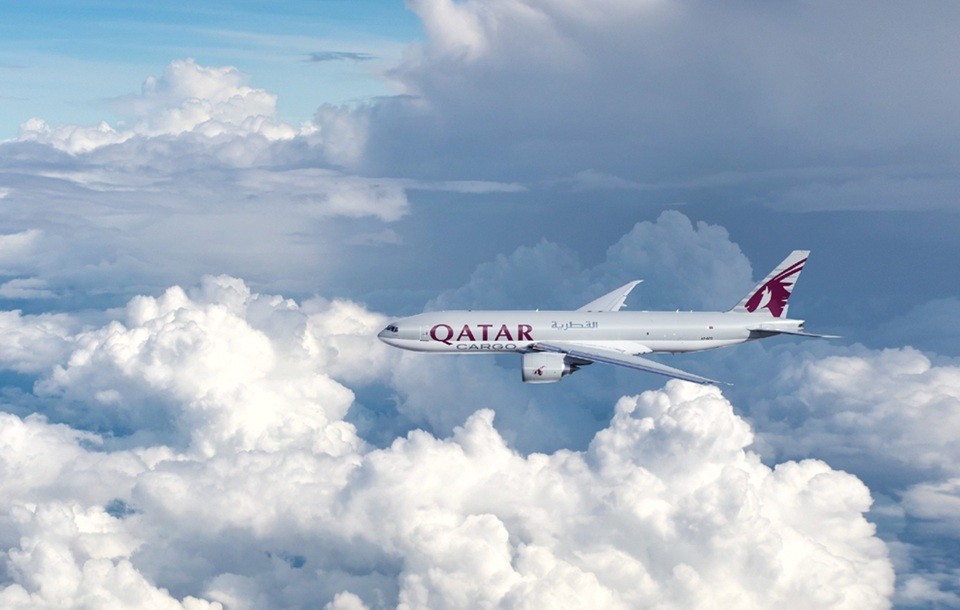
According to www.aircargonews.net, Qatar Airways Cargo will increase its offered freight capacity by 12% through new freighter routes and expanded bellyhold space on passenger flights.
New Freighters Expand European and Middle East Reach
Qatar Airways Cargo has relaunched its Boeing 777 freighter service to Vienna, Austria, operating on the Doha – Budapest – Vienna – Doha route. A second 777F has been added to the Warsaw, Poland route, which operates on the Doha – Budapest – Warsaw – Doha path. The new freighter service to Vienna adds 100 tonnes of weekly capacity each way, while the Warsaw route now offers over 273 tonnes each way per week.
Bellyhold Capacity Grows with Passenger Route Expansions
Increased passenger flight frequencies are boosting bellyhold capacity across multiple regions. On 15 July, passenger flights to Helsinki, Finland, will resume with four weekly flights, increasing to seven by 1 August. This will raise total bellyhold capacity from 40 tonnes to 70 tonnes each way per week.
The Tokyo Haneda route will relaunch on 16 July with four weekly passenger flights, scaling to seven by 1 August. Bellyhold capacity will grow from 60 tonnes to 105 tonnes each way per week.
Americas and Asia Capacity Surge
Qatar Airways has expanded its Americas network, including a new route to Caracas, Venezuela, via Bogotá, Colombia, starting 22 July. Twice-weekly flights offer 20 tonnes of bellyhold capacity each way.
Flights to Dallas have increased from seven to ten weekly, providing 54 tonnes of cargo capacity each way per week. For Houston, passenger flights have risen from three to five weekly, with two freighter flights adding 200 tonnes of capacity each way. Total cargo capacity for Dallas and Houston combined is now 228 tonnes each way per week.
Flights to São Paulo have increased from 11 to 14 weekly, with four existing freighter flights contributing 400 tonnes each way. The total cargo capacity per week each way now exceeds 479 tonnes.
Asia Network Expansion
Capacity in Asia has increased significantly. Flights to Dhaka have risen from 14 to 17 weekly, resulting in over 315 tonnes of cargo capacity each way per week. Hong Kong flights have increased from 10 to 14 weekly, with 42 existing freighter flights offering 4,200 tonnes each way. Total cargo capacity for Hong Kong is now more than 4,474 tonnes per week each way.
Flights to Shanghai will increase from seven to 10 weekly as of 1 June, with eight weekly freighter flights providing 800 tonnes of capacity each way. Total capacity for Shanghai will exceed 985 tonnes each way per week.
Europe and Middle East Network Enhancements
Weekly flights to Istanbul have increased from 14 to 17, adding to two existing weekly freighter flights. Total bellyhold capacity is 190 tonnes each way per week, with additional freighter capacity of 200 tonnes.
Vienna flights have increased from four to seven weekly, with bellyhold capacity exceeding 73 tonnes each way. The new freighter service adds 100 tonnes each way per week.
Flights to Amman have doubled from seven to 14 weekly, with one freighter flight adding 100 tonnes each way. Total cargo capacity is over 291 tonnes each way per week.
Operational and Strategic Impact
According to the source, Qatar Airways Cargo’s combined expansion of freighter capacity and bellyhold space supports a 12% increase in overall offered cargo capacity. The strategy reflects a broader industry trend of airlines leveraging passenger network growth to enhance freight capabilities, particularly in high-demand regions like Asia and Europe.
“The relaunch of the Vienna and Warsaw freighter services, alongside expanded passenger routes, significantly strengthens our global air cargo network.” — Qatar Airways Cargo
- 12% increase in total cargo capacity
- Boeing 777 freighter to Vienna and Warsaw
- Caracas route begins 22 July with 20 tonnes each way
- Helsinki passenger flights increase to 7 weekly by 1 August (70 tonnes capacity)
- Shanghai flights rise from 7 to 10 weekly (985+ tonnes total capacity)
Source: Air Cargo News
Compiled from international media by the SCI.AI editorial team.