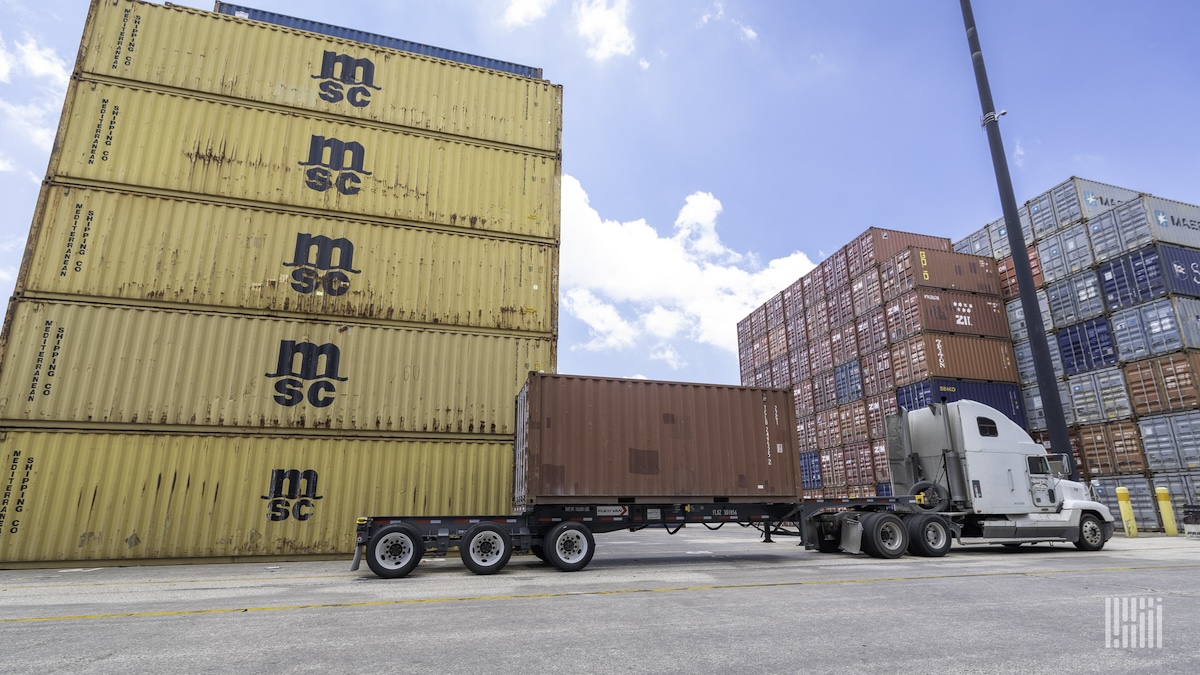
As traditional warehouse space continues to tighten in North America’s core logistics hubs, with U.S.-Mexico border crossing times fluctuating up to 72 hours and Chinese exporters’ inquiries for Latin American transshipment warehouses soaring 215% year-over-year, a mobile storage model known as “warehouses on wheels” is quietly becoming the new infrastructure for global supply chain resilience. According to the latest FreightWaves SONAR data, North American trailer storage orders surged 37% year-over-year in Q1 2026—far exceeding the 4.2% decline in industrial vacancy rates and the 18.6% increase in 3PL contract warehousing prices during the same period. This is not merely a temporary emergency measure but a structural transformation driven by three converging pressures: tariff policy uncertainty, delayed nearshoring implementation, and infrastructure mismatches during manufacturing reshoring.
Tariff Volatility Fuels Demand for Scalable Storage Solutions
Since the U.S. imposed 25% additional tariffs on certain Chinese machinery and electronic products in 2025 and initiated Section 301 reviews on Mexican semiconductor equipment exports, North American importers’ inventory strategies have fundamentally shifted. The traditional VMI (Vendor Managed Inventory) model, which relied on “large-volume, low-frequency” shipments, is no longer viable. Companies are now forced to break down safety stock into multi-tiered, small-batch, geographically dispersed buffer units. Trailer storage perfectly fits this new logic: a single 40-foot dry van provides approximately 67 cubic meters of net volume, can be independently powered, equipped with IoT temperature control and GPS tracking modules, and deployed within just 48 hours—compared to an average 14-month construction period for equivalent bonded warehouse space.
More importantly, its cost structure offers strong flexibility. Daily billing allows companies to quickly release idle trailers during tariff windows (such as temporary exemption periods), avoiding the “sunk cost trap” of traditional warehouse leases. John Brooks, founder and CEO of Warehouse on Wheels, notes: “We’re not selling space; we’re selling ‘decision delay rights’—enabling procurement directors to decide within 72 hours after CIF price locking whether to clear customs, temporarily store, or ship directly to end-users.”
Nearshoring Infrastructure Gaps Create Physical-Digital Twin Opportunities
Nearshoring was supposed to mitigate geopolitical risks, but reality has exposed severe infrastructure gaps. Mexico’s northern industrial belt added 28 million square meters of new factory space in 2025, yet faces a 43% shortage in supporting warehouse capacity. Expansion of inspection facilities at the five major U.S.-Mexico border crossings lags behind schedule by an average of 11.7 months. In this context, the “trailer-as-warehouse” model has unexpectedly become a critical interface bridging virtual capacity planning and physical infrastructure shortfalls.
Warehouse on Wheels’ trailers come pre-installed with ISO container locks and ANSI MH1 standard interfaces, seamlessly integrating with TMS systems to create digital twins. Each trailer’s real-time location, temperature, humidity, door sensor status, and loading/unloading counts synchronize with customer ERP systems, forming a “physical asset-digital mirror” closed loop. This capability enabled Nike to improve wave operation accuracy at its Guadalajara distribution center in Mexico to 99.98%.
Labor Shortages Accelerate Warehouse Morphology Revolution
North America’s logistics industry faces an unprecedented labor crisis. U.S. Bureau of Labor Statistics data shows warehouse operator vacancy rates reached 12.4% in February 2026, with forklift driver recruitment cycles averaging 132 days and a shortage of 87,000 professionals with customs documentation processing skills. In this environment, trailer storage demonstrates unique labor adaptation advantages.
Its standardized dimensions (40’×8’×8.5′) and modular design enable 90% of loading/unloading operations to be completed using portable electric pallet jacks and RFID scanning, eliminating the need for traditional high-reach forklifts and certified operators. Warehouse on Wheels’ customer feedback shows that adopting trailer solutions reduces single-warehouse staffing requirements by 41% and cuts new employee training cycles from 22 days to just 3.5 days.
Chinese Exporters Build Trans-Pacific Resilience Corridors
For Chinese manufacturers, trailer storage has evolved beyond a cost tool into a strategic lever for participating in global rule-making. In Q1 2026, Chinese goods transshipped through Mexico into the U.S. market reached $21.4 billion in value, with 68% of shippers opting for trailer storage in Monterrey or Tijuana to implement “origin再造” strategies.
These involve disassembling domestically produced finished goods into semi-finished products shipped to Mexico, completing local assembly, labeling, packaging, and ROO documentation generation within trailers, and finally clearing customs as Mexican-origin products. This approach reduces tariff costs by 18–25 percentage points and circumvents mandatory UL certification barriers for Chinese-made lithium batteries.
Capital and Technology Drive Ecosystem Evolution
The explosive growth of trailer storage is attracting multi-tiered capital investment. In March 2026, BlackRock’s infrastructure fund acquired a 15% stake in Warehouse on Wheels for $127 million, with its due diligence report explicitly stating: “Trailer assets exhibit REIT-like attributes—stable cash flow (average contract duration 2.3 years), counter-cyclicality (demand increases with tariff volatility), and high turnover (83% annual utilization rate).”
Meanwhile, technology integration is accelerating. SONAR has incorporated trailer data into its “Tariff Risk Heat Map,” providing real-time alerts on inspection probabilities for specific U.S.-Mexico routes over the next 72 hours. Blockchain startup CargoChain has launched “dynamic letters of credit” based on trailers, enabling banks to automatically release funds based on GPS trajectories and temperature/humidity data, compressing financing cycles from 5 days to 22 minutes.
Source: www.freightwaves.com
This article was AI-assisted and reviewed by SCI.AI’s editorial team before publication.