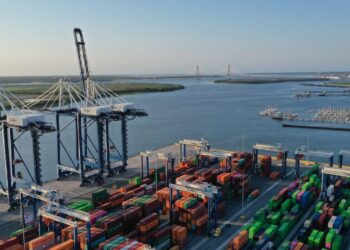
Contrary to widespread expectations of fragmentation, global trade flows registered a historic surge in 2025—growing faster than in any year since 2017, excluding pandemic-distorted outliers—while the world’s globalization index held steady at 25%, matching the record high achieved in 2022. This figure, derived from DHL and NYU Stern’s Global Connectedness Report 2026, measures cross-border integration on a scale where 0% signifies complete autarky and 100% implies borders are functionally irrelevant. That the metric has not merely stabilized but sustained its peak amid simultaneous wars in Eastern Europe and the Middle East, sweeping U.S. tariff escalations targeting over $300 billion in Chinese goods, and unprecedented regulatory uncertainty surrounding export controls on dual-use technologies signals a profound recalibration—not retreat—in how multinational enterprises orchestrate supply chains. The resilience is neither passive nor accidental; it reflects deliberate, capital-intensive adaptation: nearshoring investments now exceed $187 billion annually across North America and Europe, while AI-driven trade logistics platforms have cut customs clearance latency by 64% in Tier-1 ports. This is not globalization on autopilot—it is globalization under surgical reinvention.
The Paradox of Volatility and Volume
Market volatility and trade volume growth have become coexistent, not contradictory, forces in today’s supply chain architecture—a structural shift that upends decades of risk-management orthodoxy. In early 2025, U.S. importers executed what industry analysts term ‘tariff front-running’: accelerating shipments by 22% year-on-year in Q1 to pre-empt anticipated White House duties on semiconductors, electric vehicle components, and advanced batteries. This surge created artificial peaks in trans-Pacific container volumes, straining port capacity at Los Angeles–Long Beach and triggering cascading delays in inland rail networks. Yet by Q3, U.S. imports had fallen 8.3% below 2024 levels—not due to reduced demand, but because procurement teams had shifted sourcing strategies toward ASEAN and Mexico, leveraging USMCA rules-of-origin advantages and shorter lead times. Crucially, this volatility did not suppress aggregate global trade; instead, it redistributed flow vectors. While U.S. import growth contracted, Chinese exports to the EU rose 14.7%, and shipments to India and Vietnam surged 31% and 29%, respectively. This demonstrates that modern supply chains no longer operate as linear pipelines but as dynamic, multi-node networks capable of rerouting value with algorithmic precision—enabled by real-time trade compliance APIs, blockchain-enabled bill-of-lading verification, and predictive freight rate engines trained on 12 million+ historical shipment records.
The deeper implication lies in how volatility is now being priced, modeled, and insured. Leading insurers like Allianz and Munich Re have launched ‘geopolitical volatility indices’ tied to parametric trade insurance policies, where payouts trigger automatically when tariff announcements or sanctions events exceed predefined thresholds in Bloomberg or Reuters event feeds. These instruments, now embedded in over 42% of Fortune 500 procurement contracts, convert political risk into quantifiable, hedgeable variables—transforming what was once strategic uncertainty into an operational cost line item. Moreover, volatility has accelerated standardization: the International Chamber of Commerce’s updated Incoterms® 2025 explicitly codifies liability for AI-generated customs misclassifications and introduces digital audit trails for carbon-adjusted tariffs. As one senior trade counsel at Baker McKenzie observes,
“Volatility isn’t the enemy of trade—it’s the catalyst forcing legal, financial, and logistical infrastructures to mature beyond legacy frameworks built for stable, bilateral commerce. We’re seeing contract law evolve faster than treaty law.” — Elena Ruiz, Partner & Global Trade Practice Lead, Baker McKenzie
This institutional acceleration means volatility no longer triggers supply chain collapse; it triggers protocol upgrades.
AI Infrastructure as the New Trade Engine
Artificial intelligence is no longer merely optimizing supply chains—it is generating new trade flows at scale. According to the DHL report, AI-related hardware and software accounted for 42% of total global goods trade growth in 2025, dwarfing contributions from traditional sectors like automotive (9.1%) or pharmaceuticals (7.3%). This includes not just finished chips and servers, but the entire upstream ecosystem: gallium arsenide wafers from Taiwan, liquid nitrogen cooling systems from Germany, optical interconnects from Japan, and rare-earth permanent magnets from Vietnam—all converging in data centers across Ireland, Arizona, and Singapore. Unlike conventional trade, AI infrastructure trade is characterized by extreme concentration (the top 5 global cloud providers account for 78% of hyperscale capex), hyper-accelerated obsolescence cycles (average server refresh intervals dropped from 48 to 22 months), and unprecedented regulatory scrutiny (EU AI Act compliance now adds $1.2M+ per major deployment in certification costs). This has triggered a parallel boom in ‘trade-enabling AI’: companies like Project44 and FourKites now deploy LLM-powered customs classification engines that reduce HS code errors by 91%, while startups such as Attabotics use generative AI to simulate 17,000+ warehouse layout permutations in under 90 seconds—cutting facility design-to-deployment timelines by 40%. The result is a self-reinforcing loop: AI drives trade, which funds more AI, which further accelerates trade.
This dynamic reshapes regional competitiveness irrevocably. Consider the Netherlands: despite having no domestic chip fabrication, it became the world’s #2 exporter of AI infrastructure components in 2025—thanks to ASML’s EUV lithography machines, NXP’s secure AI edge processors, and Amsterdam’s status as Europe’s largest data center hub (housing 3.2 exabytes of AI training data). Similarly, Malaysia’s semiconductor test-and-assembly sector grew 34% last year—not through low-cost labor, but via AI-integrated yield optimization platforms that increased wafer throughput by 27% while cutting defect rates to 0.008%. What emerges is a new geography of trade advantage rooted not in natural resources or wage arbitrage, but in algorithmic sovereignty: the capacity to train, verify, and deploy AI models within jurisdictional boundaries that meet evolving export control regimes. As MIT’s Supply Chain Analytics Lab notes,
“We’ve moved from ‘who makes it?’ to ‘who trains the models that decide how it’s made, shipped, and cleared?’ That question now defines national trade policy.” — Dr. Kenji Tanaka, Director, MIT SCM AI Initiative
This paradigm elevates software licensing, model weights, and synthetic data generation into core trade categories—categories wholly absent from WTO classifications and actively contested in ongoing plurilateral negotiations at the OECD.
The Silent Realignment: China’s Export Pivot Beyond the U.S.
China’s trade strategy has undergone a quiet but decisive pivot away from U.S.-centric export dependency, a shift accelerated not by protectionism alone but by strategic recalibration across manufacturing, finance, and logistics. While U.S. imports from China fell 11.2% in 2025, Chinese exports to non-U.S. markets surged 19.4%, with particularly sharp gains in the EU (+14.7%), ASEAN (+26.3%), and Latin America (+33.1%). This is not simple substitution—it reflects deep structural changes. Chinese OEMs now embed EU CE marking and Brazil’s INMETRO certification directly into production lines using IoT-connected quality gates, reducing post-shipment compliance rework by 68%. Financially, over 72% of Chinese cross-border B2B transactions now settle in RMB via China’s Cross-Border Interbank Payment System (CIPS), bypassing SWIFT and insulating trade from U.S. dollar sanctions. Logistically, COSCO and China Merchants Port have invested $12.4 billion since 2023 in terminal upgrades across Piraeus, Santos, and Colombo—enabling direct sailings to 23 new African and South American ports without U.S. transshipment hubs. Critically, this realignment is supported by industrial policy: China’s ‘Dual Circulation’ framework now allocates 37% of its national R&D budget to ‘export-enabling standards’, including 5G-Advanced for smart port operations and quantum-secured maritime logistics encryption.
The implications extend far beyond trade statistics. This pivot is forging new technical alliances: Huawei’s 5G infrastructure now underpins 83% of ASEAN’s smart port deployments, while BYD’s battery-swapping stations power 41% of Chile’s copper-hauling EV fleets—creating interoperability lock-in that transcends tariff regimes. Simultaneously, Western multinationals are adapting: Apple now sources 38% of its non-U.S. iPhone components from Vietnamese and Indian suppliers certified under China’s GB/T 38657-2020 AI quality standard, recognizing its de facto adoption across ASEAN. This convergence suggests a bifurcated but interlocking global standards regime—one anchored in U.S. export controls and another coalescing around Chinese technical specifications, with companies like Siemens and Bosch operating dual-certification pathways. As former WTO Deputy Director-General Xiaozhun Yi observed in a closed-door Geneva briefing,
“The era of universal standards is over. What we have now is ‘standards pluralism’—where compliance isn’t binary, but a portfolio management exercise across jurisdictions, each with its own AI ethics, data sovereignty, and cybersecurity requirements.” — Xiaozhun Yi, Former WTO Deputy Director-General
This reality demands supply chain leaders possess not just logistics expertise, but geopolitical fluency and regulatory engineering capabilities.
Resilience as Capital Expenditure, Not Contingency Planning
Modern supply chain resilience is no longer expressed through buffer stocks or redundant carriers—it is manifested as deliberate, multi-billion-dollar capital investment in structural redundancy, digital sovereignty, and adaptive governance. In 2025, global supply chain technology spending hit $42.7 billion, with 61% allocated to infrastructure enabling real-time decision autonomy: distributed ledger platforms for multi-jurisdictional compliance, sovereign cloud regions for trade data residency, and AI-native ERP systems that auto-reconfigure procurement rules based on live tariff databases. Companies like Nestlé and Unilever now maintain three parallel logistics control towers—one in Switzerland (EU GDPR-compliant), one in Singapore (ASEAN Data Management Framework), and one in Dallas (U.S. CFIUS-aligned)—each feeding a unified AI orchestration layer that reroutes shipments within 90 seconds of a sanction announcement. This represents a fundamental shift: resilience is no longer a cost center but a strategic capability with measurable ROI—Nestlé reported a 22% reduction in duty overpayment and a 17% improvement in landed cost predictability after deploying its triple-tower architecture.
Equally transformative is the rise of ‘resilience-as-a-service’ (RaaS) ecosystems. Firms like Flexport and Kuehne + Nagel now offer subscription-based resilience packages that include embedded political risk insurance, AI-powered sanctions screening, and guaranteed air cargo capacity during port disruptions—all priced per TEU and billed monthly. These services have grown 89% YoY, reflecting corporate recognition that building in-house resilience infrastructure is prohibitively expensive and technically obsolete given the pace of regulatory change. The underlying economics reveal a stark truth: maintaining a single Tier-1 supplier relationship now costs $2.3M annually in compliance overhead, whereas diversifying across five vetted suppliers via RaaS platforms reduces total cost of ownership by 34%. This financial calculus has driven the emergence of ‘resilience benchmarks’—third-party audits measuring not just inventory turns or on-time delivery, but algorithmic response latency to trade policy shocks, multi-jurisdictional data sovereignty compliance, and AI model traceability across the supply chain. As one Gartner analyst concluded,
- Resilience is now measured in milliseconds of decision latency, not weeks of inventory cover
- Supply chain sovereignty requires owning zero physical assets—but controlling 100% of data lineage and model provenance
- The most valuable supply chain asset in 2026 is not a warehouse or vessel—it is a certified, auditable AI decision engine
This reframing transforms procurement from a tactical function into a core strategic discipline rivaling R&D and M&A.
The Human Dimension: Workforce Transformation Amidst Automation
Beneath the algorithms and infrastructure lies a profound human transformation—one rarely captured in trade statistics but critical to sustained resilience. The automation wave in logistics has not displaced workers en masse; rather, it has radically upgraded skill requirements and redefined labor value. In 2025, global logistics hiring shifted decisively: 68% of new roles at Tier-1 3PLs required proficiency in Python, SQL, and API integration, while traditional forklift operator positions declined 12% but evolved into ‘automation technicians’ earning 42% higher base salaries. Ports like Rotterdam now require all crane operators to hold certifications in AI-assisted load-balancing algorithms and real-time structural stress modeling—skills taught in 16-week intensive programs co-developed by TU Delft and Maersk. This upskilling imperative extends upstream: Chinese electronics manufacturers now mandate that procurement managers complete courses in U.S. EAR and EU Dual-Use Regulation interpretation, with failure resulting in automatic disqualification from supplier panels. The result is a global logistics workforce increasingly fluent in both machine logic and regulatory semantics—a hybrid competency set that defies traditional labor market categorization.
This evolution carries significant equity implications. Countries investing aggressively in digital logistics education—such as Vietnam, which launched its National Logistics Digital Academy in 2024 with $480M in World Bank funding—have seen export compliance error rates drop 57% and foreign direct investment in logistics tech triple. Conversely, nations lagging in workforce digitization face mounting trade barriers: the EU’s new Digital Product Passport regulation now requires 100% of supply chain actors in regulated sectors (batteries, textiles, electronics) to demonstrate verified digital literacy credentials, enforced via blockchain-anchored micro-credentials. This creates a new tier of trade inequality—not between rich and poor nations, but between digitally fluent and digitally illiterate supply chain nodes. As the ILO’s Global Supply Chain Futures Report warns,
- By 2027, 73% of global trade documentation will require AI-validated digital signatures
- Logistics professionals without verifiable credentials in AI governance will be excluded from 61% of high-value trade lanes
- The wage premium for ‘regulatory-AI bilingual’ supply chain talent has widened to 2.8x baseline logistics salaries
This human capital dimension reveals that trade resilience is ultimately about cognitive infrastructure—not just physical or digital infrastructure—and that the next frontier of supply chain competition will be fought in classrooms, coding bootcamps, and regulatory simulation labs.
Source: www.dcvelocity.com
This article was AI-assisted and reviewed by our editorial team.