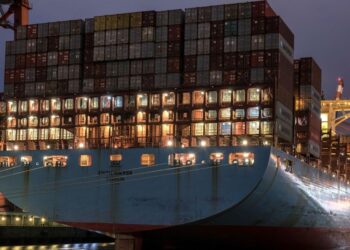
South Korea stands at a pivotal inflection point—not defined by technological leap or export milestone, but by the quiet, accelerating erosion of supply chain predictability. With 70.4 percent trade dependency ratio—meaning exports and imports constitute over two-thirds of GDP—and 90 percent energy import reliance, the nation’s economic architecture is fundamentally exposed to geopolitical tremors thousands of kilometers away. Recent escalations in the Middle East have reactivated dormant vulnerabilities: the Strait of Hormuz, through which 70.7 percent of Korea’s crude oil and 20.4 percent of its liquefied natural gas transits, is no longer just a shipping lane—it is a geopolitical pressure valve with direct calibration on Seoul’s inflation metrics, semiconductor yield rates, and power grid stability. This is not cyclical volatility; it is structural fragility amplified by converging crises—from Black Sea grain embargoes to rare earth export controls—that collectively redefine what economic sovereignty means in the 21st century.
The Hormuz Calculus: When a 34-Mile Strait Dictates National Industrial Output
The Strait of Hormuz is less a geographic feature than a strategic fulcrum—34 miles wide at its narrowest point, yet responsible for about 20 percent of global oil consumption and one-third of seaborne-traded LNG. For Korea, this chokepoint isn’t abstract infrastructure; it is the circulatory system for industrial metabolism. In 2024, Korean refineries processed 2.8 million barrels per day of imported crude, of which over 2 million bpd originated from Gulf Cooperation Council (GCC) states—nearly all routed through Hormuz. A single week-long closure would trigger immediate cascading effects: tanker charter rates would surge by 150–200 percent, as seen during the 2019 tanker attacks; spot LNG prices would spike above $35/MMBtu (versus a 5-year average of $12); and domestic fuel oil premiums would widen by 28–35 percent, directly inflating electricity generation costs for KEPCO. Crucially, these aren’t isolated price signals—they are transmission mechanisms that recalibrate capital allocation across Korea’s entire manufacturing base. Steelmakers like POSCO must recalculate blast furnace operating margins within 72 hours of a Hormuz incident; petrochemical complexes in Yeosu and Ulsan face raw material rationing before formal government intervention begins.
This vulnerability is compounded by systemic inertia in maritime risk mitigation. Unlike Japan—which maintains 180 days of strategic petroleum reserves and operates diversified tanker fleets under dual-flag registries—Korea holds only 90 days of crude reserves, with 68 percent of its energy tanker fleet registered under foreign flags (Panama, Liberia, Marshall Islands), limiting sovereign operational control during sanctions enforcement or naval interdiction scenarios. Moreover, Korea’s energy logistics digitization lags behind regional peers: real-time AIS tracking integration with customs and port authorities remains siloed, delaying coordinated rerouting decisions by 18–24 hours versus Singapore’s integrated Maritime Single Window platform. As geopolitical friction hardens into institutionalized rivalry, the Hormuz calculus shifts from ‘how fast can we respond?’ to ‘how much redundancy can our balance sheets absorb before competitiveness erodes?’ The answer, increasingly, is not enough—particularly for mid-tier manufacturers without hedging capacity or vertical integration leverage.
From Wheat to Wafers: The Cascading Impact of Black Sea Disruption
The 2022 Russian invasion of Ukraine didn’t merely fracture Eastern Europe—it detonated a global food-commodity shockwave whose reverberations struck Korean households and industries with surgical precision. Before February 2022, the Black Sea region supplied 30 percent of global wheat exports and 14 percent of maize; within weeks of port blockades, wheat futures on the Chicago Board of Trade surged 132 percent, while maize jumped 107 percent. For Korea—a country importing 93 percent of its wheat and 98 percent of its corn—this wasn’t distant market noise. It translated into 42 percent year-on-year increases in flour prices by Q3 2022, pushing instant noodle production costs up 29 percent and forcing CJ CheilJedang to reformulate recipes using domestically grown barley. More critically, feed grain shortages triggered a 35 percent rise in broiler chicken production costs, collapsing poultry farm margins and prompting the Ministry of Agriculture to release emergency soybean reserves—despite Korea holding only 22 days of strategic grain stocks, far below the FAO-recommended 90-day minimum.
Yet the true systemic lesson lies beyond agriculture. The Black Sea crisis exposed how commodity shocks propagate vertically through industrial stacks. Korean semiconductor fabs rely on high-purity nitrogen and argon gases—whose production depends on air separation units powered by coal-fired electricity. When Ukrainian coal exports collapsed, European energy prices spiked, increasing argon production costs in Germany by 41 percent, which then raised Korean wafer fab gas procurement expenses by 17 percent within six months. Similarly, fertilizer shortages constrained global urea production, elevating nitric acid prices—the key etchant in DRAM wafer cleaning processes—by 33 percent. These linkages reveal a critical blind spot: Korea’s supply chain risk models still treat sectors in isolation, ignoring cross-sectoral dependencies embedded in shared utility inputs, chemical intermediates, and energy carriers. As one senior Samsung Electronics supply chain strategist observed:
“We stress-test for chip shortages, but never modeled how a wheat embargo could delay 12nm node ramp-up because our etchant supplier’s plant ran on Ukrainian-sourced ammonia.” — Lee Min-jae, Director of Strategic Sourcing, Samsung Semiconductor
Rare Earth Realities: When Minerals Become Geopolitical Leverage
Korea’s position as the world’s second-largest semiconductor exporter and top-five battery materials producer rests precariously on mineral supply chains it neither controls nor diversifies meaningfully. China dominates 60 percent of global rare earth element (REE) mining, 85 percent of REE refining, and 92 percent of magnet production—critical for EV motors, 5G base station filters, and defense radar systems. Meanwhile, Brazil and India control 78 percent of niobium output (essential for high-strength steel in shipbuilding), and the Democratic Republic of Congo supplies 70 percent of global cobalt, a cornerstone of NCM 811 cathode chemistry used by LG Energy Solution. Korea imports 99.2 percent of its REEs, 97.8 percent of its cobalt, and 100 percent of its niobium—with no domestic refining capacity for any of them. This isn’t mere import dependence; it is strategic delegation. When China imposed export restrictions on gallium and germanium in July 2023, Korean memory chip yields dropped 4.3 percent within three months—not due to raw material scarcity, but because refined germanium oxide purity fell below 99.9999% (6N) specifications required for epitaxial layer growth.
The implications extend beyond manufacturing. Korea’s defense modernization plan (2022–2031) calls for 1,200 KF-21 Boramae fighters and 20 next-generation destroyers, both reliant on dysprosium-doped permanent magnets and tantalum capacitors—materials subject to tightening Chinese licensing regimes. Worse, Korea lacks a national critical minerals list: the U.S. identifies 50 critical minerals, the EU 34, while Korea’s 2023 ‘Strategic Materials Act’ names only 12, omitting lithium processing chemicals and high-purity graphite crucial for anode production. As Dr. Park Soo-jin, Senior Fellow at the Korea Institute for International Economic Policy, notes:
“Supply chain resilience isn’t about stockpiling—it’s about controlling nodes where value is added. Korea excels at downstream assembly but cedes upstream sovereignty. That asymmetry becomes fatal when geopolitics weaponizes processing bottlenecks.” — Dr. Park Soo-jin, Senior Fellow, Korea Institute for International Economic Policy
Without accelerated investment in hydrometallurgical recycling (currently less than 0.8 percent of Korea’s REE demand) and joint ventures with resource-rich nations like Namibia and Greenland, Korea risks becoming a high-value assembly hub perpetually negotiating access rather than commanding capability.
Resilience as Infrastructure: Why Centralized Coordination Is Non-Negotiable
Treating supply chain resilience as an operational optimization exercise—as many Korean conglomerates still do—is dangerously obsolete. The convergence of climate-driven port congestion, AI-enabled cyberattacks on logistics platforms, and state-sponsored export controls demands a paradigm shift: resilience must be treated as national infrastructure, equivalent to power grids or broadband networks. Korea’s current governance structure fragments responsibility across eight ministries—Trade, Energy, Defense, Food and Drug Safety, Environment, Oceans and Fisheries, Science and ICT, and SMEs—with no statutory authority for cross-ministerial data sharing or emergency resource allocation. Contrast this with Japan’s Supply Chain Resilience Council, chaired by the Prime Minister and empowered to mandate inventory disclosures from top 500 firms, or the U.S. Office of the National Cyber Director, which coordinates semiconductor supply chain threat intelligence across DHS, DoD, and Commerce. Korea’s proposed Critical Supply Chain Monitoring System remains conceptual, lacking legislative backing, real-time API integrations with Korean Customs Service’s UNIPASS, or predictive analytics capacity to model cascading failures across 12+ industrial tiers.
A truly functional centralized framework would require three non-negotiable pillars. First, a mandatory critical materials registry requiring Tier-1 suppliers to disclose origin, volume, and alternative sourcing options for all inputs exceeding 0.5 percent of annual procurement value. Second, a national logistics intelligence fusion center integrating AIS, satellite imagery, port congestion indices, and insurance claims data to generate predictive disruption scores—already piloted by Hyundai Merchant Marine but not scaled. Third, strategic stockpile modernization: shifting from static reserve hoarding (e.g., 90 days of crude) to dynamic, multi-tiered inventories—such as pre-positioned REE oxides at Incheon Free Economic Zone bonded warehouses with automated replenishment triggers linked to Shanghai Metal Exchange volatility indices. Without such architecture, Korea’s response to the next Hormuz incident—or a Taiwan Strait contingency—will remain reactive, fragmented, and economically corrosive.
From Vulnerability to Vertical Sovereignty: The Path Beyond Diversification
Diversification—often cited as the panacea for supply chain risk—is insufficient when diversification itself is geopolitically constrained. Relying on Vietnam for electronics components or Mexico for automotive parts merely relocates exposure to new chokepoints: Vietnam imports 82 percent of its semiconductors from Korea and Taiwan, while Mexico’s deepwater ports handle only 37 percent of its container volume, creating new bottlenecks. True resilience requires vertical sovereignty: building domestic capacity at high-leverage nodes where Korea already possesses latent advantage. Consider hydrogen: Korea aims for 10 GW electrolyzer capacity by 2030, yet imports 100 percent of iridium catalysts (used in PEM electrolyzers) from South Africa. Instead of chasing iridium substitutes, Korea should deploy its world-leading platinum-group metal refining expertise (held by companies like Kumho Petrochemical) to establish domestic iridium purification—transforming import dependency into export opportunity. Similarly, Korea’s global leadership in OLED display manufacturing (72 percent market share) could anchor domestic rare earth separation for red phosphors, bypassing Chinese refining entirely.
This vertical strategy is already emerging in niche domains. POSCO’s $1.2 billion investment in lithium hydroxide refining at Gwangyang—using brine from Argentina’s Cauchari-Olaroz project—creates closed-loop control from mine to cathode precursor. Likewise, SK On’s joint venture with Canada’s Nouveau Monde Graphite secures anode-grade synthetic graphite while co-developing Korea’s first commercial-scale graphite purification facility in Ulsan. These are not isolated projects but blueprints for sector-wide transformation. The government must accelerate this by revising the Special Taxation Law to grant 150 percent super-deduction for capex in critical mineral processing and establishing dedicated REE R&D funding streams mirroring Japan’s $2.3 billion Rare Metals Recycling Initiative. As Professor Kim Jae-ho of KAIST’s Graduate School of Green Growth argues:
- Korea’s comparative advantage lies not in raw material ownership—but in precision engineering, materials science, and process innovation
- Vertical sovereignty reduces exposure to logistical chokepoints while creating exportable IP and high-wage jobs
- Every dollar invested in domestic refining yields 3.7x more GDP impact than equivalent spending on diversified imports
Without this pivot, Korea’s supply chains will remain vulnerable conduits—not strategic assets.
Source: www.koreaherald.com
This article was AI-assisted and reviewed by our editorial team.