The global supply chain conference Manifest 2026 was held in Las Vegas, where industry leaders agreed that AI-driven forecasting, automation, and robotics have shifted from “optional” to “essential.”
The Supply Chain Revolution Under the “New Normal”
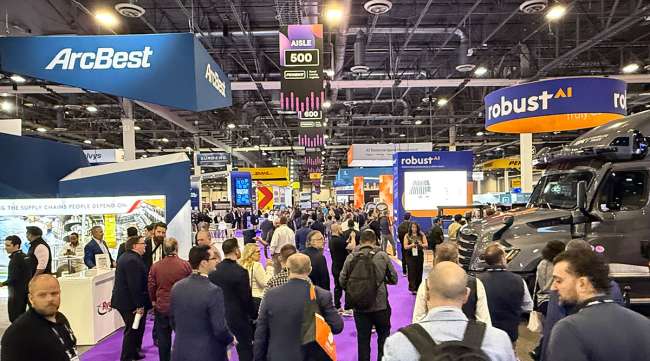
From February 9th to 11th, 2026, one of the most influential summits in the global supply chain industry—Manifest 2026—took place in Las Vegas. Executives from retail, logistics, manufacturing, and other sectors gathered to discuss a single core issue: how to use AI and automation to address “unending disruptions.”
Jake Barr, CEO of BlueWorld Supply Chain Consulting, summarized the current industry status with one word on the main stage—”The New Never Normal” (New常态:永无常态).
“You must keep your supply chain and operations in a state that can handle continuous disruptions rather than occasional ones,” Barr said.
American Eagle: AI Forecasting at ZIP Code Level
U.S. apparel retail giant American Eagle Outfitters (AEO) showcased the results of its supply chain transformation driven by AI. The company owns brands such as American Eagle, Aerie, and Todd Snyder.
Brandon Friez, Senior Vice President of Global Logistics & Supply Chain Intelligence at AEO, shared the company’s AI use cases:
- Demand forecasting at ZIP code level
- Dynamic adjustment of inventory locations based on real-time data
- Optimization of logistics mode selection based on capacity and cost
- Network simulation support for decision-making in the face of new tariff policies
“We believe that volatility actually creates opportunities,” Friez said, “A static supply chain is a dead one because it’s always evolving.”
Scotts Miracle-Gro: AI Saves $600 Million in Inventory
Scotts Miracle-Gro, the horticulture product giant, shared an impressive figure through its enterprise transformation leader David Huskisson: The company has reduced its year-end average inventory by $600 million through AI-optimized inventory management.
“Frankly, this math equation is not something humans can solve; we truly rely on AI,” Huskisson said. “By predicting consumer behavior data, we have achieved unprecedented inventory accuracy.”
DHL “Insight 2030”: 73% of Decision-makers Bet on Robots
DHL Supply Chain, a leading contract logistics company, released the research report titled “Insight 2030” at the conference. The report gathered collective insights from 350 North American supply chain leaders. Key findings include:
- 73% of decision-makers expect robots to reshape their operations—currently, only 44% have actually deployed them
- 65% plan to increase nearshoring investments to address trade uncertainties
- 62% anticipate that geopolitical tensions will impact their operations by 2030
- AI, automation, and supply chain resilience are seen as strategic priorities
Will Heywood, Chief Customer Officer of DHL Supply Chain, stated: “It’s striking how strongly leaders now believe that the supply chain plays a strategic role in overall business success.”
Gretchen Torres, Vice President of Marketing, summarized the industry’s core needs: “We need faster speed, better visibility, smarter coordination—and we can’t let costs spiral out of control.“
Ryder: No Decision Framework Means No Value for AI
Dave Yoder, Director of Product Development and Innovation at Ryder Supply Chain Solutions, brought a pragmatic reminder:
“If you haven’t established a decision framework, AI automation or Agentic AI won’t provide any value for you,” Yoder said.
He emphasized that over the past two years, industry discussions about AI have shifted from “concept hype” to “practical implementation.” After using AI in their work, managers now better understand its capabilities and limitations. The key to successfully deploying AI lies in:
- Gathering the right data
- Clarifying business processes
- Introducing AI after establishing a decision framework
Samsung SDS: Digital Logistics Platform Cello Square
Samsung SDS also showcased its digital logistics service platform Cello Square at Manifest 2026, highlighting global supply chain stability through real-time monitoring via control towers. The cost-saving effects have been validated in the European market, and the company is actively expanding customer touchpoints in North America and Europe.
Industry Consensus: Five Major Trends for Supply Chains in 2026
Based on various perspectives at Manifest 2026, global supply chains are evolving along these directions:
- AI moves from auxiliary to core—forecasting, optimization, and decision-making fully AI-driven
- Robot deployment accelerates—warehouse automation scales up beyond pilot projects
- Nearshoring continues—65% of companies plan to increase investment to mitigate geopolitical risks
- Data quality becomes a competitive advantage—”accurate, timely, actionable” is the premise for AI value realization
- Resilience prioritized over efficiency—in an era of continuous disruption, adaptability trumps cost
Source: Transport Topics, Samsung SDS, February 12th, 2026