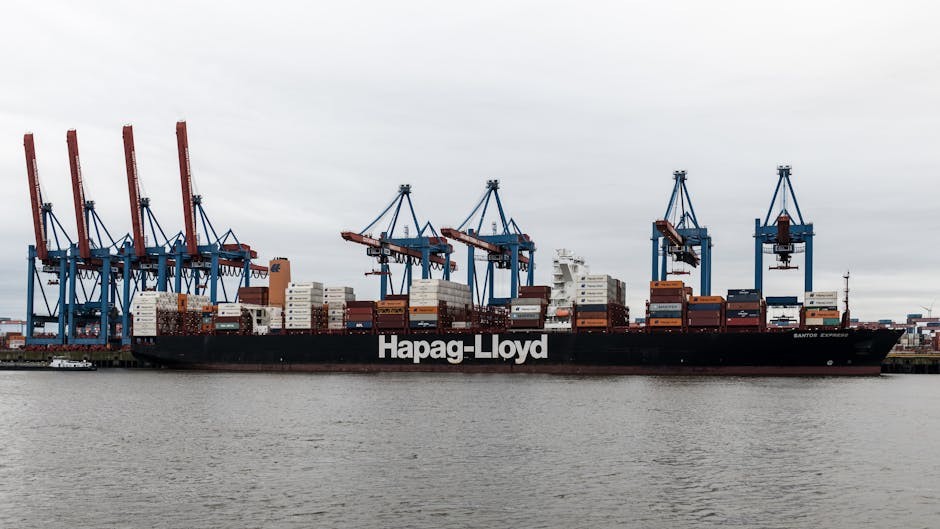
The auction for the Santos Container Terminal (TECON) — the linchpin of Latin America’s largest port complex and a critical node in the transatlantic and transpacific supply chain — has become the most consequential geopolitical flashpoint in infrastructure finance since the Belt and Road Initiative’s early expansion into Southeast Asia. With Brazil preparing to award a 35-year concession for TECON, valued at an estimated $2.8 billion in upfront payments plus annual royalties, U.S. Consul-General Kevin Murakami’s March 5, 2026 remarks in Santos were not diplomatic nuance but a calibrated intervention: a public signal that Washington views Chinese participation not as routine foreign direct investment but as a sovereignty-sensitive strategic exposure. This is unprecedented — no American diplomat has ever so explicitly weighed in on a sovereign infrastructure tender in a non-allied democracy without invoking formal security alliances. The implications extend far beyond Brazil: they reveal how supply chain resilience policy has been redefined not by logistics efficiency or cost metrics, but by geopolitical adjacency thresholds, where proximity to U.S. military logistics networks, data sovereignty frameworks, and counter-narcotics intelligence sharing now function as de facto bid eligibility criteria.
The Strategic Geometry of Santos: Why This Terminal Is Non-Substitutable
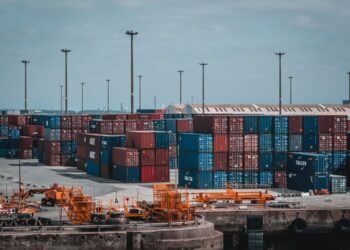
Santos Port handles over 37% of Brazil’s total containerized trade volume, moving more than 5.2 million TEUs annually — a figure projected to reach 7.1 million TEUs by 2030 under current infrastructure upgrade plans. Crucially, TECON is not merely one of eight terminals; it is the only deep-water, fully automated facility in the complex capable of berthing 24,000-TEU megaships with draft requirements exceeding 16.5 meters. Its integration with the Rio-Santos Highway Corridor and the Ferrovia Norte-Sul rail line gives it unmatched multimodal reach into Brazil’s agricultural heartland — the “Arc of Deforestation” soy and corn belt — and industrial centers in São Paulo and Minas Gerais. From a supply chain continuity perspective, TECON serves as the primary export gateway for 92% of Brazil’s agrochemical exports, 86% of its automotive component shipments, and 74% of pharmaceutical raw material imports. Disruption here does not trigger localized delays — it cascades across global just-in-time manufacturing ecosystems, particularly in Europe’s automotive sector and North America’s food processing industry. As Dr. Elena Ribeiro, Director of the Institute for Logistics Policy at FGV EAESP, explains:
“TECON isn’t infrastructure — it’s an operating system for Brazil’s external economic metabolism. A change in governance isn’t about tariffs or labor contracts; it’s about whether real-time vessel scheduling data flows through Shanghai-based cloud platforms or NATO-compliant maritime data exchange protocols.” — Dr. Elena Ribeiro, Director, Institute for Logistics Policy, FGV EAESP
This centrality explains why the U.S. State Department’s internal 2025 Western Hemisphere Critical Infrastructure Vulnerability Assessment ranked TECON as Priority Tier-1, placing it alongside Panama Canal control systems and Chile’s Valparaíso LNG terminal. The report cites three interlocking risks: first, data exfiltration vectors embedded in port management software (e.g., automated gate systems, yard crane IoT sensors, and customs declaration APIs) that could map cargo manifests, shipping routes, and consignee patterns in near real time; second, supply chain weaponization potential, where selective port congestion or documentation delays could be leveraged during geopolitical friction — a tactic observed in China’s 2020 handling of Australian barley shipments; third, military dual-use infrastructure creep, where civilian port upgrades (e.g., reinforced quay walls, expanded dry-dock capacity, or fiber-optic backbone hardening) align with PLA Navy logistical requirements for extended South Atlantic deployments. These are not hypotheticals — they reflect documented capabilities in Chinese state-owned port operators’ project portfolios across Djibouti, Gwadar, and Piraeus.
From Commercial Bid to Geopolitical Litmus Test: The New Rules of Infrastructure Tendering
The Santos auction marks a decisive rupture from the post–Cold War consensus that infrastructure concessions should be awarded solely on financial, technical, and operational merit. For decades, multilateral development banks like the IDB and IFC promoted “value-for-money” frameworks emphasizing life-cycle cost analysis, ESG compliance, and local job creation metrics. Today, the U.S. position — echoed by the EU’s recently adopted Global Gateway Investment Screening Guidelines — introduces strategic integrity scoring as a binding evaluation criterion. Under this emerging paradigm, bidders must disclose not only their corporate ownership structure but also their cloud service providers’ jurisdictions, cybersecurity certification lineage (e.g., ISO/IEC 27001 vs. China’s GB/T 22239-2019), and historical compliance with U.S. export control regimes (e.g., BIS Entity List status). Notably, the Brazilian government’s tender documents — while silent on nationality clauses — now require bidders to submit third-party audits of data residency architecture and proof of independent incident response capability certified by entities recognized by the U.S. Cybersecurity and Infrastructure Security Agency (CISA). This represents a quiet but profound norm shift: infrastructure sovereignty is now being codified through technical specifications rather than legislative bans.
This recalibration has already reshaped the competitive landscape. While COSCO Shipping Ports and China Merchants Port Holdings remain technically eligible, both face structural disadvantages. COSCO’s 2023 acquisition of a 51% stake in Piraeus Port Authority triggered mandatory CISA review of its Greek subsidiary’s network segmentation protocols — a process that delayed digital integration by 14 months. Similarly, China Merchants’ 2024 joint venture with Argentina’s Puerto Nuevo required mandatory data mirroring in Buenos Aires under Argentina’s newly enacted Strategic Infrastructure Data Sovereignty Law, increasing its operational CAPEX by 22%. In contrast, the leading non-Chinese consortium — led by DP World, PSA International, and Brazil’s own Grupo Libra — pre-certified its entire IT stack against NIST SP 800-53 Rev. 5 standards and secured pre-approval from Brazil’s National Cybersecurity Center (CGI.br) for cross-border threat intelligence sharing. The result is not market distortion but asymmetric regulatory burden imposition: what appears as “neutral” technical compliance functions as a high barrier to entry for firms whose domestic regulatory ecosystems do not align with U.S.-led cyber governance norms.
Supply Chain Fragmentation Beyond Tariffs: The Rise of Dual-Stack Logistics
The Santos episode crystallizes a deeper trend: the emergence of dual-stack logistics architectures — parallel, interoperable but jurisdictionally segregated supply chain layers that route goods, data, and financing through divergent legal and technological rails. In maritime transport, this means vessels carrying identical containers of Brazilian soybeans may follow different digital pathways: one stack using GS1 EDI standards routed through Singapore-based Maritime Single Window servers, compliant with U.S. Customs’ ACE platform; the other using China’s Blockchain-Based International Trade Platform (BITP), which integrates with WeBank’s cross-border settlement rails and requires data localization in Shenzhen. Critically, these stacks are not isolated — they interlock at choke points like Santos, where incompatible data schemas force manual reconciliation, adding 17–23 hours of dwell time per vessel call according to Maersk’s 2025 Latin America Digital Interoperability Report. This fragmentation is accelerating: the top 5 globally container lines now maintain separate IT teams — one for “Alliance Stack” (Ocean Alliance, THE Alliance) compliance and another for “Belt & Road Stack” (China-Europe Railway Express, Maritime Silk Road) integration.
This bifurcation extends to financing. While the Inter-American Development Bank (IDB) traditionally provided up to 30% of project equity for major Brazilian port upgrades, its 2026 lending guidelines now mandate “geopolitical risk mitigation bonds” for any project involving bidders from jurisdictions subject to U.S. secondary sanctions. These instruments require issuers to escrow 12% of loan proceeds in U.S.-dollar-denominated accounts held at Federal Reserve–supervised institutions, payable upon verified compliance with CFIUS-mandated audit protocols. Meanwhile, China’s Silk Road Fund has responded with “Sovereign Infrastructure Swap Agreements”, offering Brazilian states long-term soybean purchase commitments in exchange for port equity — effectively converting commodity flows into infrastructure collateral. The net effect is not higher costs alone, but structural latency inflation: a 2026 MIT Center for Transportation & Logistics study found that dual-stack environments increase average lead time variance by 41%, undermining the predictability that just-in-time manufacturing relies upon. As supply chain strategist Marcus Chen observes:
“We’re moving from ‘just-in-time’ to ‘just-in-case-of-fragmentation’. Companies aren’t stockpiling inventory because of demand uncertainty — they’re doing it because they can’t trust the coherence of the digital layer governing their physical movement.” — Marcus Chen, Partner, Resilience Advisory Group
Latin America’s Sovereignty Dilemma: Between Strategic Autonomy and Systemic Entanglement
Brazil’s dilemma transcends Santos — it reflects a continent-wide tension between developmental urgency and strategic autonomy. Latin America faces a $2.4 trillion infrastructure gap through 2030, with ports accounting for $312 billion of that shortfall. Chinese lenders have filled 63% of all new port financing in the region since 2019, offering terms unavailable elsewhere: 15-year maturities at LIBOR+125bps, versus 7-year maturities at SOFR+380bps from multilateral lenders. Yet this financial relief comes with embedded governance conditions: COSCO’s 2022 concession for Peru’s Chancay Port required Peruvian customs authorities to integrate its proprietary SmartPort OS — a system that aggregates cargo manifest data, vessel AIS signals, and inland truck GPS feeds into a single dashboard accessible to COSCO’s Shanghai headquarters. When Ecuador attempted to renegotiate similar terms for its Manta Port expansion in 2025, China Eximbank froze disbursements until Quito agreed to joint cybersecurity oversight committees with Beijing-appointed technical advisors. These arrangements are not mere commercial clauses — they constitute de facto data sovereignty transfers that undermine national customs intelligence capabilities.
Yet rejecting Chinese capital carries steep opportunity costs. Brazil’s National Transport Confederation estimates that delaying the Santos auction by 12 months would cost $1.9 billion in lost export revenue due to container ship diversions to Paranaguá and Rio Grande — ports lacking TECON’s automation and rail connectivity. Moreover, the top 5 globally agribusiness firms operating in Brazil (JBS, Amaggi, Cargill, Bunge, Louis Dreyfus) have collectively invested $4.2 billion in cold-chain logistics tied to TECON’s expansion timeline. Their supply chain planners now face impossible trade-offs: accept Chinese-operated infrastructure with opaque data governance, or absorb 12–18% higher logistics costs by rerouting through U.S.-aligned ports with longer dwell times. As former Brazilian Minister of Infrastructure Tarcísio Freitas notes:
“Sovereignty isn’t exercised in the abstract. It’s measured in milliseconds of data latency, percentage points of financing spread, and hours of vessel turnaround. When your farmers need to ship soy before the rainy season floods roads, ‘principled resistance’ becomes a luxury few can afford.” — Tarcísio Freitas, Former Minister of Infrastructure, Brazil
Pathways Forward: Toward Multilayered Resilience Frameworks
Resolving this impasse requires moving beyond binary “pro-China” or “pro-U.S.” positioning toward multilayered resilience frameworks that decouple technical interoperability from geopolitical alignment. Three concrete mechanisms show promise. First, jurisdictionally neutral data trusts: modeled on Estonia’s e-Residency digital identity infrastructure, these would host port operational data in sovereign cloud environments governed by independent trustees (e.g., the UN Commission on International Trade Law), with access rights allocated via smart contracts rather than national affiliation. Second, modular infrastructure procurement: separating hardware (cranes, quay walls) from software (TOS platforms, AI optimization engines), allowing Brazilian operators to license best-in-class components from diverse vendors while retaining full data ownership. Third, regional interoperability corridors: initiatives like the South American Digital Maritime Corridor, currently piloted by Chile, Colombia, and Uruguay, establish common API standards and mutual recognition of cybersecurity certifications — reducing the need for bilateral political negotiations on each port tender. Such approaches acknowledge that supply chain stability depends less on excluding actors than on designing systems where exclusionary behavior is technically infeasible.
Crucially, this transition demands institutional innovation. Brazil’s newly established National Infrastructure Data Authority (NIDA) — launched in January 2026 — represents a foundational step, granting it statutory authority to mandate data residency, certify third-party auditors, and enforce penalties for unauthorized cross-border data transfers. But NIDA’s effectiveness hinges on two factors: securing technical capacity funding (currently only 37% of its $180 million budget is committed) and establishing reciprocal certification agreements with trusted partners like Singapore’s IMDA and Germany’s BSI. Without such partnerships, NIDA risks becoming another layer of bureaucratic friction rather than a resilience enabler. The Santos auction, therefore, is not an endpoint but a diagnostic tool — revealing whether Latin American states can build governance architectures robust enough to navigate great-power competition without sacrificing developmental momentum or democratic accountability. As supply chains evolve from linear pipelines to contested digital-physical ecosystems, the ability to design, govern, and defend those ecosystems will define 21st-century sovereignty more decisively than territorial borders ever did.
- Key infrastructure sovereignty indicators now include: data residency compliance rate, cyber incident response time SLA, third-party audit frequency, and cross-jurisdictional API standard adoption
- Top five port operators facing dual-stack compliance burdens: COSCO Shipping Ports, China Merchants Port, PSA International, DP World, and Hutchison Ports
- Strategic vulnerabilities identified in U.S. State Department assessments: real-time cargo manifest mapping, predictive berth allocation algorithms, inland truck GPS correlation with customs declarations, and automated gate OCR data retention policies
- Financial implications of dual-stack logistics: 17–23 hours added dwell time per vessel, 41% increase in lead time variance, and 12–18% higher logistics cost absorption for Brazilian exporters
Source: www.scmp.com
This article was AI-assisted and reviewed by our editorial team.