The Illusion of Maturity in Warehouse Automation
Despite over a decade of headlines heralding the ‘robotic warehouse,’ the reality remains starkly underwhelming: less than 15% of U.S. distribution centers have deployed any form of advanced automation beyond basic conveyors or barcode scanners — and fewer than 5% operate with integrated, AI-coordinated robotic systems. This statistic isn’t merely a lag indicator; it’s diagnostic evidence of a foundational misalignment between technological capability and operational economics.
The industry has long conflated ‘automation readiness’ with ‘technical feasibility,’ assuming that once robots could lift, navigate, and sort, adoption would follow organically. But supply chain leaders know better: a forklift that autonomously moves pallets is not the same as a system that dynamically reshapes itself to absorb demand volatility, SKU proliferation, labor attrition, or seasonal recalibration.
“You’re not buying one autonomous forklift. You might be buying dozens for a warehouse — and now, what if you’re wrong? It’s a pretty big mistake.” — Mike Plasencia, RyderVentures
What’s been missing isn’t hardware sophistication — it’s ontological flexibility. Traditional automation architectures were engineered like industrial machinery: purpose-built, bolted-down, and functionally immutable. A shuttle-based ASRS designed for fast-moving consumer goods cannot pivot to handle irregular, oversized e-commerce returns without costly retrofitting or full decommissioning.
Physical AI: Beyond Buzzword — A New Ontology for Industrial Hardware
When RyderVentures’ Mike Plasencia refers to ‘physical AI,’ he is not describing AI running *on* warehouse hardware — a trivial implementation already widespread in predictive maintenance dashboards or computer-vision quality checks. He is articulating a paradigm shift: the fusion of large-scale foundation models, real-time sensor fusion, and embodied cognition into hardware platforms that possess *functional plasticity*.
This is AI not as an analytical layer, but as the core operating system governing perception, decision-making, and physical action — where the ‘model’ is trained on multimodal data (point clouds, force feedback, thermal imaging, historical throughput logs) and continuously refined through closed-loop interaction with the environment.
The Flexibility Imperative: Why Redeployability Is the New ROI Metric
For decades, supply chain finance models treated warehouse automation as a static asset class — akin to refrigeration units or dock levelers — with depreciation schedules, maintenance reserves, and lifecycle replacement plans baked into five-year capital budgets. Physical AI dismantles that framework entirely by introducing *functional liquidity*: the ability to reassign hardware capabilities across use cases without physical modification or vendor intervention.
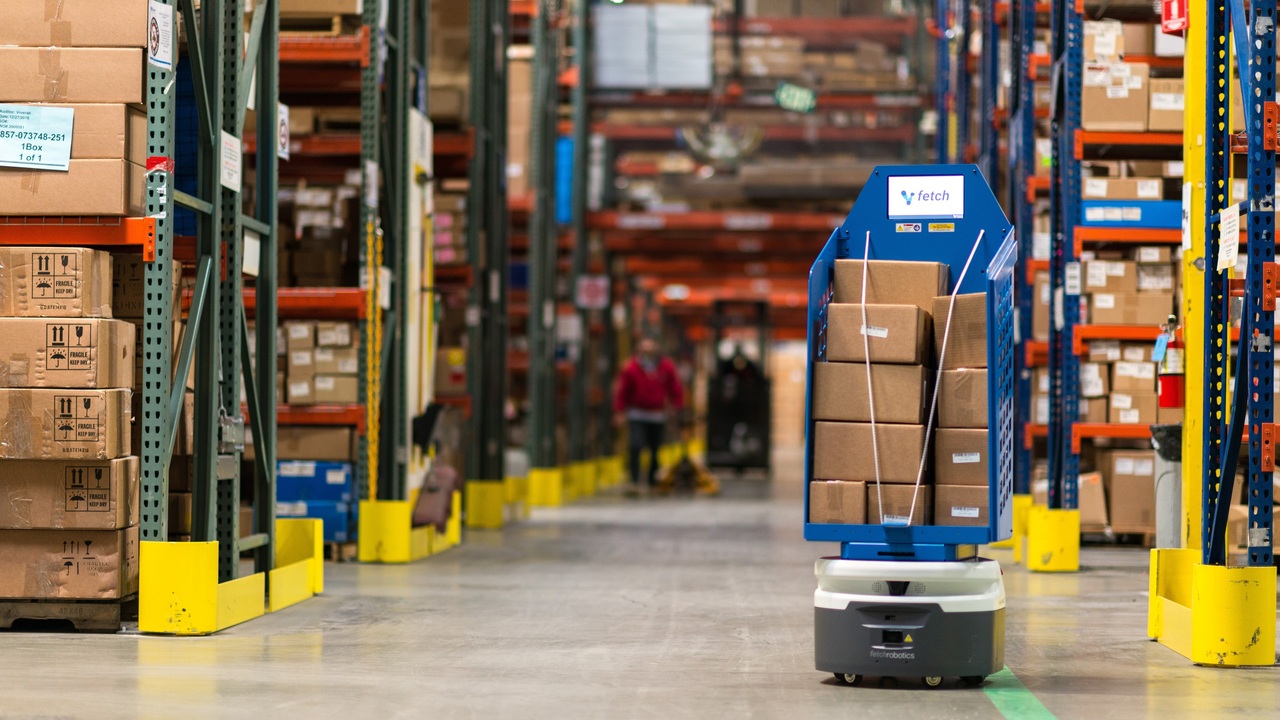
Consider the implications. A single physical AI-enabled robotic chassis might begin life as a goods-to-person sorter in a grocery DC, then, within hours, be reconfigured via software update to perform case-picking for pharmaceutical cold chain operations, and later redeployed as an autonomous trailer unloader during peak season — all using the same mechanical platform and sensor suite.
Redefining Warehouse Architecture: From Static Infrastructure to Living Systems
The most radical implication of physical AI isn’t incremental efficiency gains — it’s the obsolescence of the warehouse as a fixed architectural artifact. For over a century, warehouse design has followed immutable principles: wide aisles for forklift maneuverability, standardized racking heights dictated by reach-truck limitations, fixed staging zones, and linear material flow paths optimized for predictable, batched throughput.
Physical AI shatters these constraints by enabling *distributed intelligence* — where computational power, decision authority, and physical actuation reside within the infrastructure itself, not in centralized control rooms. Mytra’s ‘autonomous shelf’ concept is merely the vanguard of this transformation.
Strategic Adoption Pathways: Partnerships Over Pilots, Trust Over Tech Specs
In an era where physical AI capabilities are rapidly commoditizing — with open-source robotics frameworks, affordable edge AI chips, and standardized sensor suites lowering technical barriers — the decisive differentiator shifts from ‘what the technology can do’ to ‘how seamlessly it integrates into an organization’s operational DNA.’
This reality renders traditional proof-of-concept (POC) approaches obsolete. A 90-day pilot demonstrating 22% faster put-away times in a controlled lab environment provides negligible insight into whether the system can withstand the chaos of Black Friday returns, integrate with a legacy WMS lacking modern APIs, or gain buy-in from skeptical warehouse supervisors who fear job displacement.
“If you’ve got a trusted partner that is delivering and continues to expand, you’re gonna stay with the horse you’ve got.” — Mike Plasencia
The 2026 Inflection Point: From Niche Experimentation to Core Operational Logic
By 2026, physical AI will transition from an emerging trend to the foundational logic governing warehouse operations — not as a universal standard, but as the dominant paradigm for growth-oriented shippers facing intensifying pressure on margins, sustainability, and resilience.
This inflection point won’t arrive through sudden technological breakthroughs, but through the cumulative erosion of adoption barriers: hardware costs falling 40–50% as semiconductor advances and manufacturing scale accelerate; insurance products emerging to cover ‘algorithmic liability’ in autonomous material handling; and regulatory frameworks maturing to address safety certification for adaptive robotic systems.
This transition carries profound implications for the broader supply chain ecosystem. Logistics service providers (3PLs) face existential choice: invest heavily in physical AI-enabled infrastructure to offer differentiated, scalable capacity — or risk commoditization as mere labor arbitrageurs.
Most significantly, the workforce transformation accelerates beyond upskilling into wholesale role reinvention. Supervisors become ‘orchestration managers’ interpreting AI-generated workflow recommendations; technicians evolve into ‘robotic system integrators’ fluent in both mechanical diagnostics and model retraining protocols; and planners leverage real-time physical AI insights to design demand-responsive networks rather than static master plans.
As Plasencia concludes, the question is no longer whether physical AI will reshape warehousing — it’s whether organizations will lead that transformation or be reshaped by it. The winners won’t be those with the most robots, but those with the most adaptable minds, the most trusting partnerships, and the clearest vision of the warehouse not as a place where goods are stored, but as a living system where intelligence flows as freely as inventory.
This article is AI-assisted and has been reviewed and validated by the SCI.AI editorial team before publication.
Source: FreightWaves
This article was AI-assisted and reviewed by our editorial team.