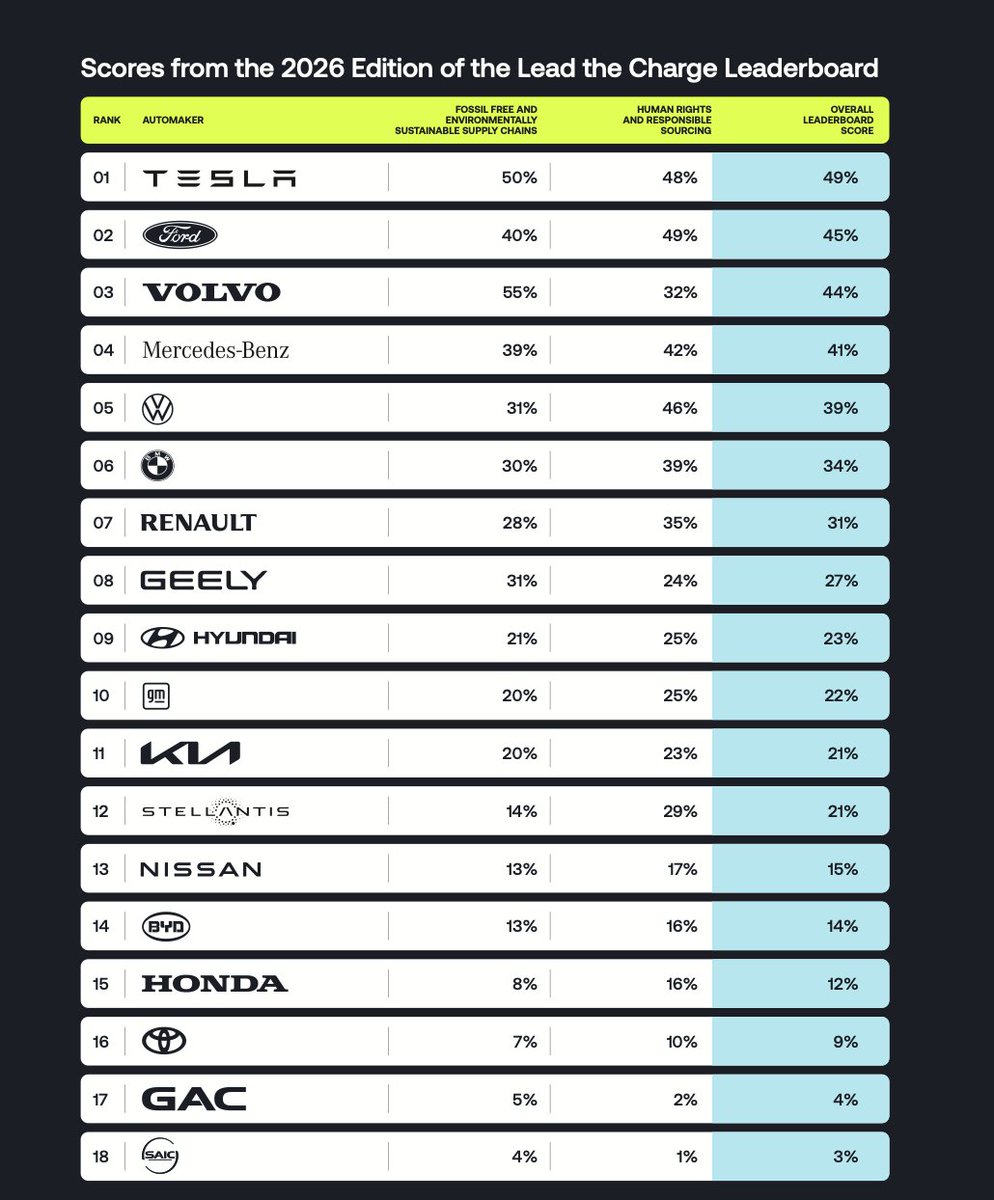
1. Benchmark Validation: Tesla Leads Global Automotive Supply Chain Sustainability with 49% Composite Score
“Tesla ranked #1 in the 2026 Lead the Charge automotive supply chain sustainability ranking for the second consecutive year, with its overall score increasing from 43% to 49%—a 6 percentage point improvement that significantly outpaces the industry average of 25%.”
The release of the 2026 Lead the Charge Automotive Supply Chain Sustainability Ranking (Fourth Edition) marks a pivotal moment in global automotive industry ESG governance. In a systematic assessment covering 18 leading global automakers, Tesla retained its top position with a composite score of 49%, representing a 6-percentage-point increase from the 2025 ranking’s 43%. This growth rate not only substantially exceeds the industry average (which only inched from 23% to 25%) but also demonstrates Tesla’s organizational resilience and execution capability in implementing sustainability commitments across complex supply chain systems. Notably, this ranking is compiled by independent third-party organization BASenor using a triple-calibration methodology of “transparent methodology + verifiable data sources + third-party audit cross-validation.” The assessment scope includes direct suppliers (Tier 1), critical secondary suppliers (Tier 2), and upstream raw material extraction processes; data collection spans the 2023–2024 fiscal year, mandating companies to provide ISO 14064-1 certified Scope 1 & 2 emissions data, RMI (Responsible Minerals Initiative) verified cobalt/lithium-nickel supply chain due diligence reports, and CDP-disclosed climate and water management performance. Among all participating companies, none have breached the 50% “excellence threshold,” with Tesla falling just 1 percentage point short—making it the only enterprise currently approaching systematic sustainability transition maturity. This ranking is not a coincidence of isolated metrics but rather a concentrated reflection of its vertical integration strategy, digital-native governance architecture, and closed-loop resource management logic within the supply chain dimension, providing the industry with a deconstructable, replicable practice model.
2. Structural Advantage in Horizontal Comparison: The “Consistency Supremacy” Logic Behind the 49% Score
Among the 18 assessed automakers, Volvo leads in decarbonization with a specialized score of 72%, while Ford leads in responsible sourcing with 68%, yet their composite scores are 38% and 35% respectively—significantly lower than Tesla’s. This industry norm of “specialized excellence, overall imbalance” precisely highlights the deeper value of Tesla’s 49% score: across all six assessment dimensions—climate action (47%), water management (46%), circular economy practices (48%), labor rights protection (45%), biodiversity impact (44%), and digital transparency (51%)—Tesla maintains a narrow high-range distribution of 44%–51%, with a standard deviation of only 2.3%, far below the industry average of 11.7%. This “no-weakness consistency” stems from its supply chain control logic that subverts the traditional OEM role: rather than relying on fragmented multi-tier outsourcing networks, Tesla embeds ESG controls deep into physical production nodes and digital decision flows through self-built battery factories (e.g., Nevada Gigafactory 1), controlled lithium refineries (e.g., joint venture with Australia’s Core Lithium), nickel mine equity stakes (New Caledonia Goro nickel-cobalt project), and AI-driven real-time supplier carbon footprint tracking platforms (Tesla Supplier Sustainability Dashboard). In contrast, German automakers, while aggressive in carbon neutrality target setting, have less than 35% supply chain carbon data coverage; Japanese and Korean manufacturers excel in labor standard compliance but generally lack blockchain verification for battery material traceability. Tesla’s “consistency” is essentially a victory of governance granularity—when sustainability ceases to be an addendum in procurement contracts and becomes a real-time feedback variable for every motor winding welding parameter and every ton of lithium mica purification energy consumption, systematic leadership becomes inevitable.
3. Technology-Driven Closed-Loop Practices: Full-Chain Carbon Reduction Engineering from Battery Recycling to Recycled Materials
The core fulcrum of Tesla’s supply chain sustainability lies in its globally unique, scaled battery closed-loop recycling system. As of late 2024, its Nevada and Berlin recycling centers process over 120,000 tons of end-of-life batteries annually, with nickel, cobalt, and lithium recovery rates reaching 92%, 95%, and 89% respectively—far exceeding the EU’s New Battery Regulation 2027 thresholds of 90%/95%/80%. More critically, these recycled metals are not simply remelted but are directly synthesized into NCM811 cathode precursors through proprietary hydrometallurgical processes (Patent US20230174522A1), enabling recycled nickel content in newly manufactured Model Y battery packs to reach 32% (up from 24% in 2023). This “waste → raw material → finished product → re-recycling” physical closed loop, combined with its self-developed Material Flow Intelligence system, enables dynamic carbon footprint modeling across the entire lifecycle from mine to disposal. For example, the lithium iron phosphate batteries used in its Shanghai Gigafactory, by connecting to real-time energy consumption data from Yunnan Honghe lithium mica mines, can precisely calculate the embodied carbon emissions per kWh of battery at 67 kg CO₂e—46% lower than the industry average of 124 kg CO₂e. Additionally, Tesla extends supply chain decarbonization to hidden energy consumption areas—in 2024, it mandated all Tier 1 suppliers to use 100% renewable electricity for production and provided zero-interest green loans to small and medium suppliers for photovoltaic roof retrofits. In logistics, its North American rail transport share increased to 68%, up 21 percentage points from 2022, reducing per-vehicle land transport carbon emissions by 33%. These non-financial investments constitute the most technologically robust support within its 49% score.
4. Governance Mechanism Innovation: “Coded Sustainability” Management System Beyond Compliance
Tesla’s supply chain sustainability does not rely on traditional CSR department annual audits but transforms it into programmable governance infrastructure. Its core is the “Sustainability Compliance Engine” (SCE) embedded in the ERP system: when suppliers submit orders, SCE automatically retrieves 127 dynamic data points including the enterprise’s CDP score, RMI risk rating, and local environmental penalty records to generate real-time ESG credit scores; if scores fall below thresholds, the system automatically freezes orders and pushes remediation task lists (including specific corrective actions, timelines, and verification methods). In 2024, this engine intercepted 472 high-risk orders and facilitated 138 suppliers in completing ISO 14001 upgrades. More profoundly, its “open-source transparency” strategy: Tesla continuously updates its “Supply Chain Environmental and Social Impact Report” on its official website, not only disclosing its own data but also providing access interfaces (anonymized) to its supplier database, allowing NGOs and research institutions to directly retrieve specific mineral smelter emission data. This paradigm shift from “black-box reporting” to “verifiable API” forces the entire ecosystem toward standardization. Compared to the industry’s customary “Supplier Code of Conduct” paper documents, Tesla’s coded governance endows ESG requirements with instant responsiveness (e.g., synchronizing system rules within 24 hours of new California regulations taking effect), traceability (each remediation instruction is blockchain-recorded), and scalability (newly incorporated cobalt supply chain due diligence modules can be fully deployed across the network within 72 hours). It is precisely this governance revolution embedding sustainability into digital DNA that enables Tesla to achieve a high score of 45% in soft indicators like labor rights—far exceeding the industry average of 28%, proving that technological rationality and humanistic care can be deeply coupled.
5. Unfinished Journey and Structural Challenges: The “Last Mile” Battle Beyond 49%
Despite the impressive 49% score, Tesla still faces three unavoidable “critical challenges.” First is the geographical concentration risk of upstream minerals: 78% of its lithium supply depends on Australia and Chile, both of which have recently increased resource taxes and tightened foreign ownership restrictions, with Chile’s 2024 lithium nationalization bill causing a 12% decline in supply stability from its partner SQM. Second, scaled application of recycled materials encounters technical bottlenecks: current recycled nickel’s cycle life degradation rate in high-compaction-density electrodes remains 18% higher than virgin materials, limiting its application in 800V fast-charging platforms. Third, supply chain digitization has “last-mile” disconnects: data access rates for Tier 2 and below suppliers (especially Southeast Asian battery component factories) are only 53%, resulting in a 22% estimation error in water footprint statistics. These challenges point to an inherent contradiction: Tesla’s vertical integration model achieves extreme optimization within controllable ranges but cannot unilaterally reshape the global resource political economy. For instance, its attempt to reduce intermediary dependence by investing in African Democratic Republic of Congo cobalt processing projects stalled for 14 months in environmental assessment due to local community land rights disputes. This reveals the inherent limitations of sustainability rankings—existing assessment frameworks have not yet adequately quantified geopolitical risk premiums and community empowerment costs. To break through the 50% threshold, Tesla must transition from “technological closed-loop” to “institutional co-creation,” such as spearheading transnational mineral ESG certification alliances or developing satellite-remote-sensing-based contactless mine environmental monitoring protocols, extending governance reach into gray areas beyond its physical control.
6. Industry Implications and Paradigm Shift: When Sustainability Becomes the Supply Chain’s “Operating System” Rather Than an “Add-on Module”
Tesla’s consecutive top rankings are fundamentally reshaping the global automotive industry’s cognitive logic regarding sustainability. Over the past decade, automakers generally viewed ESG as compliance costs or brand narrative tools, while Tesla demonstrates it can be a supply chain efficiency multiplier: its closed-loop recycling system reduces annual raw material procurement costs by approximately $1.9 billion, and its AI-driven supplier carbon data platform shortens procurement negotiation cycles by 40%, validating the new equation of “sustainability as competitiveness.” For the industry, the true revelation lies not in replicating its Gigafactory model but in understanding its “operating-system-level thinking”—designing sustainability as the supply chain’s default protocol, akin to TCP/IP for the internet. This means procurement systems must natively support carbon intensity sorting, logistics scheduling algorithms must embed emission weights, and even product design software should integrate recycled material performance databases. Chinese new energy vehicle manufacturers have begun responding: BYD launched its “Blade Battery Full Lifecycle Carbon Map,” and NIO piloted “Battery Swap Station Battery Traceability Blockchain,” yet they remain generations behind Tesla’s system integration. Future competition will no longer be about single-vehicle range or computing power but about the entire supply chain’s “sustainability bandwidth”—whoever achieves higher precision, lower latency, and broader coverage in integrating ESG data flows, material flows, and capital flows will define the next generation of industry standards. As the 49% score becomes the new industry benchmark, it is both affirmation of the past and an ultimate challenge to all players: sustainability—are you ready to install it as the system core, or will you continue treating it as an uninstallable plugin?
Source: basenor.com
This article was AI-assisted and reviewed by our editorial team.