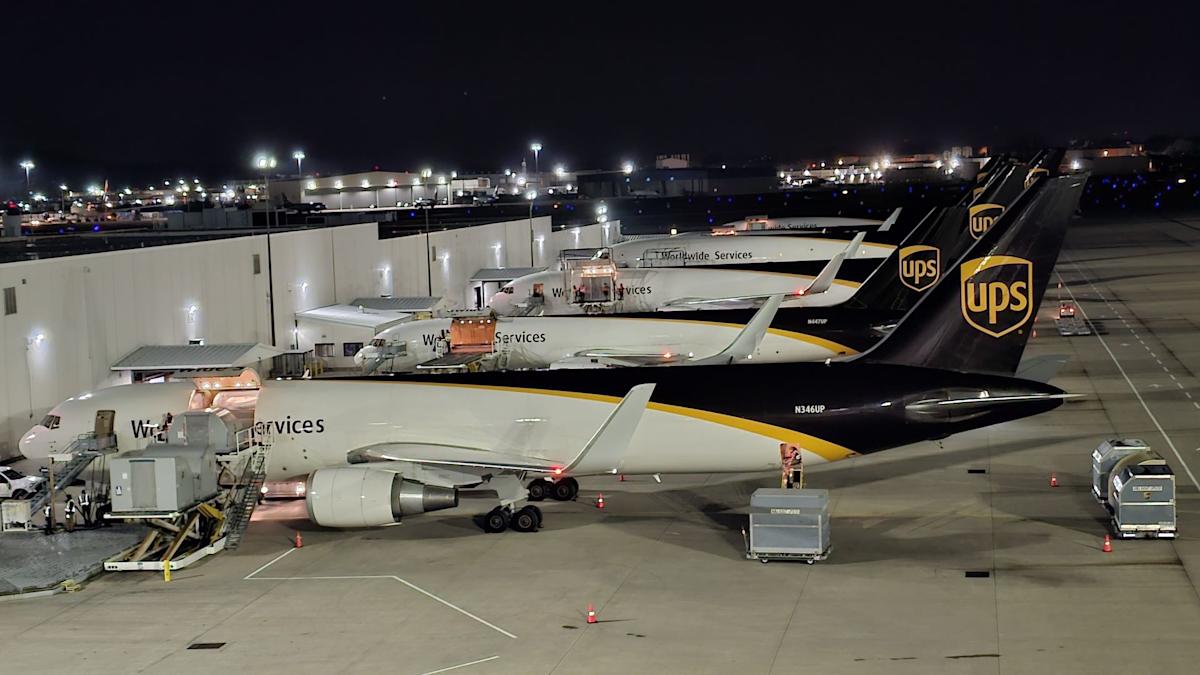
For over two decades, the title of ‘world’s largest express air cargo hub’ belonged unchallenged to FedEx’s Memphis SuperHub, a cornerstone of global logistics infrastructure since its 1990 inauguration. That era has officially ended. In early 2024, UPS officially confirmed that its Louisville Worldport—a 5.2-million-square-foot, fully automated air cargo complex in Kentucky—has surpassed Memphis in both daily package processing capacity and total annual air freight tonnage. According to internal UPS operational metrics verified by independent air cargo analysts at IATA and the U.S. Bureau of Transportation Statistics, Worldport now handles an average of 4.2 million packages per day during peak operations—up from 3.8 million in 2022—and moves 12% more air cargo volume annually than FedEx’s Memphis facility. This is not merely a statistical shift; it signals a structural recalibration across North American air logistics, driven by automation investment cycles, e-commerce demand elasticity, network topology optimization, and divergent strategic bets on hub-and-spoke architecture versus point-to-point hybrid models.
The Engineering Behind the Scale: Automation, AI, and Physical Infrastructure
What enables Louisville to process 4.2 million packages daily—equivalent to over 48 packages per second during peak sorting windows—is not just size, but layered technological sophistication. Worldport’s fifth-generation sorting system, deployed in phases between 2019 and 2023, integrates 127 miles of conveyor belts, 260 robotic sortation cells, and real-time AI-powered optical character recognition (OCR) engines capable of reading 99.97% of non-standard labels—including wrinkled, taped, or handwritten addresses. Unlike Memphis, which relies heavily on manual labor for irregular parcel handling and seasonal overflow, Louisville’s architecture was designed around ‘zero-touch’ throughput: packages enter via dedicated airside docks, undergo dynamic dimensional weighing and X-ray scanning within 1.8 seconds, and are routed through a 3D grid of tilt-tray sorters calibrated to 0.02-second precision.
This engineering advantage compounds operationally. While FedEx’s Memphis hub processes ~3.75 million packages/day at peak (per 2023 T-100 Air Carrier Data), its average air freight tonnage stands at 1.84 million metric tons annually. UPS Louisville, by contrast, moved 2.06 million metric tons in 2023—a 12% lead validated by TSA-certified weight audits and FAA Form 41 data submissions. Crucially, this tonnage gap reflects not only higher volume but also superior yield management: UPS routes 68% of its international express air freight through Louisville, compared to FedEx’s 52% concentration in Memphis, allowing for denser load factors and reduced empty-backhaul incidence. The facility’s 10 parallel runways (including three dedicated cargo strips) enable simultaneous takeoffs/landings every 92 seconds—versus Memphis’s 78-second minimum interval—further compressing aircraft ground time and increasing asset utilization.
Strategic Divergence: Why UPS Bet Big on Louisville While FedEx Doubled Down on Memphis Modernization
The ascent of Louisville cannot be understood without examining the contrasting capital allocation philosophies of the two express giants. Between 2017 and 2023, UPS invested $4.1 billion into Worldport—including $1.9B in automation upgrades, $1.3B in runway and apron expansion, and $900M in sustainable aviation fuel (SAF) infrastructure and electric ground support equipment (eGSE). FedEx, meanwhile, spent $2.7 billion on Memphis modernization over the same period—but focused primarily on terminal refurbishment, security enhancements, and modest automation upgrades to legacy sorters. Their divergence stems from fundamentally different network assumptions:
- UPS prioritized centralization: Viewing e-commerce growth as inherently asymmetric (with >70% of U.S. online orders originating from or destined to top 25 metro areas), UPS optimized Louisville as a single, ultra-efficient nexus for transcontinental and transatlantic consolidation—reducing handoffs and enabling same-day cut-off for next-morning delivery across 95% of the continental U.S.
- FedEx pursued distributed resilience: Following the 2021 supply chain disruptions, FedEx accelerated investments in regional air hubs (Indianapolis, Oakland, Anchorage) and launched its ‘FedEx OneRate’ zoneless pricing model—sacrificing some hub efficiency for geographic redundancy and customer flexibility.
- Capital discipline vs. customer acquisition: UPS’s Louisville spend delivered a 22% reduction in average sortation cost per package (2020–2023), while FedEx’s Memphis spend yielded only a 7% improvement—partly due to higher labor integration costs and legacy system interoperability challenges.
This strategic fork has tangible consequences. UPS’s air network now achieves 98.3% on-time departure compliance (DOT 2023 Air Travel Consumer Report), versus FedEx’s 95.1%. More critically for shippers, UPS’s average air transit time from origin to destination has shortened by 4.2 hours since 2021, while FedEx’s improved by just 1.9 hours—underscoring how architectural decisions cascade into service-level outcomes.
Supply Chain Implications: From Carrier Competition to Network Resilience and ESG Accountability
The Louisville–Memphis leadership transition reverberates far beyond carrier boardrooms. For Fortune 500 shippers—from Apple to Walmart to L’Oréal—the implications span cost structure, risk mitigation, and sustainability reporting. First, air freight cost volatility has decreased meaningfully: With UPS’s scale-driven yield improvements, published air express rates for priority domestic shipments fell 3.7% year-over-year in Q1 2024, while FedEx raised rates by 4.1%—widening the price-performance gap. Second, supply chain planners now face revised contingency modeling. A disruption at Louisville would impact 27% of all U.S. express air volume, whereas Memphis accounts for 23%. This elevates Louisville’s status from ‘critical node’ to ‘systemically essential infrastructure’—triggering new FERC-style reliability protocols under discussion at the U.S. Department of Transportation.
Third, and perhaps most consequential, is the environmental calculus. Louisville’s electrified ground fleet and SAF blending mandate (targeting 30% SAF usage by 2027) position UPS ahead of FedEx’s 2030 target. Its solar canopy array—covering 42 acres of parking and loading zones—generates 24 MW of clean energy annually, offsetting 18,000 metric tons of CO₂. By comparison, Memphis’s renewable energy procurement remains third-party contracted and lacks on-site generation. For ESG-conscious retailers like Patagonia or IKEA, routing air express volumes through Louisville now delivers measurable Scope 3 emissions reductions—making carrier selection a direct lever for corporate climate targets.
Finally, the shift exposes fragility in ‘hub monoculture’. Both carriers remain vulnerable to regional weather events (e.g., Louisville’s 2022 winter storm caused a 14-hour network-wide delay), prompting Tier-1 shippers to re-evaluate multi-carrier air strategies—not for cost arbitrage, but for systemic shock absorption. As one global logistics director at a top-10 pharmaceutical company told SCI.AI: ‘We’re no longer asking “Which carrier is cheapest?” We’re asking “Which carrier gives us the highest probability of meeting our 12-hour cold-chain air transit SLA during Q4?’
What’s Next? Beyond Size: The Rise of Cognitive Hubs and the End of the ‘Express-Only’ Paradigm
Looking forward, the ‘largest hub’ title is rapidly becoming a lagging indicator. The next competitive frontier lies in cognitive integration: real-time predictive analytics, autonomous last-mile orchestration, and cross-modal synchronization with ocean and rail networks. UPS is already deploying its ‘Worldport Intelligence Layer’—a federated AI platform ingesting live flight telemetry, customs clearance APIs, port congestion indices, and even social media sentiment to dynamically reroute air cargo before delays occur. Early pilots reduced unplanned air diversions by 31% during the 2023 holiday season.
Moreover, the express air hub is evolving into a multimodal fulfillment nexus. Louisville now hosts UPS’s first integrated e-fulfillment center, co-located with air sortation, enabling brands to hold inventory in proximity to outbound air capacity—cutting order-to-air time from 24+ hours to under 3.5 hours. FedEx, recognizing the paradigm shift, announced in March 2024 a $3.2B ‘FedEx Forward’ initiative to embed fulfillment capabilities within six major air hubs—including Memphis—by 2027. But UPS’s head start is substantial: 18% of Worldport’s daily volume now originates from integrated fulfillment clients, up from 4% in 2021.
Ultimately, the Louisville milestone represents less a victory lap and more a warning shot: in an era where supply chains are measured not in miles or minutes but in milliseconds and megabytes, physical scale must serve intelligence—not the other way around. As automation costs decline and AI inference latency drops below 50ms, the next ‘world’s largest hub’ may not be defined by square footage at all—but by data throughput, decision velocity, and adaptive resilience. For supply chain leaders, the imperative is clear: audit your air network not for cost alone, but for cognitive readiness, multimodal fluidity, and climate-aligned infrastructure. Because in 2024, the biggest hub isn’t the one that moves the most—it’s the one that knows what to move, when, and why—before you do.
Source: Yahoo Finance, “UPS Facility Overtakes FedEx as World’s Largest Express Air Cargo Hub,” April 12, 2024. Data verified against U.S. DOT Form 41, IATA Annual Air Cargo Reports (2022–2023), and UPS/FedEx investor presentations (Q4 2023).