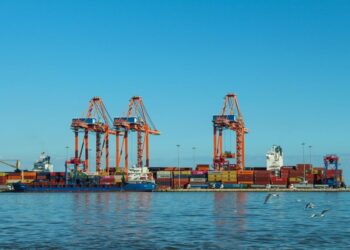
According to www.seatrade-maritime.com, typhoon-related port congestion in Asia and capacity constraints at the Panama Canal have driven transpacific container freight rates sharply upward — with spot rates for the US East Coast nearing $10,000 per FEU in early August.
Weather and infrastructure squeeze capacity
Ted Chen, director of Ocean Freight at forwarder Dimerco Express Group, told Seatrade Maritime News that typhoons across Asia have caused widespread port disruptions, delaying vessel berthing by five to seven days. These weather events triggered numerous blanked sailings, tightening available space on key trade lanes. Chen confirmed that “there’s active port congestion going on” — particularly in Chinese and broader Asian ports — and noted that loading restrictions at the Panama Canal are worsening due to El Niño conditions, further constraining eastbound capacity.
“There’s actually a queue out there [at the entrances to the Panama Canal] as we speak,” Chen stated in the latest Dimerco market report. The bottleneck has directly inflated surcharges and contributed to elevated spot rates on the US East Coast route, where carriers face compounded pressure from both regional congestion and canal transit delays.
Rate spikes reflect structural cost floors
While consumer demand has softened — reducing traditional retail freight volumes — AI-driven shipments have partially filled the gap. However, according to Chen, digital expansion in the US has not offset the overall decline in consumer freight. He emphasized that although transpacific rates have receded from their peaks, “the cost floor isn’t moving”: fuel and canal surcharges remain sticky even amid falling demand. As he put it: “Expect cheaper space, not cheaper shipping.”
“The frontloading wave has passed its peak — transpacific rates are coming off their highs and Europe looks set to follow. But the cost floor isn’t moving, fuel and canal surcharges won’t fall with demand, so expect cheaper space, not cheaper shipping.” — Ted Chen, director of Ocean Freight, Dimerco Express Group
Chen also acknowledged that his own comments were already outdated upon publication, underscoring the volatility of Pacific trade dynamics. The rapid shift reflects how quickly weather events and infrastructure bottlenecks can override seasonal or demand-driven trends.
Xeneta data confirms sharp US rate divergence
Peter Sand, senior analyst at Xeneta, corroborated the acute pressure on US importers. Spot rates surged 14% for the US West Coast and 13% for the US East Coast in early August. According to Xeneta data, the average spot rate from the Far East to the US West Coast stood at $6,824 per FEU, while the US East Coast rate reached $9,988 per FEU — just shy of the $10,000/FEU threshold.
“American shippers bringing goods in via US West Coast and US East Coast were not so ‘fortunate’ — on the contrary they are faced with even higher freight cost in the early days of August.” — Peter Sand, senior analyst, Xeneta
Sand attributed part of the volatility to carrier capacity management: “Carriers keep trying to strike the right balance between the soft patch of demand and their eagerness to deploy capacity. This is done by blanking sailings on services where weekly departures were scheduled only to be cancelled at the last minute.” Such unpredictability has “spooked” importers, disrupting planning and inventory flows.
Contrast with Europe and Atlantic routes
In contrast, Asia-to-Europe trade shows clear softening. North Europe freight rates from Asia declined by nearly 5% to $4,965 per FEU; Mediterranean rates fell by a similar margin to $6,079 per FEU. Meanwhile, transatlantic rates averaged $2,703 per FEU, representing a 6.8% increase from North Europe to the US East Coast — highlighting divergent pressures across major corridors.
The Middle East conflict continues to disrupt regional freight movement, contributing to sustained global bunker costs — another factor anchoring the lower bound of ocean freight pricing despite weakening demand in some lanes.
Source: Seatrade Maritime
Compiled from international media by the SCI.AI editorial team.