According to theloadstar.com, global air cargo spot rates stood at $3.13 per kg for the week ending 5 July 2026 — down 1% week on week but still markedly elevated versus pre-crisis levels.
Air freight market stabilizes amid shifting demand drivers
While capacity has largely returned to Gulf routes and jet fuel prices have eased, air freight rates remain stubbornly high. WorldACD data shows worldwide average air cargo rates fell to $3.13 per kg, following a 2% decline the prior week. Average spot rates slipped further to $3.62 per kg. Xeneta’s June market update confirms this trajectory: global spot rates averaged $3.40 per kg, remaining 38% higher year-on-year — though growth slowed from 41% in May.
The resilience stems not from lingering Middle East disruption, but from structural demand shifts. Total worldwide air cargo capacity is now slightly above pre-conflict levels, and the capacity deficit to and from the Middle East and South Asia has narrowed to 10%, down from 30% in early June. Yet demand continues surging: WorldACD recorded worldwide chargeable weight 4% above last year’s level, while Xeneta reported global demand growth of 7% year on year in June — outpacing capacity growth of 3%. This imbalance lifted Xeneta’s dynamic load factor to 62%.
E-commerce retreats; AI infrastructure drives new volume
Cross-border e-commerce — long air freight’s dominant growth engine — is now in clear decline. Xeneta notes that “part of the apparent decline may reflect a shift rather than a disappearance of volumes as individual B2C parcels are being moved into bulk, consolidated air freight shipments that fall outside the ecommerce parcel data. But the underlying trend is clear. After years as air freight’s single biggest growth pillar, the B2C e-commerce engine has stalled.”
This pivot is quantifiably visible in regional flows. Following the EU’s 1 July abolition of its €150 de minimis exemption, Hong Kong–Europe tonnages fell 12% week on week. Over three weeks, traffic dropped nearly 20%, returning to levels last seen at the end of March. In stark contrast, Taiwan–Europe volumes surged 20% over the same period — driven by time-sensitive shipments of AI-related computer equipment.
“The scale of AI’s impact is easy to underestimate because it sits inside a small slice of total air cargo volume. But the facts that confirm its role as the main driver of air cargo growth are undeniable.” — Niall van de Wouw, chief airfreight officer at Xeneta
Taiwan’s semiconductor boom anchors air cargo strength
The AI-driven demand surge is anchored in semiconductor manufacturing. Global semiconductor sales more than doubled year on year in April, and Taiwan posted its fastest economic growth in nearly five decades — fueled by demand for advanced chips and AI infrastructure. This trend was reinforced by Taiwan Semiconductor Manufacturing (TSMC), which reported record June revenue of NT$442.7bn ($15bn), up 67.9% year on year and 6.2% month on month — exceeding market expectations.
That investment momentum directly translates into air freight volume. TSMC’s output underpins much of the time-critical hardware shipped via air — including GPUs, accelerators, and server components destined for data centers across North America and Europe.
New freighter networks align with AI supply chain geography
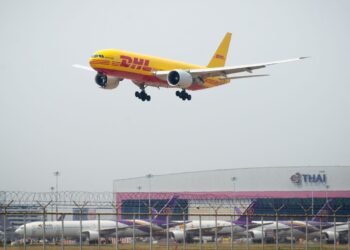
DHL Global Forwarding has launched a new thrice-weekly Bangkok–Cincinnati freighter service under its TransPac Connect offering, providing up to 100 tonnes of capacity per flight. The route also integrates cargo from Hanoi and Taipei into Cincinnati and Chicago — reflecting Southeast Asia’s expanding role as a manufacturing base for AI hardware.
Meanwhile, UAE-based cargo airline SolitAir expanded its China network with a new Tianjin service, following earlier launches to Hong Kong and Urumqi — strengthening direct links between Chinese electronics manufacturing clusters and Middle Eastern logistics hubs.
These strategic moves underscore how air cargo networks are adapting in real time: not to geopolitical volatility alone, but to the concentrated, high-value, time-sensitive nature of AI infrastructure shipments — a demand profile fundamentally different from fragmented e-commerce parcels.
Source: The Loadstar
Compiled from international media by the SCI.AI editorial team.