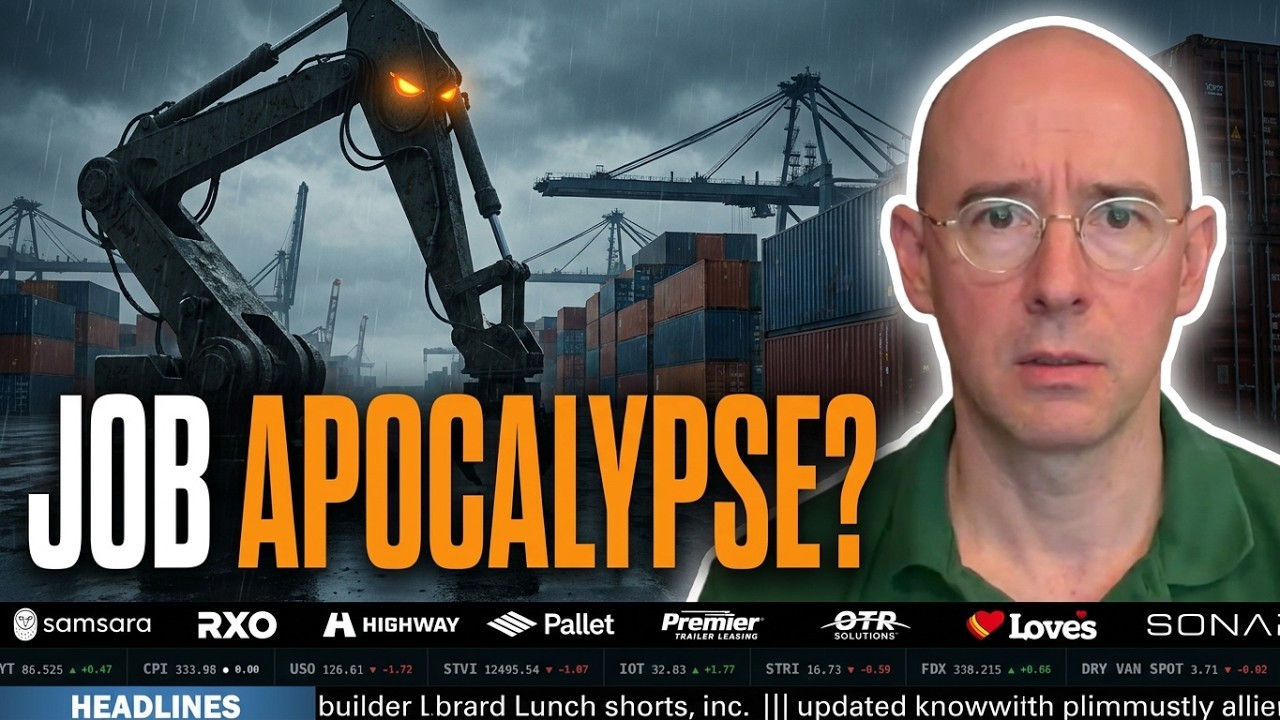
AI & Logistics: Will a ‘Job Apocalypse’ Hit the Supply Chain? — FreightWaves SONAR Demo | SONAR Login | Customer Support | SONAR Demo | Subscribe | Newsletters Contact Us Brands Search AI Search Close Search for: Search Read Brands FreightWaves American ShipShipCheckpoint SONAR Trending Topics Startups Reindustrialization Global Supply Chain Trade and Compliance Borderlands: Mexico Fuel News Legal Issues Trucking Compliance Company Earnings Modes Truckload Less than Truckload (LTL) Parcel Freight Railroad Maritime Air Cargo Insights SONAR Chart of the Week SONAR Sitreps State of Freight Insights #WithSONAR SONAR Freight Market Updates Sponsored Insights Warehouse In The Sky Insurance & Risk Management Watch FreightWaves Today What the Truck?!? Brake Check The Long Haul TruckTech Loaded & Rolling Listen Newsletters SONAR Learn More Request a Demo SONAR Knowledge Center SONAR API Awards Fraud Fighters Awards AI Excellence in Supply Chain Awards FreightTech Awards ShipChoice Awards Events Supply Chain AI Symposium Future of Rail Summit Enterprise Fleet Summit F3: Future of Freight Festival F3 Awards Dinner Resources Advertise Freight Industry White Papers FreightWaves Webinars About Us Our Mission Market Experts Editorial Team RSS Facebook Twitter LinkedIn YouTube Instagram ● Watch Now –> Click here to open Menu Click to close the product launchpad Home / Media / FreightWaves TV / FreightWaves Today / AI & Logistics: Will a ‘Job Apocalypse’ Hit the Supply Chain? FreightWaves Today FreightWaves TV AI & Logistics: Will a ‘Job Apocalypse’ Hit the Supply Chain? FreightWaves Staff · Tuesday, June 30, 2026 Summary View Transcript Trimble’s Chief Platform Officer, Jonah McIntire, unpacks the real impact of AI on logistics, addressing the buzz around a potential “job apocalypse” in the supply chain. He explains how AI is changing software development and M&A integration, and why it’s not just about flashy new tech, but about unlocking deein legacy systems and data. Discover how this shift will redefine roles and empower new business models.
AI-driven elimination of screen-mediated back-office roles
Jonah McIntyre, chief platform officer at Trimble, is doubling down on his prediction that artificial intelligence will trigger a “job apocalypse” in logistics back offices. McIntyre, who oversees all product and engineering for Trimble’s transportation segment — roughly half the division’s headcount — first made the comment around October or November 2025 before it resurfaced as AI deployment in freight accelerated. “I don’t really see a lot of reasons why those can’t be displaced or eliminated by AI,” he said of roles where all data input and output flows through a screen.
The forecast carries weight given Trimble‘s footprint: the company’s products touch an estimated 65% of all over-the-road capacity in the U.S., spanning transportation management systems, mapping, and telematics hardware now integrated through the Platform Science merger. McIntyre argues that ownership of embedded data, deployed networks, and distributed hardware gives legacy platforms a structural advantage over AI-native startups that can be built quickly but disrupted just as fast.
“You do the math and it’s not like there’s some law of physics that says that the amount of money distributed to the staff has to remain constant or something. It will just be cheahave a back office because you’ll need less people.” — Jonah McIntyre, chief platform officer at Trimble
Redefining product development and integration strategy
On the product side, Trimble recently released a new TMS called Trimble TMS aimed squarely at small and mid-sized U.S. carriers, many of whom are buying a TMS for the first time. The offering is built on a build-to-order model made economically viable by AI-driven development costs. McIntyre said the unit economics have flipped: it is now cheamore effective to build custom workflows for individual customers than to persuade them to conform to pre-written code.
He cited a hypothetical chocolate carrier that needs automatic refrigeration checks at every stop — under the new model, Trimble would simply build that feature at a price point below what a conventional TMS cost just a few years ago. The downmarket push also reflects how AI is reshaping Trimble‘s integration strategy across its many acquisitions. Rather than enforcing a uniform look and feel across platforms — some dating to the 1960s, including Innovative, which McIntyre called arguably the first commercially available TMS in the world — the company is pursuing what he described as “maximum interoperability with minimum interdependence.”
Common elements such as master data and external connections will be standardized; everything else, including user interface, can vary by product. AI is also allowing Trimble to layer modern experiences on top of mainframe-based legacy systems without requiring customers to migrate their data.
Data assets and network effects as enduring moats
McIntyre acknowledged that Wall Street’s concern about AI eroding the value of traditional software businesses has some merit, particularly for vendors whose only competitive moat was the time it took to build their code. But he argued that data assets, installed-base stickiness, and brand durability have held or increased in value in the AI era, even as pure-software differentiation has weakened.
He described AI-native startups enjoying rapid hypergrowth as a potential “sugar high,” vulnerable to the same low barriers that enabled their rise. McIntyre noted that 65% of U.S. OTR capacity runs on Trimble products — from Trimble Maps to TMSs to formerly standalone telematics devices now part of the Platform Science merger — and emphasized that AI cannot generate accurate real-world data, nor deploy software into cabs or back offices without existing infrastructure.
“If you’re buying a clever piece of software or clever piece of even hardware, like clever piece of kit, that’s just worth less now than it was in the past. But if you’re buying a network, if you’re buying a trove of data, if you’re buying kind of like a distributed system that’s out there in the world and you can now inject like new intelligence into it, those are the things that have risen in value rather than declined in value,” McIntyre said during a FreightWaves Today interview.
He added that while legacy systems like Innovative — launched pre-deregulation in the U.S. — appear outdated, their survival over decades proves resilience. With AI, Trimble can now deliver modern user interfaces atop those mainframe-based systems without data migration, preserving customer data integrity while delivering 2026-grade experiences.
Source: FreightWaves
Compiled from international media by the SCI.AI editorial team.