A Driver’s Paper Logs Said He Was in One Place. A Roadside Camera Network Said Otherwise. Welcome to the New Era of Trucking Enforcement.
Why This Is Different From Anything Drivers Are Used To
For most of trucking history, the record of where a truck had been came from the truck itself. The driver’s logs, the carrier’s own systems, the paperwork generated and held by the operator. If a logbook said a truck was in one place, contradicting that claim required someone to have independently observed the truck somewhere else, and outside of a physical inspection or a witness, that rarely happened. The falsified or fudged log worked for exactly one reason: there was usually no independent record to check it against.
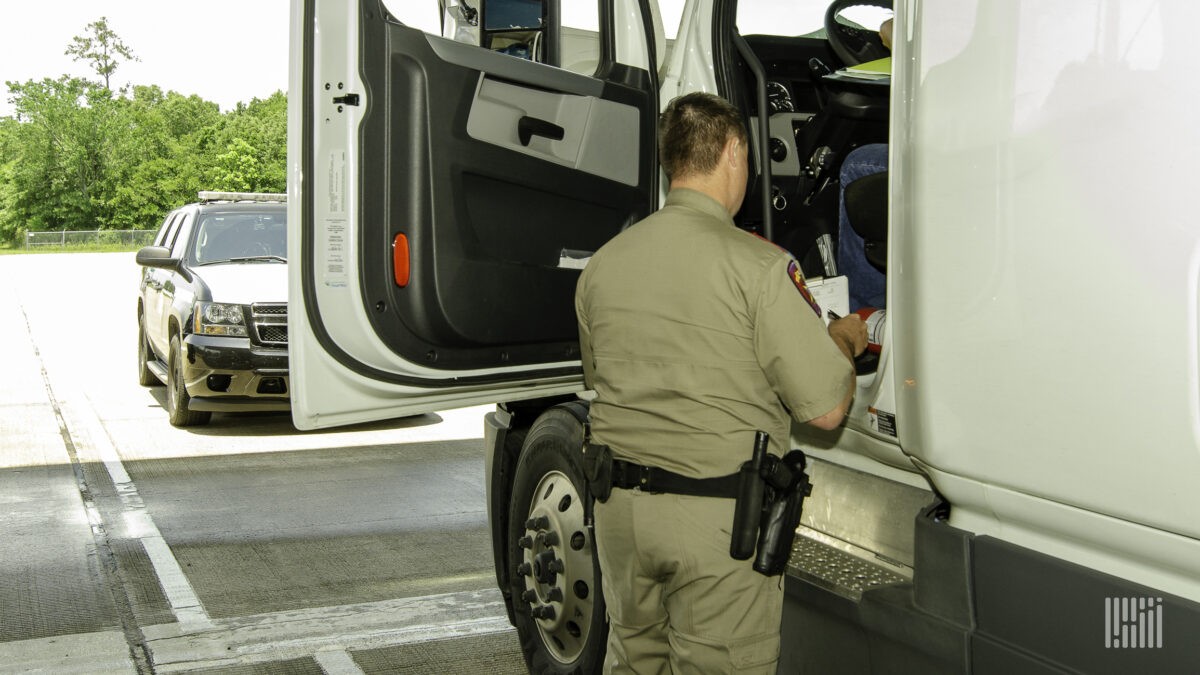
That assumption is what the Arizona scale-house incident demolishes. The officer did not have to take the driver’s logs at face value, and did not have to catch him in the act somewhere down the road. He had an independent, after-the-fact record of the truck’s actual movements, assembled from cameras and plate readers the driver had passed without a second thought, and he could lay that record next to the logbook and see the gap instantly.
That is a fundamentally new enforcement posture. It is not about catching a driver at a single moment. It is about reconstructing an entire trip from infrastructure the carrier does not control, cannot opt out of, and cannot edit after the fact. The driver in this case said it himself: the officer pulled him all the way back to Louisiana just by running plates and stitching together camera sightings across state lines. That capability did not exist in any practical, routine way for most of the careers of the veterans this driver spoke to. Now it does.
The Technology Behind the Curtain
License plate recognition has existed for years, but what makes this moment different is the scale and sophistication of the camera and sensor networks now blanketing the nation’s freight corridors, and the speed with which scattered sightings can be assembled into a coherent travel history.
The most prominent company building this kind of capability is GenLogs, a freight intelligence firm founded in 2023 by a team with roots in the U.S. intelligence community, including a former CIA case officer. GenLogs operates a nationwide network of roadside sensors and cameras paired with artificial intelligence, and the system captures images of commercial trucks in motion and extracts identifying details from them, including USDOT and motor carrier numbers, VINs, license plates, cab numbers, and truck logos. The company has reported capturing just under 20 million truck images a day across a network exceeding 1,000 camera locations, building a dataset the company says has surpassed 600 million truck images.
It is worth being precise here, because accuracy matters. The driver in the Arizona incident did not name the system that caught him, and described it in general terms as scales, plate readers, and cameras at various points along the highway. GenLogs is the leading commercial example of where this capability has gone, but the broader point holds regardless of which specific network produced any single sighting: the highways are now lined with infrastructure that reads commercial plates and logs truck movements, and that data can be assembled into exactly the kind of multi-state timeline the officer recited.
These systems are built with privacy controls. GenLogs, for instance, trains its AI to remove passenger vehicles from footage entirely, blur driver faces and vehicle windows, and focus strictly on commercial assets. The purpose is not to monitor the general public. It is to build what the company describes as an independent ground-truth record of where commercial trucks actually are and where they have been, which is precisely the kind of record that turns a paper log from an unverifiable claim into a checkable one.
Who Is Using This, and Why It Reaches Beyond the Scale House
Here is a point the Arizona story should not obscure. While the incident played out as a roadside enforcement encounter, the larger world of truck-tracking data is not primarily an enforcement tool. GenLogs and platforms like it are sold mainly as freight intelligence, and their core customers are freight brokers, shippers, insurance companies, logistics firms, and government agencies.
Freight brokers use the data to verify that a carrier actually operates the lanes it claims to, a direct response to the explosion in freight fraud and double brokering. Insurance companies use it to verify operations and sharpen underwriting, which is why some insurers are now repricing risk around what these networks reveal. Honest carriers benefit, too. There are tens of thousands of trucking companies that have never had a roadside inspection and are nearly invisible in traditional systems, and visual sighting data lets those carriers prove their legitimacy to brokers and insurers who would otherwise have no way to confirm they are real.
The law enforcement dimension, the one the Arizona driver ran into, is real and growing alongside all of that. The same data that lets a broker confirm a carrier’s lanes can let an investigator reconstruct a truck’s path, and the same timeline that exposes a fabricated logbook can support a serious criminal case. The practical lesson is that a truck’s physical movements are now being recorded continuously and held by multiple parties who decide whether a carrier gets paid, gets insured, gets hired, and gets scrutinized. A discrepancy between a paper log and the real record can surface through any of those channels, not only at a scale house.
The Enforcement Climate This Lands In
The timing matters. This kind of independent tracking is maturing at the exact moment federal trucking enforcement has entered one of its most aggressive phases in years. The FMCSA has been executing large-scale enforcement actions, from non-domiciled CDL crackdowns to tightened identity verification to the removal of thousands of bad actors from the system. The Supreme Court’s decision opening freight brokers to negligent selection liability has pushed brokers to scrutinize carriers more closely than ever. Insurers facing rising claims are demanding more verification and more documentation.
Every one of those forces increases the value of an independent, incorruptible record of what a carrier actually does on the road, and every one of them increases the consequences of being the carrier whose stated operations and physical footprint do not line up.
What This Means for Owner-Operators and Small Fleets
The honest takeaway from the Arizona driver’s experience is not panic. It is preparation, and a recognition that the ground has genuinely shifted under a practice many in the industry quietly assumed was low risk.
Run a compliant electronic logging setup and know your hours-of-service obligations cold. Federal rules require most commercial drivers to use ELDs that automatically record driving time, with only narrow exceptions for certain short-haul operations and limited paper-log use. If you legitimately qualify for an exception, document the basis carefully, because the old assumption that a paper log cannot be independently checked is no longer safe. Keep your records clean and consistent enough that they would match any independent sighting of your equipment, because increasingly they will be matched against exactly that.
Understand, too, that this technology is becoming part of how you get hired and insured, not just how you get inspected. Brokers and insurers are using freight intelligence data to evaluate carriers before they ever award a load or write a policy. A carrier whose physical movements consistently match its stated operations is building a verifiable, valuable track record. A carrier whose claims and real-world footprint diverge is building a problem that will eventually surface somewhere, whether at a scale, in an underwriting review, in a broker’s vetting, or, as one driver learned on his way through Arizona, in a computer an officer pulls up after running a plate.
“guys who had been doing this 15 and 20 years, and none of them had ever had this happen.”
That driver said he shared his story because guys with 20 years on the road had never seen this and needed to know it was happening. He is right. The independent record of where a truck has been now exists, it is growing by millions of images a day, and it is in the hands of the people who decide whether a carrier operates, gets paid, and stays insured. The era when a logbook was the only word on where a truck had traveled is ending, and it is not coming back.
Source: FreightWaves
Compiled from international media by the SCI.AI editorial team.