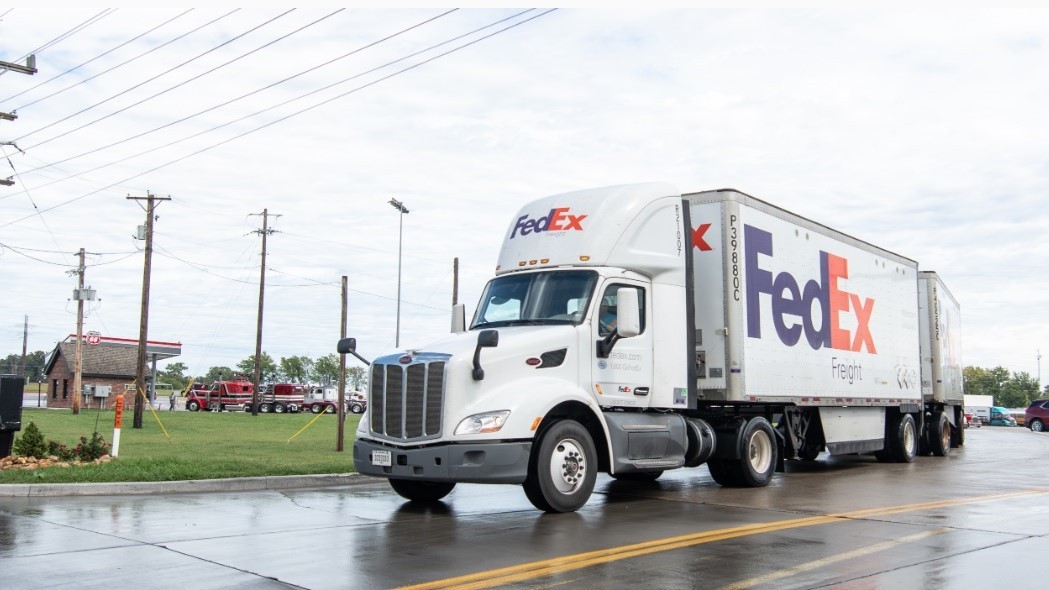
The nation’s largest less-than-truckload carrier, FedEx Freight, began trading Monday on the New York Stock Exchange under the ticker symbol FDXF. The spinoff from parent FedEx Corp. allows the carrier to approach the market with a narrowed commercial focus. The transaction is also expected to unlock shareholder value at both companies.
Spinoff structure and market positioning
The transaction included a pro rata distribution of 80.1% of FedEx Freight’s (NYSE: FDXF) outstanding common stock to FedEx (NYSE: FDX) shareholders. Investors of record as of May 15 received one share of the new standalone company for every two shares of FedEx held. FedEx will keep a 19.9% stake in FedEx Freight, but plans to dispose of the holdings within two years through debt repayment or dividend distributions to shareholders.
FedEx Freight has replaced American Airlines (NASDAQ: AAL) in the Dow Jones Transportation Average (DJTA). The stock has also been included in the S&P 500. FedEx remains in the DJTA and the S&P 500.
Shares of FDXF were off 2.9% to $155.75 in early trading on Monday. Shares of FDX were up 0.8%.
“We move forward as an independent company with a sharpened focus and disciplined strategy to build on our competitive advantages and accelerate profitable growth,” said John Smith, FedEx Freight president and CEO, in a news release. “As the largest pure-play LTL carrier in North America, we will leverage our comprehensive network with more than 26,000 service center doors to deliver cost and service advantages to our customers and capitalize on growth opportunities in high-potential verticals.”
Financial targets outlined at April investor day
“Medium-term” financial expectations were provided at an April investor day in New York City.
- The company forecast compound annual growth rates of 4% to 6% for revenue and 10% to 12% for adjusted operating income.
- The outlook implies high-20% incremental margins at the midpoints of the ranges, assuming 2026 fiscal year baselines of $8.7 billion in revenue and $1.1 billion in adjusted operating income. (The adjusted operating income forecast excludes $500 million in estimated spinoff costs.)
- Revenue increases will be driven by higher yields and volumes, with an emphasis on yields. Combined with cost reductions, the improved revenue profile is expected to generate 300 basis points of adjusted operating margin improvement, pushing the company’s operating margin from roughly 12% currently to 15% over the near term. (The company flagged a 50-bp margin headwind from spinoff costs and fees associated with unwinding existing service agreements.)
FedEx Freight now has over 500 dedicated LTL sales reps and is currently targeting small- and midsize shipper accounts, which typically generate higher margins. It is also targeting the healthcare, grocery and energy (data centers) verticals.
The company previously said it has unwound 99% of its bundled-pricing agreements (agreements for customers using both parcel and freight services) to reflect an LTL-specific framework.
On the cost side, it is continuing to optimize its linehaul network and dock operations, and lower its fleet age. Further, tech upgrades are expected to reduce manual touchpoints by 60% in the coming years.
The company’s long-term goal is to generate 50 cents in operating income for each $1 of gross profit.
Annual capex is forecast at just 5% of revenue. For the year ended May 31, plan allocations included equipment (45%), facilities (25%), technology (25%) and “other” (5%). The company will also look to replace its lease-heavy terminal portfolio with owned locations in key markets.
FedEx Freight’s guidance calls for over $1 billion in annual free cash flow. Management previously said the company would exit the transaction with $4.3 billion in debt. It plans to lower gross debt leverage to 2.5x within 12 months while maintaining an investment-grade rating.
FedEx’s LTL origins
FedEx began LTL operations in 1998 with the acquisition of Viking Freight. It acquired American Freightways in 2001 and Watkins Motor Lines in 2006. In 2011, it merged its national (Watkins) and regional (Viking and American Freightways) operations into one network offering priority and economy services.
FedEx Freight has 40,000 employees, 365 terminals (26,000 doors) and 30,000 vehicles (17,000 tractors), generating approximately $9 billion in annual revenue.
Source: FreightWaves
Compiled from international media by the SCI.AI editorial team.