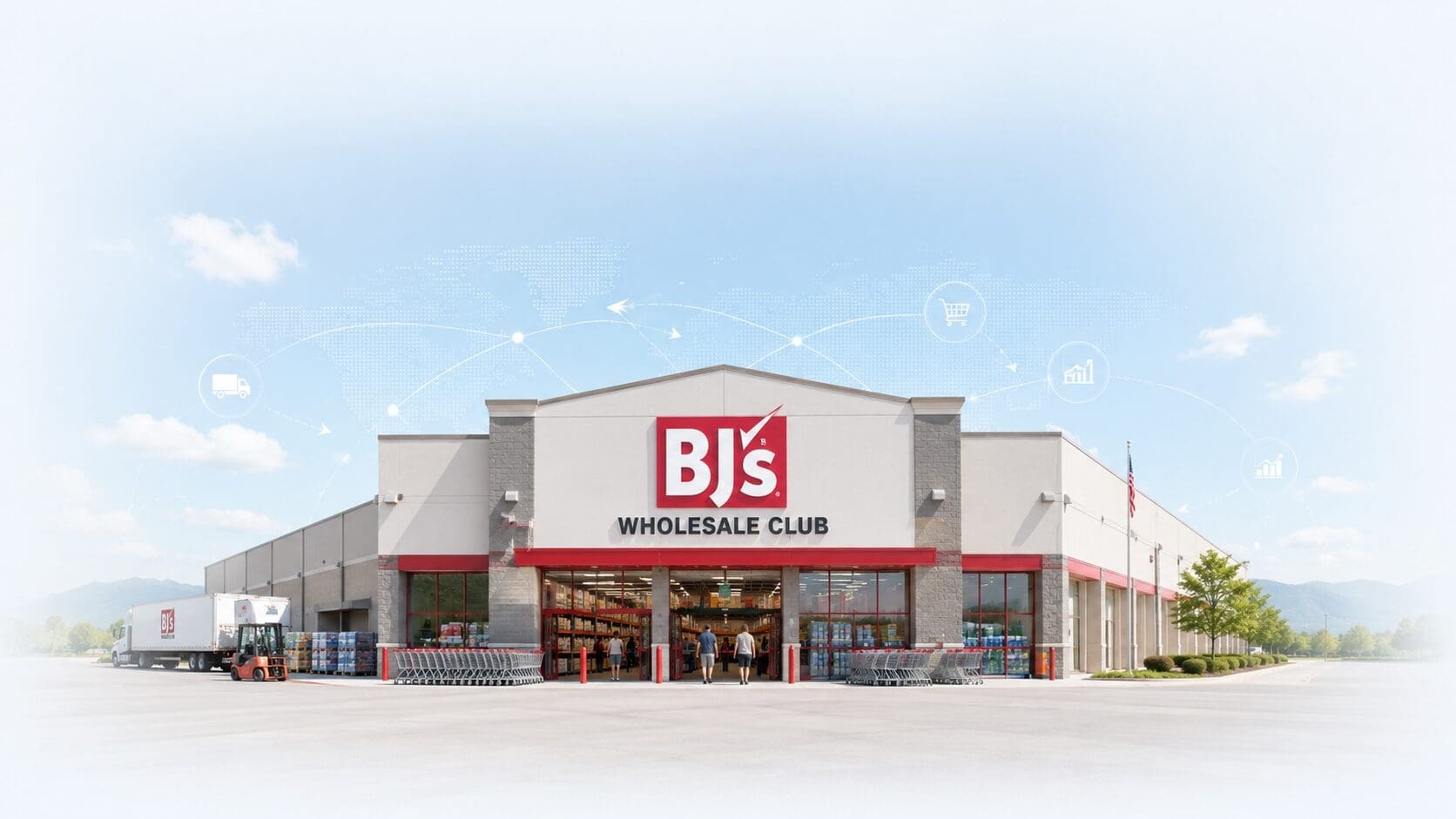
According to logisticsviewpoints.com, BJ’s Wholesale Club is extending its disciplined supply chain model into new geographic and operational territory — launching its first Texas club in Forney and planning two additional locations in Waxahachie and Southwest Fort Worth, with a fourth in Grand Prairie.
The Original Advantage: Supply Chain Simplicity
BJ’s competitive edge has long rested on structural supply chain efficiency rather than e-commerce scale. As the source states, the company relies on direct purchasing from manufacturers, cross-docking consolidation points, limited SKU complexity, truckload buying, and fast inventory turns. Its distribution centers receive large manufacturer shipments and move goods to individual clubs rapidly — often within a short operating window — minimizing dwell time and inventory carrying costs. This model reduces labor intensity in stores and supports BJ’s value proposition without relying on frills or digital spectacle.
Three Key Shifts Since 2020
According to the report, three developments have reshaped BJ’s operational priorities since Logistics Viewpoints’ 2020 analysis. First, membership income remains a meaningful contributor to the business, with high renewal rates underpinning recurring revenue that funds digital investment, new club openings, and supply chain upgrades. Second, digital fulfillment has grown substantially: BJ’s now serves members via curbside pickup, same-day delivery, app-based ordering, and digital engagement — raising the stakes for inventory accuracy, labor planning, and order staging discipline. Third, geographic expansion has accelerated: the Forney location marks BJ’s 264th club and its 202nd gas station, confirming a deliberate push beyond its historical eastern U.S. base.
Regional Density as a Supply Chain Imperative
Unlike Costco and Sam’s Club — which operate national footprints — BJ’s remains regionally concentrated. The source states that its growth strategy prioritizes building local density over nationwide coverage. From a logistics perspective, clustering clubs improves replenishment economics, brand awareness, and distribution asset utilization. The Texas expansion tests this principle in the Dallas-Fort Worth metroplex, where population growth, suburban density, household formation, and car-oriented shopping patterns align with warehouse-club economics. Yet the market is highly competitive — requiring BJ’s to prove both the portability of its value proposition and the scalability of its supply chain outside its legacy regions.
Grocery Frequency Raises Operational Stakes
BJ’s is increasingly positioned as a weekly destination — not just an occasional stock-up stop. The source emphasizes that fresh food, grocery, household consumables, gasoline, and convenience services drive higher shopping frequency. But this shift demands tighter execution: more precise demand forecasting, stronger cold chain management, improved replenishment discipline, and rigorous store-level operations. Produce and meat categories, in particular, require shorter lead times and stricter temperature control — adding complexity to a model historically built on simplicity and speed.
Industry Context and Practitioner Implications
This evolution mirrors broader industry trends. In 2025, Walmart opened 12 new Neighborhood Markets with integrated fuel stations and expanded same-day delivery to 95% of U.S. households; Kroger completed its $25 billion acquisition of Albertsons in early 2024, aiming to consolidate regional distribution networks. Meanwhile, according to the Council of Supply Chain Management Professionals (CSCMP), U.S. warehouse-club same-day delivery adoption rose 42% between Q2 2023 and Q2 2025. For supply chain professionals, BJ’s Texas rollout underscores a critical lesson: regional density isn’t optional — it’s foundational to maintaining cost discipline while layering in digital and fresh-food capabilities. A single distant club strains transportation routing, increases inbound freight costs by up to 18% (per CSCMP 2024 benchmark data), and dilutes labor productivity. Clustered expansion, by contrast, enables shared DC assets, optimized last-mile routes, and localized vendor partnerships — turning geography into a strategic lever, not just a footprint metric.
Source: logisticsviewpoints.com
Compiled from international media by the SCI.AI editorial team.