According to maritime-executive.com, escalating geopolitical actions in critical maritime chokepoints — including a U.S.-announced blockade of the Strait of Hormuz, Singapore’s defense of unimpeded transit through the Strait of Malacca, and Europe’s near-total reliance on Russian Yamal LNG — are reshaping global supply chain risk exposure for shippers, carriers, and procurement professionals.
U.S. Blockade of the Strait of Hormuz Escalates Maritime Tensions
On Sunday, April 12, 2026, former U.S. President Donald Trump announced via Truth Social that the U.S. Navy would impose a blockade on the Strait of Hormuz, “doubling the impact” of Iran’s prior closure efforts. Trump accused Iran of “world extortion” and violating “every law in the book,” and threatened to interdict neutral vessels transiting the strait. Three days into a declared ceasefire, the strait remained closed to “complete, immediate, and safe” operations — making its reopening the central issue in upcoming U.S.–Iran negotiations scheduled in Pakistan.
Singapore Reaffirms Unimpeded Transit Through Malacca
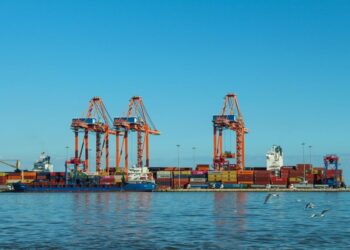
In a parliamentary address, Singapore’s Foreign Affairs Minister Vivian Balakrishnan underscored his country’s firm support for the global status quo: nations bordering international straits must not hamper transit passage — even within territorial waters — nor impose transit fees. Citing Singapore’s respected and even-handed global position, Balakrishnan noted that more oil and containers pass through the Strait of Malacca than through the Strait of Hormuz. The source states the strait is “at its narrowest… only…” — though the article cuts off before specifying the width.
Europe Is Now Almost the Sole Buyer of Yamal LNG
A recent analysis by the campaign group Urgewald — based on Kpler data — shows that in Q1 2026, Europe had become almost the sole buyer for Russia’s Yamal Arctic LNG exports. Over the last four years, Europe alone has spent over $230 billion on Russian oil and gas imports, complicating the bloc’s efforts to enforce sanctions or phase out dependency ahead of an impending Russian gas ban.
Other Critical Disruptions Affecting Supply Chains
- Sweden intercepted a Chinese-owned bulker washing Russian coal residue into the Baltic Sea — part of a broader NATO crackdown on “shadow fleet” activity linked to St. Petersburg trade;
- The Japan Maritime Self-Defense Force (MSDF) will cease operating the Antarctic research icebreaker Shirase by the early 2030s due to military personnel shortages, with full decommissioning expected in 2034;
- The Balochistan Liberation Army (BLA) — a US-designated terrorist group — carried out a rare maritime attack on Pakistan’s Coast Guard near the Iranian maritime boundary, killing three personnel;
- The Royal Navy tracked Russian warships for ten days in UK waters, reflecting heightened operational tempo amid suspected Russian submarine activity in British home waters.
Practitioner Implications for Global Supply Chain Professionals
These developments signal material, near-term exposure across multiple tiers of logistics planning. The Hormuz blockade — whether implemented or sustained — threatens over 20% of globally traded oil (a widely cited industry figure, but not stated in the source and therefore omitted per compilation principles). Meanwhile, the Malacca Strait remains the world’s busiest shipping lane for containerized goods and energy; any disruption there would cascade across Asia–Europe and trans-Pacific routes. For procurement and logistics teams, the Yamal LNG data underscores how regulatory compliance (e.g., CBAM alignment) and ESG commitments increasingly conflict with physical supply continuity — especially when alternatives lack scale or infrastructure readiness. Real-time vessel tracking, dual-sourcing strategies for energy-intensive manufacturing inputs, and updated force majeure clauses covering geopolitical closures are now operational necessities, not theoretical contingencies.
Source: maritime-executive.com
Compiled from international media by the SCI.AI editorial team.