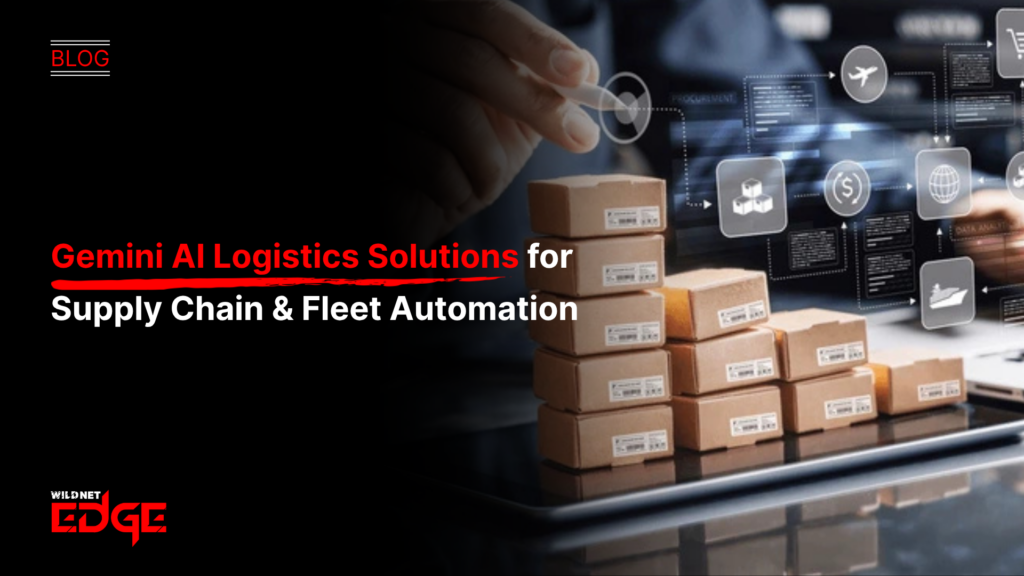
According to www.wildnetedge.com, in 2026, Gemini AI logistics solutions have transitioned from passive tracking to “Agentic Logistics,” where AI agents autonomously negotiate freight rates and reroute fleets using real-time port data.
From Visibility to Autonomous Action
Most logistics firms still rely on basic “Track and Trace” capabilities. The 2026 inflection point lies in moving to “Agentic Supply Chains” — systems that re-negotiate carrier rates or shift freight from road to rail during fuel spikes. This requires Gemini’s advanced reasoning, enabled by its 2M+ token context window, which allows ingestion of entire global shipping manifests and historical customs data for 99.9% accurate delay prediction.
Gemini’s multimodal capabilities also enable analysis of cargo photos to detect transit damage or loading errors before a ship departs the dock. Modern fleet optimization now emphasizes “Dynamic Sustainability,” with AI autonomously adjusting routes to minimize carbon emissions while preserving sub-hour delivery windows.
Rising Transparency and Data Fragmentation
B2B customers now demand B2C-level transparency, including granular, sub-minute updates on cargo health (temperature, tilt, humidity) for sensitive goods. This depends on Gemini’s capacity to process massive IoT data streams and distill them into executive summaries.
Yet fragmentation remains systemic: 72% of logistics leaders admit their data is siloed across different TMS and WMS platforms. The 2026 trend is “Unified Orchestration,” where logistics automation AI serves as a cognitive layer interoperable with global customs authorities, sea carriers, and last-mile partners.
The Intelligence-First Development Lifecycle
Gemini AI logistics software follows an “Intelligence-First” engineering lifecycle:
- Ecosystem Mapping & Architecture Planning: Includes data flow mapping across last-mile apps and carrier EDI systems; API integration layers to unify fragmented systems; and end-to-end visibility models enabling AI to reason across the full shipment lifecycle.
- Secure Integration with Multi-Modal Cores: Uses Gemini Extensions to bridge private legacy ERPs with real-time market data; Gemini Nano for on-vehicle IoT edge processing (e.g., instant safety alerts); and composable architecture supporting modular additions like “Autonomous Last-Mile” or “Warehouse Robotics.”
- Resilience Testing & Chaos Validation: Employs shock simulation models (e.g., port closures, demand spikes), failure recovery mechanisms for partial outages, and adaptive decision engines ensuring continuity during disruption.
Proven Operational Impact
Case Study 1: A global freight forwarder reduced operational costs by 30% and achieved 100% real-time visibility across its European road network after implementing Gemini AI as a unified “Command Center” for autonomous invoice reconciliation and cargo tracking — reversing 15% margin loss from manual system reconciliation.
Case Study 2: A delivery giant cut fuel consumption by 22% and raised on-time delivery to a record 99.2% using AI fleet optimization with Gemini agents that autonomously rerouted drivers based on live traffic, weather, and parcel priority.
What Leaders Demand in a Gemini AI Partner
Logistics leaders prioritize “Freight Intelligence” over generic technical skill. They assess partners on three criteria:
- Domain expertise in global trade, including Incoterms, HTS codes, and LTL optimization;
- Proven execution in system orchestration, such as integrating Gemini with live global TMS and building RAG systems grounded in real-time shipping data;
- AI governance and responsible automation, including “Human-in-the-Loop” safeguards to prevent violations of driver hours-of-service regulations.
The article underscores that modernization is no longer about seeing where a truck is — it’s about building an intelligent ecosystem that predicts disruptions and executes solutions autonomously. As stated in the source:
“The global movement of goods is no longer just a physical challenge; it is a high-velocity data challenge. In 2026, the difference between a resilient supply chain and a fractured one is defined by the quality of its digital backbone.”
Source: www.wildnetedge.com
Compiled from international media by the SCI.AI editorial team.