# The Eight Technology Revolutions in Warehouse Automation for 2026: From AMR to Digital Twin in Supply Chain Intelligence
With the continuous expansion of global e-commerce and rising consumer expectations for instant delivery, modern warehouses are undergoing unprecedented technological transformation. According to industry analysis, the global warehouse automation market is expected to reach nearly $30 billion in 2026, with potential to double by 2030.
“Automation is no longer an option but a survival necessity. Companies that can rapidly adapt to technological changes will gain decisive advantages in future supply chain competition.” — Global supply chain expert analysis
Behind this rapid growth are eight key technologies reshaping every aspect of warehouse operations—from material handling to order fulfillment, from system coordination to virtual simulation. This article provides an in-depth analysis of how these technologies work together to propel the supply chain industry into a new era of intelligence, while exploring the challenges and opportunities enterprises face during implementation.
## Foundational Automation Layer: Revolution in Material Handling and Storage
Automated pallet movement systems represent the technological frontier for large-scale inventory processing. These systems include high-speed conveyors, pallet shuttles, and integrated Automated Storage and Retrieval Systems (AS/RS), collectively addressing efficiency bottlenecks in receiving, put-away, and replenishment of pallet-level goods in traditional warehouses. Taking pallet shuttle systems as an example, these self-powered robotic carriers can autonomously move pallets within racking structures, handling over 11,000 movements per week.
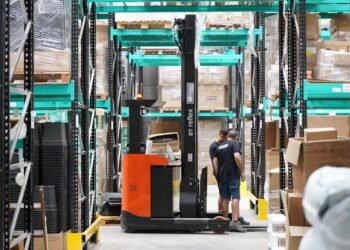
Forklift-free warehouse design is not merely an equipment replacement strategy but a complete operational philosophy shift. This design completely reconfigures internal logistics processes by combining Autonomous Mobile Robots (AMRs), Automated Guided Vehicles (AGVs), intelligent conveyors, and automated cranes. Safety risks, space wastage, and efficiency fluctuations inherent in traditional forklift operations are systematically addressed under this new paradigm.
## Intelligent Execution Layer: From Automation to Autonomy
Autonomous material transport technology is rapidly evolving from single-function to multi-scenario applications. While both AGVs and AMRs replace manual transport, they differ significantly in technical approach and application scenarios. AGVs rely on predefined paths (such as magnetic tape, lasers, or visual markers) and are suitable for highly repetitive transport tasks between fixed points.
Goods-to-Person (G2P) automation technology completely颠覆s the traditional “person-to-goods” picking model. By delivering inventory directly to stationary workstation operators via robots, conveyors, or shuttle systems, this technology increases picking efficiency by 3-5 times. Vertical lift modules and robotic shuttle systems can rapidly retrieve totes or pallets from dense storage structures, reducing average order processing time from minutes to seconds.
“G2P technology not only improves efficiency but more importantly redefines human-machine collaboration in warehouse work, allowing humans to focus on higher-value decision-making tasks.” — Logistics automation expert
## Precision Operation Layer: Refined Application of Robotic Technology
Robotic picking technology is evolving from simple mechanical repetition to complex cognitive decision-making. Leveraging advanced machine vision, deep learning, and adaptive grippers, modern picking robots can handle tens of thousands of SKUs with different shapes, sizes, and materials. Deep learning algorithms enable robots to quickly learn grasping strategies for new items from small samples.
High-speed automated sorting systems represent the core processing capability of modern warehouses. Tilt-tray sorters, cross-belt sorters, and pouch sorting systems can process tens of thousands of items per hour while ensuring each item is accurately routed to its predetermined destination. These systems are not only fast but更重要的是 possess intelligent routing capabilities.
## System Coordination Layer: Intelligent Brain and Digital Mapping
Warehouse Execution Systems (WES) serve as the “central nervous system” of automated warehouses, coordinating all hardware resources and operational processes in real time. Compared to traditional Warehouse Management Systems (WMS), WES operates at a finer time granularity—not planning by hours or batches, but allocating tasks by the second.
Digital twin technology provides unprecedented simulation and optimization capabilities for warehouse management. By creating precise virtual replicas of physical warehouses—including every device, every inventory unit, and even every employee—managers can test new layouts, evaluate equipment configurations, and optimize workflows in a zero-risk environment.
## Implementation Challenges and Transformation Pathways
Despite increasing maturity of individual technologies, integrating eight technology categories into a协同working ecosystem remains a significant challenge. Equipment from different suppliers uses varying communication protocols, data formats, and interface standards, resulting in high integration costs and maintenance difficulties.
The proliferation of automation technology is reshaping warehouse workforce structures. Traditional manual operation positions are decreasing, while new roles in equipment monitoring, system maintenance, data analysis, and exception handling are emerging. Surveys show 68% of US workers are willing to retrain to adapt to these changes.
## Return on Investment and Strategic Value
Warehouse automation investment returns manifest across multiple dimensions. Most directly, operational efficiency improvements: companies adopting robotic systems report 300% faster order fulfillment, 99% accuracy, and 30% lower labor costs. These metrics translate into concrete financial benefits.
Beyond financial returns, warehouse automation is reshaping industry competition. Early adopters establish competitive barriers through significant cost advantages and superior service quality, forcing later entrants to accelerate追赶. This technology diffusion is changing supply chain power structures.
“2026 will be a critical inflection point where warehouse automation transitions from technology demonstration to verifiable business value realization, with ROI moving from theoretical calculations to measurable commercial outcomes.” — Industry analyst forecast
## Conclusion: Toward Intelligent, Adaptive Warehouses of the Future
2026 marks a critical inflection point in warehouse automation’s evolution from isolated technology applications to integrated ecosystems. The eight technologies are not mutually exclusive choices but complementary,协同components collectively building intelligent, efficient, and resilient modern warehouses.
Looking ahead, we foresee several clear trends: artificial intelligence will evolve from辅助decision-making to autonomous decision-making, enabling truly “self-optimizing warehouses”; 5G and edge computing will eliminate data transmission delays, supporting real-time coordination and predictive maintenance; sustainability considerations will be deeply integrated into automation design.
For supply chain enterprises, automation is no longer a question of “whether” but “how” and “how fast.” Those capable of systematic planning, agile execution, and continuous learning will occupy leading positions in the intelligent supply chain era, creating lasting competitive advantages. The journey of warehouse automation has just begun, and 2026 will be a decisive milestone along this path.
【AI-Generated Content Disclosure】This article was assisted by artificial intelligence technology, reviewed by the SCI.AI editorial team for factual accuracy and content structure before publication. Data sources include public industry reports and research, with analytical perspectives based on professional expertise in supply chain automation.
Source: Global Trade Magazine