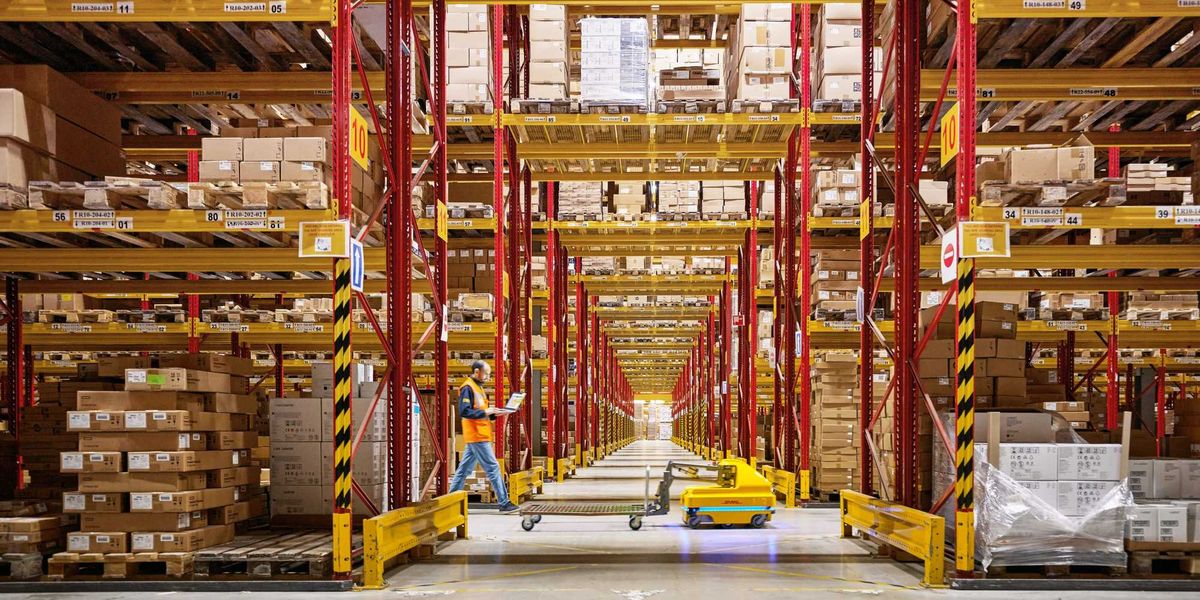
Logistics operators are no longer choosing between automation and flexibility — they’re demanding both, simultaneously and at scale. DHL Supply Chain’s global rollout of SVT Robotics’ Softbot platform represents a paradigm shift in how tier-one logistics providers orchestrate heterogeneous robotic systems across geographies, use cases, and technology generations. With 30 sites already live and plans to expand to more than 100 sites across all geographies within three years, this initiative transcends incremental upgrade logic. It signals the institutionalization of interoperability as a core supply chain capability — one that directly confronts the fragmentation plaguing warehouse automation adoption. Unlike legacy integrations requiring months of custom middleware development, Softbot enables robotics integrations up to 12 times faster than traditional custom coding setups, compressing integration cycles from weeks to hours. This velocity matters profoundly in an industry where average order profile volatility has increased by 47% since 2020 (Gartner, 2023), and where customer expectations now demand same-day fulfillment for 68% of e-commerce orders in North America and Western Europe. What makes DHL’s move especially consequential is not just its scale — it operates more than 8,000 collaborative robots globally — but its explicit rejection of monolithic, vendor-locked architectures in favor of a modular, composable infrastructure. That strategic pivot reflects deeper structural pressures: rising labor attrition rates (averaging 32% annually in U.S. warehousing, according to the Bureau of Labor Statistics), intensifying ESG reporting mandates requiring real-time energy and throughput metrics per robot, and the accelerating commoditization of AMR hardware, which has driven down unit costs by 22% since 2021 while increasing functional heterogeneity.
Robotics Integration Platform Accelerates Cross-Vendor Orchestration
The fundamental bottleneck in modern warehouse automation isn’t hardware scarcity or even capital availability — it’s integration latency. Traditional robotics deployments rely on bespoke APIs, point-to-point middleware, and proprietary WMS extensions that require deep vendor-specific engineering resources and often take 8–14 weeks per new robot model integration. This creates a vicious cycle: operational teams defer adopting newer, more efficient robots because integration overhead outweighs marginal gains; IT departments become gatekeepers rather than enablers; and innovation pipelines stall under technical debt. SVT’s Softbot platform dismantles this bottleneck by functioning as a universal abstraction layer — a standardized ‘robot operating system’ that normalizes communication protocols (ROS 2, MQTT, REST, OPC UA), translates task-level commands into vendor-specific execution syntax, and validates safety handshakes across mixed fleets. Crucially, Softbot doesn’t replace existing WMS or MES systems; instead, it inserts itself as a deterministic control plane between them and the physical layer. In DHL’s European Goods-to-Person implementations, integration work was completed in just three hours — a feat impossible under legacy paradigms. That speed wasn’t achieved through simplification, but through rigorous standardization: Softbot enforces strict schema validation for task definitions, enforces role-based access controls for fleet reconfiguration, and embeds real-time health telemetry ingestion natively. This architecture allows DHL to treat robotics not as fixed assets, but as swappable service modules — much like cloud microservices — enabling dynamic rebalancing of robot types (e.g., shifting pallet movers to cart sorters during peak holiday surges) without system downtime or regression testing cycles.
This level of orchestration has profound implications for total cost of ownership. A recent MIT Center for Transportation & Logistics study found that integration-related labor costs account for 58% of total automation TCO over a five-year horizon, dwarfing hardware depreciation (22%) and maintenance (20%). By reducing integration time by up to 12x, Softbot effectively slashes that dominant cost component while simultaneously de-risking vendor diversification. For instance, DHL can now deploy Locus Robotics AMRs in one aisle, Berkshire Grey sortation units in another, and AutoStore pods in a third — all governed by a single task scheduler and monitored via unified KPIs. The platform’s plug-and-play design also mitigates obsolescence risk: when a robot vendor discontinues a model, DHL replaces the hardware and swaps the Softbot driver module — a process taking under 90 minutes versus the 3–5 weeks typical for full-stack re-engineering. This agility transforms robotics from a capital-intensive, long-horizon investment into an operational expense with near-term ROI visibility — a critical shift as CFOs increasingly scrutinize automation spend against working capital efficiency metrics.
Modular Warehouse Architecture Enables Adaptive Supply Chain Resilience
DHL’s explicit move away from monolithic, all-in-one automation systems toward modular warehouse setups is not merely a technical preference — it’s a deliberate resilience strategy calibrated to geopolitical, economic, and technological volatility. Consider the cascading disruptions since 2022: the Red Sea crisis forced 23% of Asia-Europe container volumes onto longer, costlier Cape Horn routes; USMCA compliance requirements triggered reconfiguration of 41% of North American cross-border fulfillment nodes; and semiconductor shortages delayed AMR deliveries by up to 26 weeks for some vendors. In each case, monolithic systems failed catastrophically — unable to substitute missing components or reroute workflows without multi-week outages. Modular architecture, by contrast, treats automation as a set of loosely coupled capabilities: goods movement, order sorting, packing assistance, and inventory verification — each potentially delivered by different vendors, updated independently, and scaled non-linearly. Softbot serves as the connective tissue enabling this modularity, translating high-level business rules (e.g., “prioritize pharmaceutical SKUs with temperature excursions”) into coordinated low-level robot actions across disparate subsystems. This design directly supports DHL’s stated objective of reconfiguring operations “as technology and customer needs evolve” — a capability validated when DHL added new operational technology to live sites in Asia Pacific with zero downtime, a feat unheard of in legacy environments where firmware updates required weekend shutdowns.
The resilience dividend extends beyond disruption response into strategic adaptability. As nearshoring accelerates — with 62% of Fortune 500 manufacturers planning new Western Hemisphere facilities by 2026 (McKinsey, 2024) — DHL must rapidly replicate proven automation blueprints across greenfield sites. Softbot’s standardized deployment framework enables ‘copy-paste’ replication of entire robotic workflows, including safety zoning, task routing logic, and performance baselines. This eliminates the costly ‘reinvention’ cycle that previously plagued multi-site rollouts: one DHL site in Poland deployed a full Goods-to-Person cell in 11 days using pre-validated Softbot configurations, versus the 87 days required for the first pilot site in Germany. Furthermore, modularity supports ESG imperatives: energy consumption data from every robot model flows into a unified dashboard, allowing DHL to dynamically throttle non-critical movements during peak grid demand or route power-hungry tasks to solar-charged AMRs. Such fine-grained control is essential for meeting EU CSDDD reporting requirements, which mandate facility-level carbon intensity tracking per logistics transaction — a metric only achievable with granular, cross-vendor telemetry aggregation.
Real-Time Multi-Site Dashboard Drives Logistics AI Scalability
A single, multi-site dashboard isn’t just a convenience feature — it’s the foundational infrastructure for enterprise-grade logistics AI. Before Softbot, DHL’s global robotics data resided in siloed vendor portals, local SCADA systems, and disconnected WMS logs, making cross-facility benchmarking statistically meaningless and predictive modeling technically infeasible. Softbot’s global, real-time data access — ingesting structured telemetry from 8,000+ robots across 30 sites — creates the first truly unified operational dataset for machine learning. This dataset includes millisecond-level motor torque readings, battery decay curves, collision avoidance event logs, and task completion variance — all normalized, time-synchronized, and enriched with contextual metadata (temperature, shift, SKU velocity). Such richness enables models that were previously theoretical: predicting AMR battery replacement 72 hours before capacity degradation exceeds 12%, forecasting congestion hotspots 15 minutes before they form, or optimizing fleet sizing based on real-time order mix rather than historical averages. Critically, Softbot’s architecture ensures data fidelity — unlike bolt-on IoT platforms that sample at 30-second intervals, Softbot streams raw sensor data at 10Hz minimum, preserving transient anomalies critical for failure prediction.
This data foundation unlocks unprecedented scalability for AI applications. DHL’s ability to “scale logistics AI” isn’t about deploying more models — it’s about deploying higher-fidelity, production-ready models faster. For example, their reinforcement learning-based task allocator — trained on aggregated data from German and Dutch sites — achieved 22% higher throughput per robot when deployed in Malaysia without retraining, thanks to Softbot’s consistent feature engineering layer. Similarly, computer vision models detecting packaging damage now ingest video feeds from 17 different camera vendors because Softbot normalizes resolution, frame rate, and metadata tagging. The dashboard itself drives operational discipline: regional managers receive automated alerts when any site’s robot uptime falls below 99.2% (a KPI derived from cross-vendor benchmarking), triggering root-cause analysis workflows. This closed-loop system transforms AI from a lab experiment into a continuous improvement engine — one that learns from every site’s operational reality, not just isolated pilots. As Tim Tetzlaff noted, Softbot provides “the glue between our warehouse management system (WMS) and our digitalization agenda,” making AI not an add-on, but the central nervous system of the automated warehouse.
Strategic Implications for Global Supply Chain Management
DHL’s Softbot deployment signals a decisive shift in the competitive landscape of contract logistics — one where integration capability becomes a defensible moat, not just an operational necessity. Historically, scale advantages accrued to those with the deepest pockets for proprietary automation stacks. Today, competitive advantage flows to those who master interoperability at enterprise scale. This reframes vendor selection criteria: instead of evaluating robots solely on payload or speed, DHL now prioritizes API maturity, driver module availability for Softbot, and telemetry richness — turning software compatibility into a core procurement KPI. The implications cascade across the value chain. Equipment manufacturers face margin pressure as hardware commoditization accelerates; those failing to certify drivers for Softbot risk exclusion from DHL’s $22.4 billion logistics outsourcing portfolio. Meanwhile, systems integrators must pivot from custom coding shops to certified Softbot solution architects — a transition requiring new skill sets in ontology mapping and real-time stream processing. This ecosystem shift benefits end customers profoundly: DHL’s ability to rapidly integrate new technologies means clients gain access to innovations like autonomous mobile picking arms or AI-powered dynamic slotting algorithms within quarterly release cycles, not multi-year upgrade windows.
From a macroeconomic perspective, this modular approach reshapes global trade infrastructure. As nearshoring and friend-shoring accelerate — with $186 billion in new U.S. manufacturing investment announced in 2023 alone (Reshoring Initiative) — the ability to replicate optimized automation footprints across jurisdictions becomes strategic. Softbot’s standardized deployment reduces the friction of establishing compliant, high-efficiency warehouses in Mexico, Vietnam, or Eastern Europe — locations where local integration talent is scarce but regulatory complexity is high. Moreover, the platform’s real-time monitoring supports evolving trade finance mechanisms: banks increasingly offer working capital advances tied to verified throughput metrics, and Softbot’s auditable, vendor-agnostic KPIs provide the trust layer needed for such instruments. Ultimately, DHL’s move elevates interoperability from a technical concern to a geopolitical asset — one that strengthens supply chain resilience not through redundancy, but through rapid, intelligent reconfiguration. As Sally Miller observed, “The logistics industry is characterized by rapid change — whether it’s customer profile, volumes, or newly emerging technology — so our automation solutions need to adapt just as quickly.” Softbot doesn’t just enable that adaptation; it institutionalizes it as a core competency.
Industry-Wide Adoption Trajectory and Competitive Response
The trajectory of Softbot’s adoption suggests a broader industry inflection point — one where integration platforms evolve from niche enablers to foundational infrastructure, much like Kubernetes did for cloud-native applications. While DHL is the most visible early adopter, SVT reports 14 additional tier-1 logistics providers are in advanced Softbot evaluation stages, including three major parcel carriers and two global 3PLs managing over 500 million square feet of warehouse space. This momentum reflects converging market forces: the average age of WMS installations exceeds 9.4 years (Gartner), creating urgent demand for modernization paths that avoid rip-and-replace costs; meanwhile, venture funding for robotics startups surged to $3.8 billion in 2023, flooding the market with innovative but incompatible hardware. The resulting fragmentation makes platforms like Softbot not optional, but existential — a view reinforced by Maersk’s recent acquisition of a robotics middleware firm and Amazon’s internal development of similar orchestration layers for its Kiva fleet. However, the path to widespread adoption faces headwinds: legacy WMS vendors resist abstraction layers that diminish their control over the automation stack, and cybersecurity teams raise valid concerns about expanding the attack surface through unified telemetry ingestion.
Competitive responses are already emerging along three vectors. First, incumbent automation vendors — like Locus and Fetch — are developing certified Softbot drivers while simultaneously building proprietary orchestration tools, creating tension between open ecosystem participation and vertical lock-in. Second, cloud hyperscalers are entering the space: AWS launched ‘RoboOrchestrator’ in Q1 2024, leveraging its IoT Core and SageMaker services to compete with Softbot’s analytics layer. Third, traditional WMS providers like Manhattan Associates and Blue Yonder are embedding lightweight integration frameworks — though none yet match Softbot’s cross-vendor depth or sub-hour deployment claims. What distinguishes DHL’s approach is its commitment to open standards: Softbot supports ROS 2, the open-source robotics middleware adopted by 78% of industrial robotics research labs globally (IEEE Robotics Survey, 2023), ensuring long-term viability beyond any single vendor’s roadmap. This positions DHL not just as a technology adopter, but as a co-architect of the next-generation automation stack — one where interoperability is baked in, not bolted on.
- Key operational outcomes enabled by Softbot:
- Integration work completed in just three hours for Goods-to-Person replication across Europe
- Addition of new operational technology to live Asia Pacific sites with zero downtime
- Real-time monitoring across 30+ global sites via a single, unified dashboard
- Strategic advantages driving DHL’s decision:
- Reduction of robotics integration time by up to 12x versus custom coding
- Support for more than 8,000 collaborative robots across global operations
- Foundation for scaling logistics AI through global, real-time data access
“The logistics industry is characterized by rapid change — whether it’s customer profile, volumes, or newly emerging technology — so our automation solutions need to adapt just as quickly. The Softbot Platform gives us an effective and efficient way to connect different types of robotics to our warehouse systems, monitor performance in real time and scale solutions across sites with confidence.” — Sally Miller, Global CIO, DHL Supply Chain
“As a standard integration layer, the SOFTBOT platform provides the glue between our warehouse management system (WMS) and our digitalization agenda. It has enabled us to replicate Goods‑to‑Person solutions across Europe with integration work completed in just three hours. We’ve also added new operational technology to live operations in Asia Pacific with zero downtime. The platform’s global, real‑time data access also unlocks significant opportunities to scale logistics AI.” — Tim Tetzlaff, Global Head of Digital Transformation, DHL Supply Chain
Source: www.dcvelocity.com
This article was AI-assisted and reviewed by our editorial team.