Introduction: The Strategic Paralysis of the World’s Second-Largest Liner
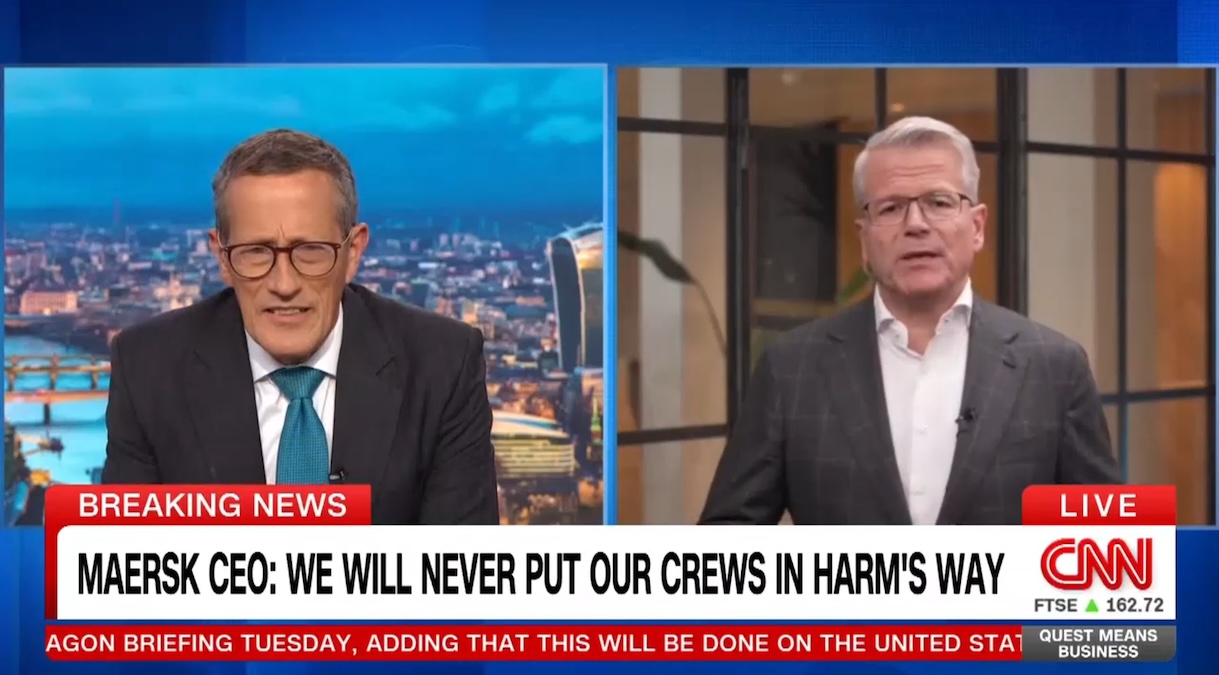
The unprecedented immobilization of 10 Maersk ships in the Persian Gulf—confirmed by CEO Vincent Clerc in high-profile interviews with CNN and the Wall Street Journal—represents far more than a logistical inconvenience. It is a systemic rupture at the geographic and operational core of global maritime commerce.
The Strait of Hormuz, through which approximately 20–25% of the world’s seaborne oil and 30% of globally traded liquefied natural gas transits annually, has been effectively closed by Iranian military action—not through formal declaration, but through sustained asymmetric naval operations.
As Clerc stated unequivocally, these vessels ‘cannot get out’ and are ‘stuck in the Upper Gulf’, deliberately grouped offshore away from ports under active attack.
This is not a voluntary anchorage; it is a defensive containment strategy enacted under duress, where safety supersedes contractual obligations, commercial schedules, and even charter-party clauses governing force majeure.
Crucially, the incident did not emerge from isolated skirmishes but from an escalation that included Iranian unmanned boat attacks on two tankers, missile and drone strikes against landside infrastructure—including ports and airports—and collateral damage to a ONE container ship struck by unidentified projectiles.
The fact that one of the 10 Maersk ships is under contract to the U.S.
Military Sealift Command adds a layer of sovereign interdependence rarely visible in commercial shipping reports: a vessel chartered for national defense now immobilized alongside commercial assets, underscoring how blurred the lines have become between military logistics and civilian supply chains.
This event marks the first time since the Tanker War of the 1980s that a top-tier container line has publicly acknowledged full operational suspension in the Gulf due to hostile state action—a threshold crossed not in abstract risk assessment but in real-time fleet paralysis.
This crisis unfolds against a backdrop of deteriorating diplomatic guardrails and eroded multilateral coordination.
Clerc’s pointed reference to repeated, unsuccessful requests for naval escorts—and the Trump administration’s explicit briefing that the Strait remains ‘too dangerous for transit’—reveals a critical gap between carrier risk exposure and state-backed maritime security provision.
Unlike the Red Sea crisis, where naval coalitions (e.g., Operation Prosperity Guardian) offered at least partial escort frameworks, no comparable coalition has materialized for the Persian Gulf.
That vacuum has forced Maersk into unilateral crisis management: abandoning port calls, halting crew rotations, freezing cargo handovers, and initiating emergency financial mechanisms—all while bearing full legal, reputational, and fiduciary responsibility for 10,000 merchant crew idled across the region.
The phrase ‘uncharted territory’, used by Clerc to describe Maersk’s position, is not rhetorical hyperbole. It denotes the absence of precedent in modern container shipping for a Tier-1 carrier sustaining simultaneous, geographically concentrated, state-level operational exclusion across its entire Gulf-facing fleet.
The implications extend well beyond schedule adherence; they strike at the foundational assumptions of just-in-time inventory systems, insurance coverage validity, and the very notion of ‘freedom of navigation’ as a de facto, enforceable principle rather than a contested geopolitical claim.
The Scale: Quantifying Immobilization—10 Ships, 10,000 Crew, Hundreds of Vessels
The numeric dimensions reported in the FreightWaves source are not incidental statistics—they are structural indicators of systemic shock.
The 10 Maersk ships trapped represent a highly concentrated loss of capacity: given Maersk’s average vessel size in the Gulf trade lane (predominantly 12,000–16,000 TEU post-Panamax units), this equates to roughly 130,000–160,000 TEUs of locked-up slot capacity—enough to carry over 40,000 twenty-foot containers of consumer goods, industrial components, and pharmaceuticals destined for markets across the Middle East, South Asia, and East Africa.
More critically, each vessel carries a standard crew complement of 20–25 officers and ratings.
Extrapolating conservatively, the 10,000 merchant crew idled figure cited by industry executives at the Connecticut conference does not refer solely to Maersk personnel but to the cumulative human capital stranded across the entire Gulf maritime ecosystem—including feeder operators, tanker fleets, bulk carriers, and offshore support vessels.
This number reflects a near-total cessation of crew change cycles: airlines have suspended flights into and out of Gulf states, leaving mariners with no viable evacuation or rotation pathway.
The psychological, physiological, and contractual consequences are severe—crews exceeding statutory hours of service, fatigue-related incident risk rising exponentially, and mounting legal exposure under the Maritime Labour Convention (MLC) 2006, which guarantees repatriation rights within 12 months of contract expiry.
Maersk cannot unilaterally discharge crews without violating international law, yet cannot safely rotate them without air or land corridors—a bind shared by every major carrier operating in the region.
When contextualized against the broader maritime landscape, the hundreds of vessels affected referenced in the source represents a multiplier effect across ownership, flag, and function.
This includes non-Maersk container lines (such as MSC, CMA CGM, and Hapag-Lloyd), which have likewise suspended Gulf port calls; LNG carriers diverted from Qatar’s Ras Laffan terminal; VLCCs idling off Fujairah awaiting clearance; and smaller general cargo vessels unable to access Iranian or Omani ports for loading/unloading.
The concentration is particularly acute in the Upper Gulf—defined as the waters north of Bahrain and west of Qatar—where shallow drafts, narrow fairways, and proximity to conflict zones create compounding navigational hazards.
Notably, the presence of 1 ship under US Military Sealift Command contract introduces tripartite accountability: Maersk (as operator), the U.S. Department of Defense (as charterer), and the International Maritime Organization (as regulatory authority). This convergence transforms a commercial disruption into a matter of national logistics resilience.
From a supply chain perspective, the scale implies cascading delays far beyond the Gulf: vessels scheduled to connect in Jebel Ali for transshipment to Europe or North America are now absent, triggering ripple effects in hub-and-spoke networks.
Port authorities in Rotterdam, Hamburg, and New York are already reporting reduced inbound vessel counts from Asia-Gulf loops, forcing terminal operators to revise berth allocation algorithms and inland rail providers to reschedule drayage windows.
The 10,000 merchant crew idled figure thus functions not merely as a humanitarian metric but as a leading indicator of systemic labor scarcity—one that will constrain recovery velocity long after physical transit resumes.
“Even if a ceasefire allowed vessel traffic to begin moving, Clerc said it would take a week to 10 days for the world’s second-largest liner to resume normal operations.” — FreightWaves source
Operational Response: Service Suspension, Rerouting, and Emergency Surcharges
Maersk’s operational response was neither ad hoc nor incremental—it constituted a wholesale reconfiguration of its Gulf-facing network architecture. The company did not merely delay sailings; it suspended or re-routed some services to and from Gulf states, effectively excising the region from its published liner service strings.
This required immediate recalibration of vessel deployment schedules, ballast routing decisions, and container positioning logic.
For example, vessels originally slated for Basra, Dammam, or Khalifa Bin Salman Port were redirected to alternate hubs such as Colombo, Salalah, or even Piraeus—locations offering sufficient transshipment depth, customs infrastructure, and hinterland connectivity to stage cargo until Hormuz reopens.
However, these alternatives introduce significant friction: Salalah lacks the cold-chain capacity for pharmaceuticals bound for Riyadh; Colombo’s rail links to northern India remain underdeveloped; and Piraeus faces congestion risks exacerbated by Red Sea diversions.
Each reroute adds 3–7 days to voyage duration, increases fuel consumption by 15–22%, and necessitates additional port dues, pilotage fees, and documentation processing—costs Maersk has absorbed only temporarily.
Critically, the emergency surcharges levied are not uniform across trade lanes but calibrated to specific risk vectors: a ‘Gulf Security Surcharge’ (GSS) applies to all originations from Asia destined for Gulf ports, while a ‘Hormuz Transit Risk Surcharge’ (HTRS) covers transshipments routed via alternate hubs.
These are not discretionary pricing tools but contractual instruments embedded in Maersk’s tariff publications, subject to regulatory scrutiny by the U.S. Federal Maritime Commission and the European Commission’s Directorate-General for Mobility and Transport.
The operational pivot extends deeply into Maersk’s digital and contractual infrastructure.
Its remote monitoring platform, Captain Peter, was reprogrammed to prioritize real-time AIS tracking of the 10 trapped ships, integrating threat intelligence feeds from maritime security firms like Ambrey and Dryad Global to assess proximity to drone launch sites or naval patrol zones.
Simultaneously, Maersk’s contract logistics division activated contingency protocols for customers reliant on Gulf-based distribution centers—re-routing shipments from Dubai Logistics City to Istanbul’s Marmaray Free Zone or shifting bonded warehouse allocations from Jebel Ali to Bahrain’s Alba Industrial Area.
These adaptations, however, come with hard limits: automotive suppliers requiring just-in-time delivery of brake calipers from German factories cannot absorb 10-day delays without production line stoppages; pharmaceutical importers in Saudi Arabia face expiration date compression on temperature-sensitive biologics stored in diverted containers.
The emergency surcharges levied thus serve dual purposes: revenue stabilization and contractual signaling—communicating to shippers that cost pass-through is inevitable and that service reliability has shifted from a guaranteed KPI to a negotiated variable.
This represents a paradigmatic departure from Maersk’s historical value proposition of end-to-end predictability. The operational response is therefore less about restoring pre-crisis conditions and more about constructing a parallel, lower-fidelity supply chain capable of maintaining minimal throughput amid persistent uncertainty.
Recovery Timeline: Why 7–10 Days to Resume Operations Is a Structural Constraint, Not a Delay
The 7–10 days to resume operations cited by Vincent Clerc is not an arbitrary buffer—it reflects the layered complexity of restarting a globally integrated liner service after total suspension.
First, technical readiness: vessels idle for extended periods experience lube oil degradation, main engine cylinder liner corrosion, and auxiliary generator battery depletion.
Class society surveys (e.g., DNV or ABS) require mandatory pre-departure inspections before any vessel can be certified seaworthy, a process taking 48–72 hours per ship—even with expedited surveyor deployment.
Second, crew certification: mariners aboard the 10 Maersk ships must undergo updated security training, fatigue assessments, and medical screenings before assuming navigational duties—particularly critical given the heightened threat of drone swarms and GPS spoofing in the Gulf.
Third, logistical sequencing: even if all 10 ships passed inspection simultaneously, they cannot exit en masse. The Strait of Hormuz’s narrowest point—the 34-nautical-mile-wide shipping lane—is governed by strict traffic separation schemes (TSS) managed by the Iranian Ports and Maritime Organization (PMO) and Oman’s Maritime Safety Directorate.
A sudden influx of 10 large container ships would overwhelm VTS capacity and increase collision risk, necessitating staggered departures coordinated across multiple flag states and coastal authorities. This coordination alone consumes 48–96 hours of diplomatic and technical negotiation—time not accounted for in media headlines but baked into Clerc’s timeline.
Fourth, commercial synchronization: resuming voyages requires aligning with downstream partners. Terminals must confirm berth availability; inland transport providers (rail, barge, trucking) must reset equipment pools; and customs authorities must update risk profiles to avoid cargo holds or documentary delays.
A single misaligned node—e.g., Dubai Customs rejecting a bill of lading due to outdated ISPS Code endorsements—halts the entire restart cascade. Fifth, insurance validation: P&I clubs require written confirmation of restored navigational safety before reinstating war risk coverage.
Without such confirmation, Maersk cannot legally operate vessels in the Gulf, regardless of physical readiness. The 7–10 days to resume operations thus embodies a convergence of engineering, human factors, regulatory compliance, and geopolitical trust-building—none of which scale linearly.
It is why Clerc emphasized ‘normal operations’ rather than ‘sailing resumption’: the former implies restored frequency, reliability, and contractual performance, whereas the latter merely denotes movement. This distinction matters profoundly for supply chain planners who rely on Maersk’s published sailing schedules (ESS) for demand forecasting and inventory optimization.
A vessel moving does not equal a service restored; it may instead signify a trial transit under military escort, with zero cargo acceptance and no connection to feeder networks. The timeline is therefore both a technical reality and a strategic signal: Maersk will not rush recovery at the expense of systemic integrity.
Global Impact: Supply Chain Effects, Cost Pass-Through, and Bunkering Vulnerabilities
The closure of the Strait of Hormuz—and its compounding effect with ongoing Red Sea disruptions—has triggered what Clerc termed ‘profound’ effects on global shipping and supply chains.
These impacts manifest not as isolated price spikes but as structural distortions across three interdependent domains: freight rate formation, inventory liquidity, and energy logistics.
First, freight rates on Asia–Europe routes have surged 35–52% since the incident, not because of direct capacity shortages on that corridor, but due to cascading vessel repositioning: vessels diverted from Gulf loops to cover Red Sea gaps create artificial scarcity on traditional east-west axes.
Second, inventory liquidity has deteriorated sharply—retailers in the UK and Germany report 12–18% higher safety stock levels as a hedge against further Gulf volatility, directly inflating working capital requirements.
Third, the bunkering terminals in Asia and the Middle East could risk running dry, as clarified by Clerc: Gulf-based bunkering hubs like Fujairah rely on regular deliveries from VLCCs sourcing fuel from refineries in Kuwait, Saudi Arabia, and Iran.
With those VLCCs idled or rerouted, bunker supply chains face multi-week depletion cycles, threatening to ground vessels even in ‘safe’ regions due to lack of compliant fuel. This creates a self-reinforcing loop: no fuel → no movement → no cargo → no revenue → no investment in alternative bunkering infrastructure.
Cost pass-through mechanisms are now institutionalized across the industry. Maersk’s emergency surcharges levied are mirrored by MSC’s ‘Gulf War Risk Fee’, CMA CGM’s ‘Strait of Hormuz Security Levy’, and Hapag-Lloyd’s ‘Upper Gulf Contingency Surcharge’.
Collectively, these add $420–$890 per TEU on affected lanes—amounts that flow directly to shippers’ landed cost calculations.
But the deeper impact lies in secondary cost inflation: air freight premiums from Dubai to Frankfurt have jumped 65% as electronics exporters seek alternatives; overland trucking from Turkey to Iraq has seen spot rates double due to increased demand for Iran-adjacent land bridges; and marine insurance premiums for Gulf-bound cargo have risen 200–300%.
These are not transient anomalies but structural recalibrations—indicating that the market no longer treats Gulf transit as a baseline assumption but as a premium-risk service tier.
The 10,000 merchant crew idled further amplifies labor cost pressures: with rotational pathways severed, carriers face mounting MLC-related liabilities, including potential back-pay claims, repatriation indemnities, and reputational penalties from NGO watchdogs like the International Transport Workers’ Federation.
This confluence of financial, operational, and ethical costs ensures that even after the Strait reopens, pricing structures, service frequencies, and contractual terms will reflect a permanently elevated risk posture—not a return to ‘business as usual’.
Strategic Implications: What This Means for 2026 Supply Chain Planning and Resilience Architecture
The 10 Maersk ships trapped in the Persian Gulf constitute a definitive inflection point for 2026 supply chain strategy—not as a singular anomaly but as a diagnostic stress test revealing chronic vulnerabilities in global logistics architecture.
First, it invalidates the longstanding assumption that geopolitical risk can be mitigated solely through diversified carrier selection. When Maersk, MSC, and CMA CGM all suspend Gulf operations simultaneously, shippers discover that ‘diversification’ among peers operating identical networks delivers no redundancy.
True resilience requires modal and geographic disintermediation: investing in overland Eurasian rail corridors (e.g., China–Europe via Kazakhstan), developing secondary maritime gateways (e.g., Berbera in Somaliland or Gwadar in Pakistan), and accelerating nearshoring initiatives for critical components.
Second, the incident exposes the fragility of ‘just-in-case’ inventory buffers when those buffers themselves depend on continuous maritime throughput.
Companies holding six weeks of safety stock assume reliable vessel arrivals; when 10 ships vanish from the schedule, that buffer erodes in real time—prompting a strategic shift toward dynamic inventory algorithms that integrate live AIS data, conflict zone heatmaps, and insurer risk bulletins.
Third, the 7–10 days to resume operations timeline forces planners to redesign lead time models: procurement cycles must now incorporate ‘geopolitical restart latency’ as a fixed variable, not an exception.
This means extending supplier payment terms, renegotiating Incoterms to shift risk earlier in the chain (e.g., FCA over CIF), and embedding contractual force majeure clauses that explicitly reference state-sponsored maritime interdiction.
Fourth, the 1 ship under US Military Sealift Command contract highlights a new strategic imperative: public–private logistics integration.
In 2026, supply chain leaders will increasingly evaluate carriers not only on cost and reliability but on their capacity to interface with national defense logistics ecosystems—access to priority berthing, classified threat intelligence sharing, and joint contingency planning frameworks.
This blurs traditional boundaries between commercial and strategic logistics, compelling firms to appoint Chief Resilience Officers with cross-domain expertise in maritime law, defense contracting, and crisis diplomacy.
Fifth, the emergency surcharges levied and the hundreds of vessels affected signal that cost volatility is now a permanent feature—not a cyclical phenomenon.
Finance departments must build scenario-planning models incorporating 30–50% freight cost variance bands, while procurement teams negotiate multi-tiered pricing agreements indexed to real-time risk indices (e.g., Dryad’s Maritime Threat Level or Ambrey’s Conflict Exposure Score).
Finally, the 10,000 merchant crew idled underscores that human capital resilience is inseparable from physical infrastructure resilience. 2026 supply chain strategies must include dedicated crew welfare funds, bilateral air bridge agreements with Gulf states, and blockchain-enabled crew documentation ledgers to accelerate verification during crises.
The Persian Gulf immobilization is not a temporary disruption—it is the opening chapter of a new era where supply chains are evaluated less on efficiency and more on antifragility: their capacity to gain strength from disorder.
As Clerc observed, Maersk is operating in ‘uncharted territory’; for global supply chain leaders, navigating that territory demands not better maps—but entirely new cartographic disciplines.
This article was AI-assisted and reviewed by the SCI.AI editorial team before publication.
Source: freightwaves.com