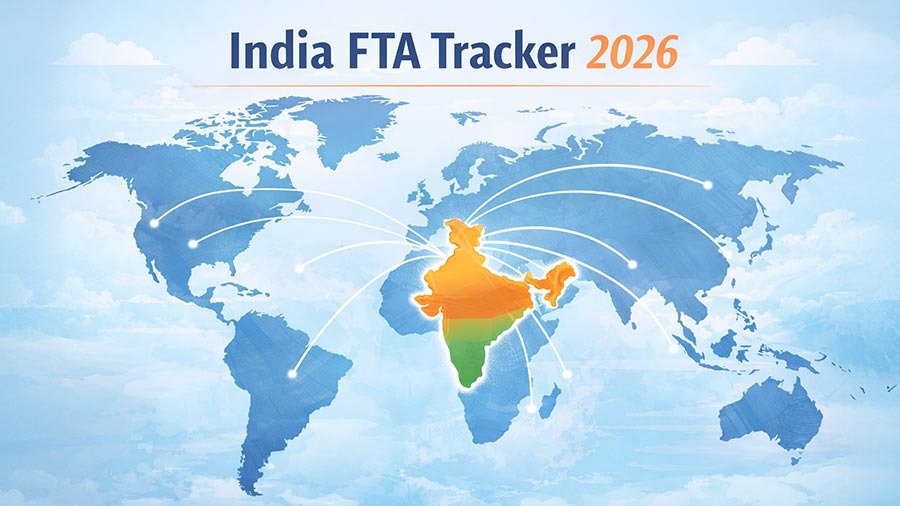
India's 2026 FTA offensive—featuring the EU pact covering nearly 2 billion consumers, Canada CEPA targeting US$50 billion trade by 2030, and Brazil agreement to double bilateral trade to US$30 billion—reshapes global supply chains. Simultaneously, U.S. solar tariffs at 125.87% duties and Section 122's 10% global tariff introduce acute uncertainty. Japan's 7th CEPA Joint Committee and France's Rafale-M procurement (26 jets) deepen advanced manufacturing and defense ties. This analysis examines operational impacts and three strategic scenarios for procurement leaders.
India-EU FTA: A 2-Billion-Consumer Gateway to European Supply Chains
The India-EU Free Trade Agreement, concluded on January 27, 2026, covers nearly 2 billion consumers—establishing one of the world’s largest integrated trade zones. As reported by india-briefing.com, the pact embeds deep regulatory alignment beyond traditional tariff cuts, including a Financial Services Annex finalized on January 6, 2026 enabling cross-border fintech interoperability and digital payment integration.
For supply chain professionals, this signals enforceable harmonization of technical standards across 27 EU member states. Indian auto component suppliers, pharmaceutical manufacturers, and electronics assemblers now face structured pathways—not just theoretical opportunities—to integrate into Tier-1 supplier networks for German automotive OEMs, French medical device firms, and Dutch semiconductor equipment integrators.
The agreement’s emphasis on sustainable supply chains—including binding commitments on responsible mineral sourcing and carbon footprint disclosure—means Indian steel producers, battery recyclers, and textile mills must align with EU’s Corporate Sustainability Reporting Directive (CSRD) timelines. india-briefing.com notes this triggers upstream investments in traceability systems and third-party verification. Full compliance with EU REACH and CE marking requirements will require an estimated 18–24 months of process re-engineering for mid-sized Indian chemical exporters—concrete, time-bound operational imperatives reshaping procurement calendars across India’s manufacturing belt.
India-Canada CEPA: Targeting US$50 Billion Trade by 2030 via Critical Minerals Alignment
On March 2, 2026, India and Canada formally launched CEPA negotiations, signing Terms of Reference in New Delhi in the presence of both prime ministers. As documented by india-briefing.com, the initiative targets US$50 billion bilateral trade by 2030—a sharp increase over recent levels—covering goods, services, investment, and digital trade.
For supply chain planners, the most immediate implications lie in critical minerals, agri-food logistics, and clean energy equipment. Canada’s vast reserves of nickel, cobalt, and uranium—and India’s growing demand for battery-grade inputs—create urgent incentives for joint ventures in downstream processing. The agreement proposes Mutual Recognition Arrangements (MRAs) for organic certification and veterinary health standards, potentially compressing Indian export clearance from 90-day quarantine periods to under 15 days via shared digital health certificates.
Strategically, the CEPA serves as a deliberate counterweight to overreliance on East Asian supply chains. Its timing—immediately following the EU FTA signing—signals India’s intent to build parallel, interoperable trade architectures. india-briefing.com highlights that only 12% of Indian food processing units currently meet Canada’s Safe Food for Canadians Regulations (SFCR), necessitating a coordinated capacity-building program funded jointly by both governments to realize the bilateral trade target.
“India’s FTA push is designed to reduce dependence on any single trade partner.” — india-briefing.com, March 2026
India-Brazil: Doubling Trade to US$30 Billion Through South-South Industrial Linkages
On February 21, 2026, India and Brazil agreed to double their bilateral trade to US$30 billion by 2030. As reported by india-briefing.com, the partnership extends across critical minerals, steel supply chains, renewable energy, digital technologies, and healthcare—prioritizing vertical integration over transactional commerce.
The pharmaceutical regulatory MoU between India’s CDSCO and Brazil’s ANVISA represents the most operationally significant breakthrough. Per india-briefing.com, it enables mutual recognition of Good Manufacturing Practice (GMP) inspection reports for finished dosage forms, substantially reducing validation timelines and costs for Indian generic drug manufacturers exporting to Brazil’s public health system. The agreement also includes provisions for joint training of inspectors and shared reference laboratories, creating a South-South regulatory bridge potentially extensible to African and Southeast Asian markets.
From a risk-rebalancing perspective, the India-Brazil axis offers unique advantages in commodity-linked supply chains. While EU and Canadian partnerships emphasize high-value services and precision manufacturing, Brazil provides scale, resource security, and geographic diversification. india-briefing.com confirms the MoU commits both nations to co-fund digital twin modeling of key ports to optimize berth allocation and container stacking algorithms, with full interoperability targeted for Q3 2028—quantifiable, auditable supply chain modernization anchored in contractual obligations.
US Trade Friction: 125.87% Solar Duties and 10% Section 122 Tariff Disrupt Clean Energy Supply Chains
On February 20, 2026, the U.S. Commerce Department imposed preliminary countervailing duties of 125.87% on solar cell imports from India, alongside a temporary 10% global import tariff under Section 122 of the Trade Act of 1974. As documented by india-briefing.com, these actions triggered a strategic pause: India has temporarily delayed high-level trade negotiations while assessing the evolving tariff framework.
For supply chain professionals, the impact is immediate. Indian solar module manufacturers exporting to the U.S. market face prohibitive duty liabilities or costly re-routing through third countries, significantly adding to lead times and landed costs. india-briefing.com notes that the U.S. petition cited India’s concessional land leases, interest-free loans for polysilicon plants, and tax holidays for wafer fabrication units as actionable subsidies—forcing Indian firms to reconsider the architecture of their clean energy manufacturing base.
Three scenarios emerge for navigating this friction. In the optimistic case, bilateral talks resume by Q3 2026 with a negotiated carve-out substantially reducing duties. The base case sees prolonged stalemate, pushing manufacturers to accelerate localization in third countries at significant capex. The pessimistic scenario involves escalation: if the U.S. extends tariffs to batteries or EV components, India’s nascent lithium-ion ecosystem could face cascading input cost inflation, while retaliatory measures could disrupt bilateral agricultural trade flows. This is a fundamental stress test for India’s multi-alignment strategy in a supply chain diversification era.
Japan CEPA & France Partnership: Advanced Manufacturing and Defense Supply Chain Deepening
The 7th Joint Committee Meeting of the India-Japan CEPA, held on March 2, 2026 in Tokyo, marked a decisive shift from tariff liberalization to advanced manufacturing integration. As reported by india-briefing.com, discussions centered on textiles, pharmaceuticals, agriculture, advanced manufacturing, and supply chain resilience—with formal working groups established on semiconductor packaging, battery recycling, and AI-driven predictive maintenance.
Parallel developments with France underscore India’s dual-track defense-industrial strategy. On February 17, 2026, India-France relations were elevated to a “Special Global Strategic Partnership,” culminating in procurement of 26 carrier-based Rafale-M fighter jets from Dassault Aviation and continued Scorpène submarine program collaboration. india-briefing.com details substantial indigenous content mandates in the contract, with Indian defense public sector units responsible for avionics integration and radar signal processing.
What distinguishes these partnerships from transactional deals is their embeddedness in measurable industrial KPIs. The India-Japan CEPA explicitly references Industry 4.0 adoption metrics, requiring Indian SMEs to implement internationally compliant machine interfaces to qualify for Japanese vendor development funds. The India-France Year of Innovation 2026—covering AI, digital technologies, healthcare research, and startups—creates spillover effects into civilian supply chains. india-briefing.com emphasizes that annual skill certification exchanges and mandatory technology transfer timelines represent hard-wired capability building, not soft-power initiatives.
Strategic Outlook: Three Scenarios for Global Procurement Leaders in 2026
The optimistic scenario (probability ~30%) envisions India operationalizing all major FTAs by late 2027, becoming a true multi-hub sourcing destination: EU-bound pharmaceuticals cleared via streamlined digital customs, Canada-sourced minerals processed in India for battery exports, and Brazilian feedstocks supporting Indian agri-food supply chains. india-briefing.com projects that manufacturers achieving full FTA compliance across multiple blocs could capture significant new market share in EU medical devices, North American agri-tech, and ASEAN generic pharmaceuticals by 2030—driving substantial export revenue growth.
The base-case scenario (probability ~50%) assumes partial implementation: EU FTA delivers most benefits by 2028, Canada CEPA remains in negotiation through 2027, India-Brazil cooperation advances steadily but faces regulatory friction. Supply chain professionals must adopt a modular compliance approach—prioritizing certifications with highest marginal returns, such as CDSCO-ANVISA GMP alignment for pharma or quality certifications for automotive electronics. india-briefing.com estimates this selective strategy achieves substantial tariff savings while containing capex, making it most viable for SMEs. The result: tiered competitiveness, with large conglomerates achieving full multi-bloc compliance while smaller players specialize in single-corridor excellence.
The pessimistic scenario (probability ~20%) arises if U.S. trade friction escalates into broader technology containment, disrupting semiconductor and battery supply chains and deterring FDI. In response, Indian firms would accelerate friend-shoring toward Japan and France, but at steep cost in time and capital. india-briefing.com emphasizes the fundamental imperative: India is no longer a low-cost option but a complex, high-stakes strategic node demanding granular understanding of each FTA’s implementation cadence, certification pathways, and geopolitical contingencies. Success belongs not to the lowest bidder, but to the most institutionally agile—those who translate live FTA tracker data into dynamic sourcing calendars and risk-adjusted capex plans.
Source: india-briefing.com
This article was AI-assisted and reviewed by our editorial team.