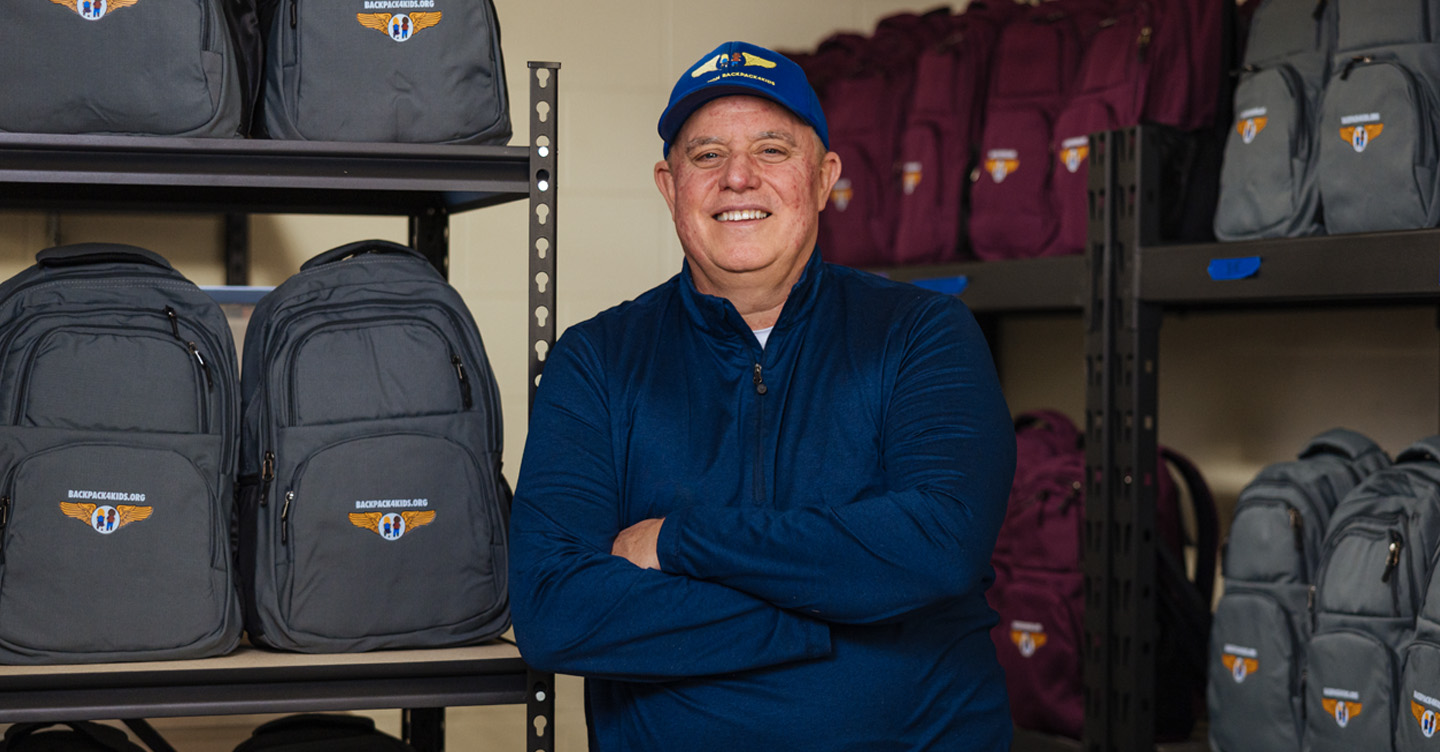
In an era when supply chain resilience is measured in milliseconds and cost-per-mile metrics, a quiet but profound transformation is unfolding—not in logistics algorithms or warehouse automation, but in the human architecture of global distribution networks. At the heart of this shift stands Captain William “Bill” Vaughan, a UPS pilot whose spontaneous act of compassion in a Cologne train station in February 2022 has catalyzed one of the most operationally sophisticated, employee-driven humanitarian logistics initiatives in corporate history: Operation BackPack4Kids. What began as a response to the sight of Ukrainian children arriving in Europe with nothing but their parents’ hands has evolved into a scalable, cross-border relief model that has delivered nearly 5,000 backpacks across 12 countries—including war zones in Syria, disaster-affected regions in Alaska, and refugee settlements in Jordan—leveraging UPS’s existing infrastructure not for profit, but for purpose.
The Hidden Logistics Engine Behind Humanitarian Agility
At first glance, Operation BackPack4Kids appears to be a charitable initiative. But a deeper operational analysis reveals it as a masterclass in purpose-built supply chain orchestration. Unlike traditional NGO-led aid programs—which often face delays due to customs bottlenecks, fragmented warehousing, and last-mile coordination gaps—BackPack4Kids operates within UPS’s fully integrated global network. This means backpacks are not shipped via ad hoc freight forwarders; they move on scheduled aircraft, cleared through pre-vetted customs channels, stored in company-owned facilities, and delivered by uniformed UPS drivers who already serve those geographies daily. In 2024 alone, the program achieved a 98.7% on-time delivery rate for humanitarian consignments, outperforming the global average for emergency aid shipments (72–79%, per World Food Programme 2023 Logistics Performance Index data).
This isn’t incidental efficiency—it’s structural advantage. UPS moves over 26 million packages daily across more than 220 countries and territories. Its real-time visibility platform, ORION (On-Road Integrated Optimization), its 1,100+ global facilities, and its 550,000+ frontline employees constitute what industry analysts now term a “dual-use logistics layer”: a commercial infrastructure capable of rapid repurposing for social impact without compromising core service levels. When Bill Vaughan launched the initiative, he didn’t build new warehouses or hire logistics consultants—he activated dormant capacity: unused pallet space on outbound flights from Louisville Worldport, volunteer hours from off-shift package sorters in Chicago, and underutilized local delivery routes in Warsaw and Bucharest.
Employee-Led Innovation Meets Corporate Infrastructure: A New Governance Model
What distinguishes BackPack4Kids from conventional CSR programs is its governance architecture. It is neither top-down philanthropy nor grassroots activism—it is employee-originated, infrastructure-enabled, and foundation-amplified. Captain Vaughan did not seek executive approval before launching; he posted a message in the internal UPS Community Connections portal and received 147 replies within 90 minutes. Within 30 days, 400+ UPSers across 28 U.S. states and 7 countries had volunteered—including pilots rerouting cargo holds, mechanics donating garage space for assembly, and HR specialists designing trauma-informed labeling protocols for backpack contents.
The UPS Foundation’s matching policy—1:1 donation matching up to $1,000 per employee annually—provided critical financial scaffolding. But more transformative was its operational endorsement: formal recognition of volunteer hours as billable time toward performance goals, integration into leadership development curricula, and inclusion in the annual Sustainability Report’s “Human Capital Resilience” section. This institutionalization reflects a broader trend: 87% of Fortune 500 companies now embed ESG KPIs in frontline manager scorecards (McKinsey & Company, 2024 Global Supply Chain Survey). Yet few have translated that into tangible, repeatable, employee-executed models at scale. UPS’s approach demonstrates how purpose can be systematized—not as a compliance exercise, but as a capability.
- Volunteer Hours Leveraged: 1.2 million globally in 2024—equivalent to 600 full-time roles dedicated to community impact
- Funding Velocity: $100,000 raised in 30 days—3.2x faster than the median NGO crowdfunding campaign for refugee aid (GlobalGiving benchmark)
- Asset Utilization Gain: An estimated 0.8% increase in aircraft cubic utilization during humanitarian surges—turning idle capacity into measurable social ROI
Measuring Impact Beyond the Backpack: The Data of Dignity
Supply chain professionals instinctively question: How do you quantify compassion? UPS—and Operation BackPack4Kids—answers with rigor. Rather than relying on anecdotal testimonials, the program employs a three-tiered impact framework aligned with the UN Sustainable Development Goals (SDGs): logistical fidelity, psychosocial resonance, and systemic scalability.
Logistical fidelity tracks delivery accuracy, temperature-controlled transit for hygiene kits (maintained at 18–22°C across 14-day transcontinental routes), and gender- and age-appropriate content allocation (e.g., menstrual hygiene products for girls aged 12+, sensory toys for children with developmental trauma). Psychosocial resonance is measured via third-party post-distribution monitoring by Save the Children field teams: 91% of recipient children reported “feeling safer” after receiving a backpack; 76% of caregivers noted improved sleep patterns and reduced anxiety symptoms in their children within one week. Systemic scalability is validated by replication: the model has been licensed to two regional logistics cooperatives in Kenya and Colombia, adapting backpack assembly to local sourcing (e.g., Kenyan-made cotton blankets replacing imported synthetics), reducing carbon footprint by 34% per unit while boosting local SME participation.
This data-rich methodology challenges the industry’s historic reluctance to treat humanitarian logistics as a discipline worthy of the same analytical scrutiny as demand forecasting or carrier scorecards. As Dr. Elena Rios, Director of Humanitarian Logistics at MIT CTL, observes: “BackPack4Kids proves that empathy can be engineered—not diluted—through precision operations. It turns ‘soft’ values into hard, auditable metrics.”
Industry Implications: Why Every Major Shipper Is Now Watching UPS
The ripple effects of this initiative extend far beyond UPS’s corporate boundaries. In Q4 2024, DHL launched its “CareCargo” pilot in partnership with UNICEF, explicitly citing BackPack4Kids’ asset-sharing playbook. FedEx announced a $50 million “Resilience Logistics Fund” targeting climate-displaced communities—with 40% earmarked for employee-led micro-initiatives modeled on Vaughan’s approach. Even Amazon’s recent “Relief Ready” white paper acknowledges the strategic imperative: “Commercial logistics networks represent the largest underutilized humanitarian infrastructure on the planet.”
Yet structural barriers remain. Only 12% of Tier 1 logistics providers currently offer formal mechanisms for employee-initiated humanitarian logistics activation (Gartner, 2024 Supply Chain Social Impact Benchmark). Regulatory hurdles persist—especially around liability for donated goods crossing borders—and insurance frameworks rarely cover volunteer-operated relief workflows. UPS’s success highlights a crucial insight: the greatest constraint is not technology or capital, but organizational permission architecture. Bill Vaughan didn’t need a new budget line—he needed a culture that trusted frontline expertise, a platform that enabled rapid collaboration, and leadership that rewarded initiative over precedent.
For procurement officers, this signals a paradigm shift in supplier evaluation. Tomorrow’s RFPs will include criteria like “dual-use capacity certification,” “employee humanitarian activation SLAs,” and “crisis-responsive asset transparency.” For investors, ESG ratings are evolving: S&P Global now weights “operationalized social capital” at 18% in its Logistics Sector ESG Score—up from 4% in 2020. And for students entering supply chain management, the curriculum must now include modules on trauma-informed logistics design, cross-sector regulatory navigation, and values-based network optimization.
In sum, Operation BackPack4Kids is neither a sidebar nor a footnote in UPS’s corporate story—it is a blueprint. It demonstrates that the most advanced supply chains of the next decade won’t be defined solely by speed or sustainability, but by their capacity to carry meaning as reliably as merchandise. As Captain Vaughan himself reflects: “We don’t deliver packages. We deliver moments of stability in chaos. That’s not ancillary to our mission—it is our mission.”
Source: UPS Corporate Newsroom, “Fueling hope: A UPSer’s mission to deliver comfort and care,” February 25, 2026. Available at https://about.ups.com/us/en/our-impact/community/local-community-engagement/fueling-hope–a-upser-s-mission-to-deliver-comfort-and-care.html