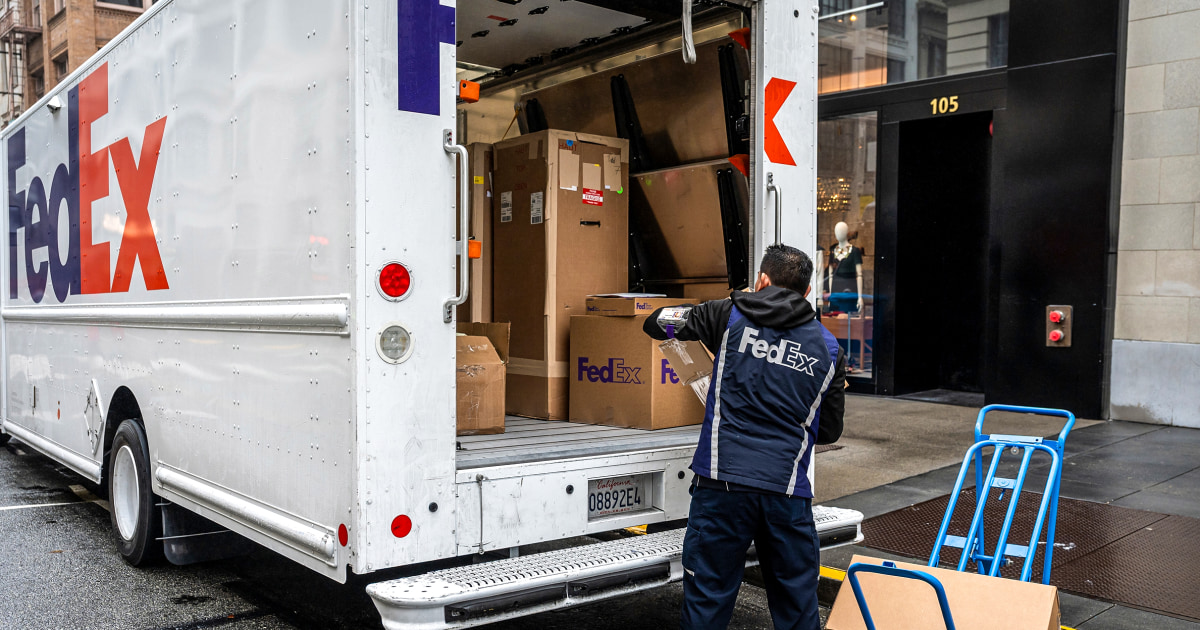
On February 23, 2026, FedEx Corporation filed a landmark lawsuit in the U.S. Court of International Trade demanding a full refund of all tariffs paid under the invalidated International Emergency Economic Powers Act (IEEPA) authority—a legal maneuver that transcends corporate restitution and signals a pivotal inflection point for global supply chain finance, customs compliance, and trade policy accountability. The suit follows the U.S. Supreme Court’s unanimous Friday ruling (February 21, 2026) declaring that former President Donald Trump’s use of IEEPA to impose sweeping, non-emergency tariffs on over 140 countries—including China, the EU, Canada, Mexico, Vietnam, and India—exceeded statutory bounds and violated the separation of powers. While the decision nullified the tariffs retroactively, it left unresolved the critical question of financial redress for importers who bore the brunt of the duties. FedEx, moving 17 million packages daily across more than 220 countries and territories, is now the first Fortune 100 logistics firm to initiate formal recovery proceedings—and its claim could set binding precedent for thousands of U.S. importers, freight forwarders, and contract manufacturers.
The IEEPA Tariff Experiment: A $52 Billion Policy Detour
Between March 2025 and January 2026, the Trump administration levied IEEPA-based tariffs ranging from 10% to 25% on an estimated $210 billion in annual U.S. imports, covering everything from semiconductor packaging materials and medical device components to e-commerce fulfillment kits and last-mile delivery hardware. Unlike traditional Section 301 or Section 232 tariffs—which require formal investigations, interagency review, and congressional notification—the IEEPA mechanism bypassed statutory guardrails by declaring a ‘national economic emergency’ tied to ‘unfair trade practices’ and ‘currency manipulation.’ According to U.S. International Trade Commission (USITC) data, these duties generated approximately $52.3 billion in federal revenue before being struck down—a sum representing nearly 18% of total U.S. customs duties collected in FY2025.
FedEx’s exposure was both structural and operational. As a de facto importer of record for millions of cross-border e-commerce shipments—particularly under its FedEx CrossBorder and FedEx International Deferred services—the company routinely advanced duties on behalf of clients lacking U.S. customs bonds or continuous entry privileges. Its September 2025 earnings call disclosed an anticipated $1 billion fiscal year 2026 earnings impact directly attributable to IEEPA duties, with CFO Michael Lenz noting that ‘duty accruals have increased average landed cost per package by 14.7% in trans-Pacific lanes and 9.3% across North Atlantic corridors.’ That figure aligns with third-party analysis from Descartes Systems Group, which found that IEEPA tariffs added an average $8.42 in duty costs per small-package shipment valued under $2,500—the dominant segment for U.S. cross-border B2C flows.
Supply Chain Finance at Risk: When Carriers Become De Facto Tax Collectors
FedEx’s lawsuit illuminates a rarely scrutinized but increasingly consequential role in modern trade: the carrier-as-financial-intermediary. Under U.S. customs law, the ‘importer of record’ bears legal responsibility for duty payment—even when goods are shipped via third-party logistics providers. To maintain service velocity and customer trust, FedEx (and peers like UPS and DHL) routinely assume this liability, paying duties upfront to U.S. Customs and Border Protection (CBP) and later invoicing shippers. This practice—known as ‘duty drawdown’ or ‘duty advance’—has grown exponentially with the rise of direct-to-consumer (DTC) commerce: CBP reports show that over 68% of all low-value shipments entering the U.S. in 2025 were cleared via carrier-assumed duty liability, up from just 39% in 2020.
This model creates acute financial risk when tariff regimes shift abruptly. FedEx’s complaint details how it paid IEEPA duties on over 42.7 million individual import entries between April 2025 and December 2025—spanning air freight, ocean LCL, and express parcels. Each entry required real-time classification, valuation, and duty calculation using automated customs engines integrated with CBP’s Automated Commercial Environment (ACE). When the Supreme Court voided the underlying authority, those payments did not automatically reverse. Instead, importers must file post-summary corrections (PSCs) or protest filings—processes that typically take 18–36 months for resolution and often result in partial recoveries due to statute-of-limitations constraints or administrative discretion. FedEx’s suit seeks judicial mandate for immediate, full refunds—an unprecedented ask that challenges CBP’s long-standing administrative autonomy.
- CBP processed over 12.4 million PSC filings in FY2025, yet only 29% resulted in full duty refunds
- Average processing time for duty refund claims stood at 22.8 months, per GAO Report GAO-26-104R
- Carriers collectively advanced an estimated $14.2 billion in duties on behalf of clients in 2025—up 31% YoY
- Small and medium-sized exporters bore 63% of total IEEPA-related duty costs, despite representing only 22% of total import value
Cascading Impacts Across the Logistics Ecosystem
The ramifications of FedEx’s litigation extend far beyond Memphis headquarters. First-tier logistics providers, contract manufacturers, and e-commerce platforms face mounting pressure to reassess their customs risk architecture. Consider the case of Shein or Temu: both rely heavily on FedEx and UPS for final-mile U.S. clearance. If FedEx recovers $1 billion in duties, will it pass savings back to clients—or retain them as margin protection against future regulatory shocks? Industry analysts at Armstrong & Associates estimate that at least $3.7 billion in IEEPA duties were paid by logistics intermediaries acting as importers of record—not end-product manufacturers. That means potential refund pools may exceed $4 billion once other major carriers and customs brokers follow FedEx’s lead.
Second, the lawsuit accelerates adoption of digital trade finance tools. Companies are rapidly deploying blockchain-enabled duty escrow accounts (e.g., KlearNow’s DutyLock platform), AI-powered tariff scenario modeling (like Amber Road’s TradeLens integration), and real-time duty forecasting APIs. According to a 2026 McKinsey Global Trade Survey, 74% of Tier-1 shippers now mandate ‘tariff volatility clauses’ in carrier contracts—requiring shared liability for duty overpayments arising from unlawful regulations. FedEx’s filing also spotlights gaps in insurance coverage: less than 12% of global cargo policies include ‘regulatory invalidation’ riders, leaving most firms self-insured against policy reversals.
Third, the case exposes stark asymmetries in trade compliance capacity. While FedEx employs over 1,200 customs specialists and operates 24/7 global trade compliance centers, small exporters lack even basic tariff classification expertise. As Brie Carere, FedEx’s Chief Customer Officer, stated in September 2025: ‘We saw SMBs abandon U.S. market entry entirely—not because of cost, but because they couldn’t decipher whether a $12 widget attracted a 10% or 25% duty under three overlapping HTSUS subheadings.’ This knowledge gap has tangible consequences: USITC data shows that U.S. small-business import volumes fell 19.4% YoY in Q4 2025, while large-enterprise imports rose 5.2%, widening the competitiveness chasm.
Toward Structural Reform: What the Industry Must Demand
FedEx’s action should catalyze systemic upgrades—not just in refund mechanisms, but in foundational trade governance. Three reforms are now urgent:
- Statutory ‘Duty Reversal Triggers’: Congress must amend the Tariff Act of 1930 to mandate automatic, interest-bearing refunds within 60 days of any judicial or administrative invalidation of tariff authority—eliminating reliance on slow, discretionary protest processes.
- Public Tariff Validity Registry: CBP and the Office of the U.S. Trade Representative (USTR) must jointly maintain a real-time, machine-readable API listing all active tariff actions—including statutory basis, sunset dates, and judicial status—to prevent inadvertent compliance with voided measures.
- Carrier Liability Standardization: The National Customs Brokers & Forwarders Association of America (NCBFAA) and CSCMP should co-develop industry-wide standards for duty advance agreements—clarifying ownership of refund rights, audit trails, and client notification protocols during regulatory upheavals.
Without such reforms, supply chains remain vulnerable to what trade economist Dr. Elena Rodriguez terms ‘policy whiplash’: rapid, untested regulatory interventions whose financial fallout is absorbed not by policymakers—but by the very infrastructure enabling global commerce. FedEx’s $1 billion claim is not merely about reimbursement; it is a demand for accountability, predictability, and resilience in an era where trade policy is increasingly weaponized—and logistics providers are the unintended shock absorbers.
As the Court of International Trade schedules initial hearings for late March 2026, eyes will be on whether this becomes a narrow restitution case—or the opening salvo in a broader recalibration of trade finance ethics, regulatory humility, and the true cost of unilateralism. One thing is certain: when a company moving 17 million packages per day sues the federal government over tariff legitimacy, the supply chain industry isn’t just watching—it’s taking notes, updating risk registers, and reengineering its relationship with sovereignty itself.
Source: NBC News, “FedEx sues Trump administration for tariff refunds after Supreme Court ruling,” February 23, 2026.