IoT Adoption Report 2024: IoT Initiatives Yielding Positive ROI with Growing Case Study Utilization in Enterprises
Top 10 IoT Use Cases
September 11, 2024
Dimitris Paraskevopoulos
In a Nutshell
-
According to the 418-page IoT Use Case Adoption Report 2024 published by IoT Analytics, 92% of enterprises reported positive Return on Investment (ROI) from their IoT use cases, indicating that IoT projects are more successful than ever.
-
The number of adopted IoT use cases by enterprises increased by 53% between 2021 and 2024.
-
Complexity in adopting IoT use cases seems to have decreased, driving growth in adoption and ROI.
-
In 2024, investment in IoT use cases by enterprises continues to grow but at a slower pace compared to previous years.
-
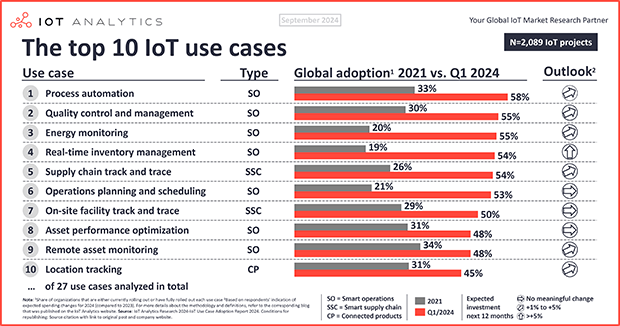
IoT Analytics has released the top ten IoT use cases, with process automation ranking first.
-
- *
Why This Matters?
-
For IoT Suppliers: The success and increased adoption rates of IoT projects can help suppliers understand which use cases end-users are adopting, allowing them to adjust their products and services accordingly.
-
For IoT Adopters: Adoption of IoT use cases often shows ROI within two years. IoT can assist adopters in optimizing operations and supporting digital transformation.
-
- *
Status of IoT Projects in 2024: More Successful Than Ever
Over 90% of IoT use cases have achieved positive ROI. For years, IoT Analytics could not verify the common claim that many IoT projects fail. According to the 418-page IoT Use Case Adoption Report 2024, published in July 2024 and based on a survey of 200 IoT use case end-users, analyzing 27 IoT use cases, 91.7% of organizations have seen ROI from their adopted IoT use cases, an increase of 13 percentage points compared to similar research conducted in 2021. Additionally, the number of adopted IoT use cases by organizations increased by 53%, indicating a healthy state for IoT (see The Summer State of IoT Report 2024).
Simplification in IoT Project Complexity. In 2021, many respondents in similar IoT use case surveys pointed out the complexity of IoT projects and their technology, which required significant effort. However, this year’s report shows a decrease in perceived complexity, driving growth in adoption and ROI.
Increase in Investment for IoT Use Cases. In 2024, investment in IoT use cases by enterprises continues to grow but at a slower pace compared to previous years.
Top Ten IoT Use Cases
-
Process Automation: The top-ranked use case with an adoption rate of over 56%. This application involves using IoT technology for real-time monitoring and control, which is crucial in manufacturing and industrial settings.
-
Real-Time Inventory Management: Leading the smart supply chain category with a 54% adoption rate. Companies are increasingly adopting this use case to prevent shortages or excess inventory due to post-pandemic supply chain issues and economic uncertainty.
-
Supply Chain Tracking & Traceability: With an adoption rate of 54%, this application uses IoT technology to monitor the location, status, and condition of products and materials throughout the supply chain. It offers real-time visibility into logistics operations and helps companies reduce losses and improve delivery accuracy.
-
Energy Monitoring: The adoption rate has increased from 20% in 2021 to 55%, making it one of the fastest-growing IoT use cases due to new sustainability strategies and high electricity prices, especially in Europe. This application helps companies closely monitor energy consumption at individual asset levels.
-
Work Scheduling & Planning: Energy companies are expected to increase investment in this area by 5.5% on average. By integrating IoT technology with planning systems, organizations can dynamically adjust schedules based on real-time production status, equipment availability, and workforce capabilities.
-
In-Facility Tracking & Traceability: This application uses IoT to track assets in real time within facilities such as factories or warehouses. The wholesale and retail sectors are expected to lead investment growth in this area.
Source Website: IoT Analytics