Rethink Robotics Reenters Boston with Redesigned Collaborative Robots and New Mobile Robots/Arms
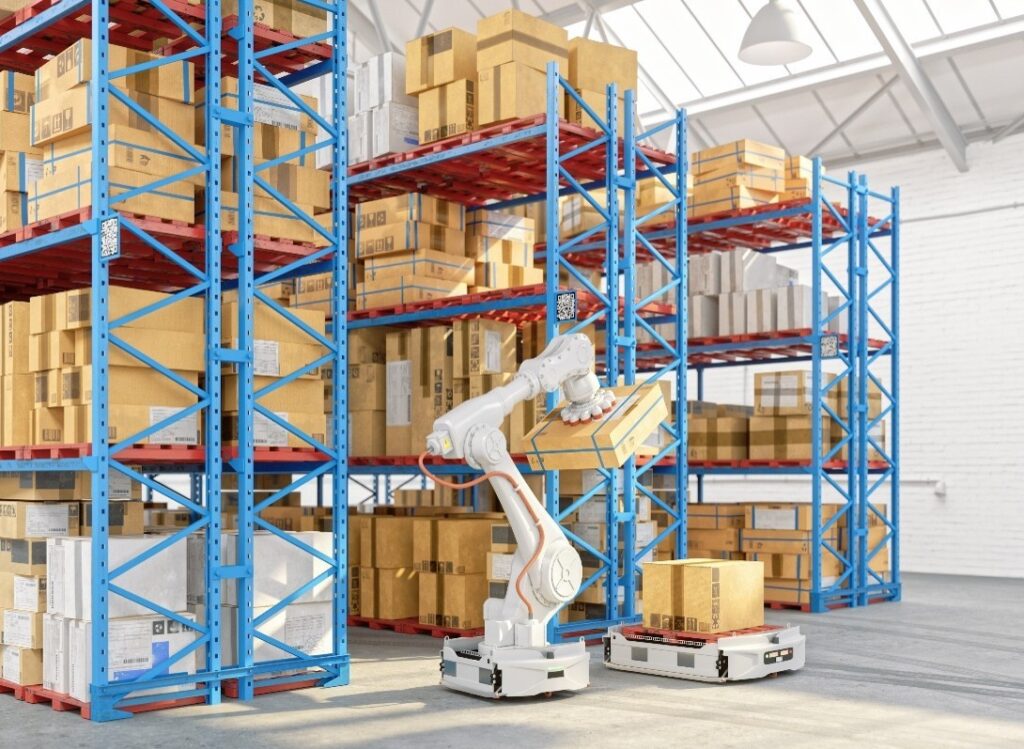
The new Reacher collaborative robot arm from Rethink Robotics. | Image Source: Rethink Robotics
Rethink Robotics is returning to Boston with a new lineup of collaborative robot arms, autonomous mobile robots (AMRs), and mobile manipulators. The company began developing collaborative robots in Boston as early as 2008 but later had to restructure its product line and find a new owner.
Rethink Robotics raised $150 million and developed the well-known Baxter and Sawyer collaborative robots, but it closed down in 2018. The series of elastic actuators that Rethink introduced from MIT caused issues with precision in the collaborative robots.
Less than a month after its closure, German automation and robotics expert HAHN Group acquired the intellectual property and trademarks for Sawyer and Intera software. HAHN redesigned Sawyer but still struggled to gain market recognition in industrial applications.
Boston is My Home
Rethink Robotics is now part of United Robotics Group under the HAHN Group. The company hopes to restart its operations in Boston, one of the world’s leading robotics clusters, and regain a foothold in the industry. Rethink currently has only an office at MassRobotics but aims to change this situation soon.
The US-based company told The Robot Report that it is looking for office space and hopes to form a team within 3 to 6 months.
“When we started Rethink Robotics, we considered Atlanta, Chicago, and Detroit,” said Julia Astrid Riemenschneider, Vice President of International Business Development for Industrial Robots at United Robotics Group. “But everyone knows that Rethink Robotics is based in Boston.”
Since the closure of Rethink Robotics in 2018, collaborative robots have made significant progress. Universal Robots (UR), which also has an office in Boston and is owned by Massachusetts-based Teradyne, remains a market leader.
However, large robotics companies such as ABB, FANUC, and KUKA have also improved their respective collaborative robot offerings. Force-limited and power-limited robots are now stronger with larger working ranges and more intuitive user interfaces among other improvements.
Rivaling these enterprises will be a significant challenge for Rethink Robotics or any new entrant in the collaborative robotics market. Riemenschneider stated that competing with UR was not the deciding factor for setting up operations in Boston.
“For industrial applications, Sawyer had issues with repeatability and accuracy and made this strange noise,” she acknowledged. “It wasn’t robust enough for most industrial applications. But our new slogan is ‘Better, Faster, Stronger.’ Rethink Robotics is now ready for the industry.”
Rethink Launches New Collaborative Robots
In Rethink Robotics’ new Reacher collaborative robot arm lineup, you won’t see any trace of Baxter and Sawyer. The new product line includes seven models — RE 07, 09, 13, 16, 21, 30, and 30L — capable of handling payloads from 7 to 30 kg.
Each collaborative robot has an IP65 protection rating for use in wet and dusty environments and a pose repeatability of ±0.03 mm. According to the model, Rethink Robotics claims a maximum speed range of 120 to 200 degrees per second.
The Reacher collaborative robots feature collision detection and are compatible with various accessories such as grippers, vision systems, tracks, and other end-effectors and peripheral tools.
Rethink states that its new collaborative robots are suitable for a variety of applications including assembly, machine tending, material handling, palletizing, welding, quality inspection, etc. Please refer to the table below for a quick overview of Rethink Robotics’ new Reacher series:

Image Source: Rethink Robotics
AMRs as Part of the New Product Lineup
Rethink Robotics has launched its first autonomous mobile robot (AMR). The new Rethink Ryder series includes a lightweight MRE 550 AMR capable of handling up to 550 kg payloads and a heavy-duty MRE 1400 AMR capable of handling up to 1400 kg payloads.
The company states that both AMRs come with integrated lifting capabilities.
Rethink adds that both AMRs use multiple sensing modes for real-time 360-degree environment views. The AMRs utilize simultaneous localization and mapping (SLAM) for environmental visualization, dynamic obstacle avoidance, and path planning.
Furthermore, Rethink notes that low-level controllers and sensor data can be accessed through an open architecture software compatible with third-party applications.

The Rethink Robotics Ryder AMR platform.
Riser Mobile Manipulator Combines Multiple Products
Rethink Robotics has also launched its Riser mobile manipulator system. The system combines the Ryder AMR, Reacher collaborative robot arm, and a portable battery pack. The company told The Robot Report that the innovation lies in easily removing and reinstalling the robotic arm from the AMR.
Rethink states that when we spoke with them last week, they would send us an operation video, but we are still waiting for it.
The company notes that each collaborative robot arm and AMR has its own dedicated battery pack requiring separate charging. Rethink claims Reacher has a 22-hour runtime, while the Ryder AMR can be charged manually or via induction. Each Ryder is equipped with three or four battery units depending on its size.
The control box that comes with the Reacher is a compact and integrated unit designed for managing and controlling robot operations. The control box includes necessary electronics such as the robot’s processor, power supply, and communication interfaces. It serves as the central hub for executing commands, processing sensor data, and coordinating robotic movements.

The Rethink Robotics Riser mobile manipulator.
About the Author

Steve Crowe
Steve Crowe is the Executive Editor for Robotics at WTWH Media, responsible for robotics and serves as Chair of Robotics Summit & Expo and RoboBusiness. He also co-hosts The Robot Report Podcast, one of the highest-rated podcasts in the robotics industry. Steve joined WTWH Media in January 2018 after serving as Editor-in-Chief at Robotics Trends Media for over four years. His contact is scrowe@wtwhmedia.com.
Source: The Robot Report