Skip to content

Road & Rail · Supply Chain · Warehousing & Transport

ATA’s “2024 U.S. Trucking Trends” Provides a Detailed Overview of Key Industry Metrics

Describing the Trucking Market: Insights from ATA's "2024 U.S. Trucking Trends" Report

Original source: Source information pending

ATA’s “2024 U.S. Trucking Trends” Provides a Detailed Overview of Key Industry Metrics

Ask SCI.AI about this story

📋 本文要点

Describing the Trucking Market: Insights from ATA's "2024 U.S. Trucking Trends" Report

ATA Releases Overview of Key Industry Benchmarks in the “2024 U.S. Trucking Trends Report”

Author: Jeff Berman
Publication Date: September 13, 2024

Words like “disheartening” or “challenging” often describe the state of the trucking market. However, a better example can be found in this year’s annual “2024 U.S. Trucking Trends Report,” released by the American Trucking Associations (ATA) this week.

This “Trends” report is essentially ATA’s annual compilation of data on the trucking industry. ATA officials believe that this publication serves as an indispensable reference for freight companies, industry suppliers, logistics service providers, analysts, and policymakers.

The current version delves into the performance of the industry in 2023, with Bob Costello, ATA’s chief economist, noting that “challenging” was a key word for 2023.

“This year’s report shows that 2023 was an extremely challenging year, but the industry stood firm and transported over 1.1 billion tons of freight throughout the year,” he said.

The report indicates that based on preliminary data, trucks hauled 1.18 billion tons in 2023, slightly below the 1.146 billion tons moved in 2022 but still surpassing it. In terms of revenue, ATA reported that the industry’s income reached $987 billion in 2023, up from $940.8 billion in 2022.

In terms of workforce, there were a total of 8.5 million people employed in the trucking industry in 2023, including 3.55 million drivers. Additionally, 95.5% of operators owned ten or fewer trucks, and 96.6% had less than 100 power units.

In cross-border trade, the report notes that trucks transported 66.5% of U.S.-Canada land trade goods in 2023, as well as 84.5% of freight crossing the Mexican border.

As always, ATA’s annual “U.S. Trucking Trends” publication excels in providing deep insights into key industry aspects. The data mentioned here is just a part of what the complete publication offers for further exploration.

For more information on the “2024 U.S. Trucking Trends Report,” please visit ATA’s official website.

About the Author

Jeff Berman's Avatar

Jeff Berman

Jeff Berman is the Group News Editor for Logistics Management, Modern Materials Handling, and Supply Chain Management Review, and a contributor to Robotics 24/7. Jeff works and resides in Cape Elizabeth, Maine, covering all aspects of supply chain management, logistics, freight transportation, and material handling daily.


Source Website: Logistics Management
Ask SCI.AI Finished reading? Continue with SCI.AI. Explore the related policy, route, company and historical context. Continue asking
Stay ahead of supply chain shifts

One email a week: the stories that matter and new risk events — in English, free.

Prefer RSS? Articles Risk events

Xeneta: Asia-US West Coast spot rates jump 343% on Iran war
Warehousing & Transport

Xeneta: Asia-US West Coast spot rates jump 343% on Iran war

Asia-U.S. West Coast container spot rates were 343% above their February 28 level in October, just 14% below the pandemic-era record, according to freight-rate intelligence provider Xeneta. The company forecasts a 5% decline in long-term contract rates for 2027, with the global container fleet expected to grow 6.8% while demand rises between 2.5% and 4%. Xeneta chief analyst Peter Sand traces the volatility to the Red Sea conflict in 2024, U.S. tariffs in 2025 and the Strait of Hormuz closure in 2026, and warns that fuel costs and route disruptions could still upend the outlook.

AI hardware demand lifts air cargo rates 30% year over year
Warehousing & Transport

AI hardware demand lifts air cargo rates 30% year over year

Air cargo rates are up 30% year over year and volumes have grown about 6%, according to FreightWaves, as surging AI equipment demand offsets slower e-commerce and automotive flows. The strength has defied forecasts of a 2025 softening after a down 2024. Meanwhile, Walmart is deploying Wing and Zipline drones across nearly 300 stores; Zipline raised $1.5 billion and Wing plans a $125 million Texas factory ahead of anticipated FAA beyond-line-of-sight rules.

Truckload rejections hold at 12.8% as peak season stalls
Risk & Resilience

Truckload rejections hold at 12.8% as peak season stalls

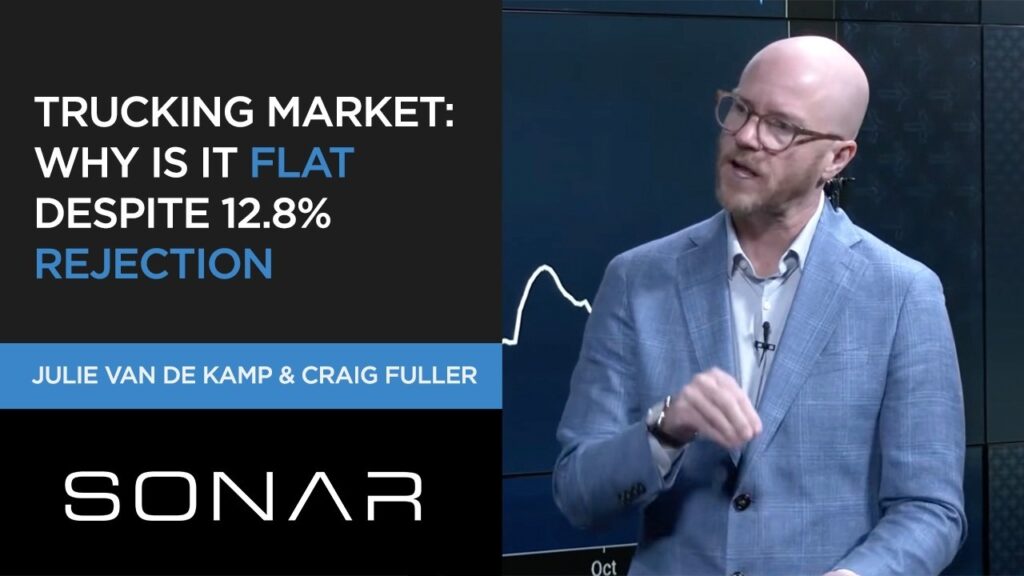
Truckload tender rejections are holding near 12.8%, roughly double the 6% recorded a year earlier, yet FreightWaves analysts Julie Van de Kamp and Craig Fuller say the market shows little of the tightening momentum normally seen ahead of peak season. The rejection index has slipped only about one percentage point in 20 days, even as November's Outbound Tender Volume Index averages 11,434, up 12% year over year and 3% from October. Refrigerated freight is the exception, with reefer rejections at 21% versus 12.6% last year, and a super El Niño could add further pressure on reefer capacity this winter.

Welcome Back!

Login to your account below

Create New Account!

Fill the forms below to register

Retrieve your password

Please enter your username or email address to reset your password.

Scan to share via WeChat

Open WeChat and scan the QR code to share

QR Code

Add New Playlist