Skip to content

Ocean · Supply Chain · Warehousing & Transport

Hurricane Helen: FedEx, UPS, and USPS Still Affected

Carrier Delays Persist a Week After Storm Strikes

Original source: Source information pending

Hurricane Helen: FedEx, UPS, and USPS Still Affected

Ask SCI.AI about this story

📋 本文要点

Carrier Delays Persist a Week After Storm Strikes

# Hurricane Helene: FedEx, UPS, and USPS Operations Still Disrupted

A week after landfall, parcel carriers are still reporting delivery delays.

Published on October 4, 2024

By Max Garland, Senior Reporter

Hurricane Helene’s devastation has led to prolonged delays and disruptions in delivery services for FedEx, UPS, and the United States Postal Service (USPS) across the Southeast, particularly in North Carolina.

The tropical storm resulted in over 200 fatalities and destroyed roads while damaging infrastructure in numerous communities within the region.

For parcel carriers, Helene-related delays first emerged in Florida before the storm moved northward along a destructive path. A week after landfall, disruptions to delivery operations are still ongoing.

According to information on the company’s website Friday morning, FedEx’s express and ground deliveries have limited or suspended services in nearly 600 ZIP code areas across North Carolina, South Carolina, Georgia, and Tennessee. The company’s freight operations also face limited or halted service in over 300 ZIP codes within these states.

UPS has warned that delivery delays may occur in two specific ZIP codes (28720 and 28746) in North Carolina, down from the 69 affected ZIP codes reported earlier in the week.

“Despite UPS facilities providing pickup and delivery services where conditions permit, some delays are expected,” the company stated.

UPS and FedEx service guarantees do not apply to delays caused by weather events such as Hurricane Helene.

USPS announced earlier this week that all deliveries and retail operations have been suspended for ZIP codes 286, 287, 288, and 289 in North Carolina due to the impact of Hurricane Helene. Additionally, 39 postal service facilities within the state will not accept any mail due to operational suspensions.

“We will reopen as soon as conditions are safe,” the agency said.

#### Multiple USPS Facilities Affected by Hurricane Helene

Mail acceptance at the following locations is suspended until further notice.

—

Source: Supply Chain Dive
Ask SCI.AI Finished reading? Continue with SCI.AI. Explore the related policy, route, company and historical context. Continue asking
Stay ahead of supply chain shifts

One email a week: the stories that matter and new risk events — in English, free.

Prefer RSS? Articles Risk events

Xeneta: Asia-US West Coast spot rates jump 343% on Iran war
Warehousing & Transport

Xeneta: Asia-US West Coast spot rates jump 343% on Iran war

Asia-U.S. West Coast container spot rates were 343% above their February 28 level in October, just 14% below the pandemic-era record, according to freight-rate intelligence provider Xeneta. The company forecasts a 5% decline in long-term contract rates for 2027, with the global container fleet expected to grow 6.8% while demand rises between 2.5% and 4%. Xeneta chief analyst Peter Sand traces the volatility to the Red Sea conflict in 2024, U.S. tariffs in 2025 and the Strait of Hormuz closure in 2026, and warns that fuel costs and route disruptions could still upend the outlook.

AI hardware demand lifts air cargo rates 30% year over year
Warehousing & Transport

AI hardware demand lifts air cargo rates 30% year over year

Air cargo rates are up 30% year over year and volumes have grown about 6%, according to FreightWaves, as surging AI equipment demand offsets slower e-commerce and automotive flows. The strength has defied forecasts of a 2025 softening after a down 2024. Meanwhile, Walmart is deploying Wing and Zipline drones across nearly 300 stores; Zipline raised $1.5 billion and Wing plans a $125 million Texas factory ahead of anticipated FAA beyond-line-of-sight rules.

Truckload rejections hold at 12.8% as peak season stalls
Risk & Resilience

Truckload rejections hold at 12.8% as peak season stalls

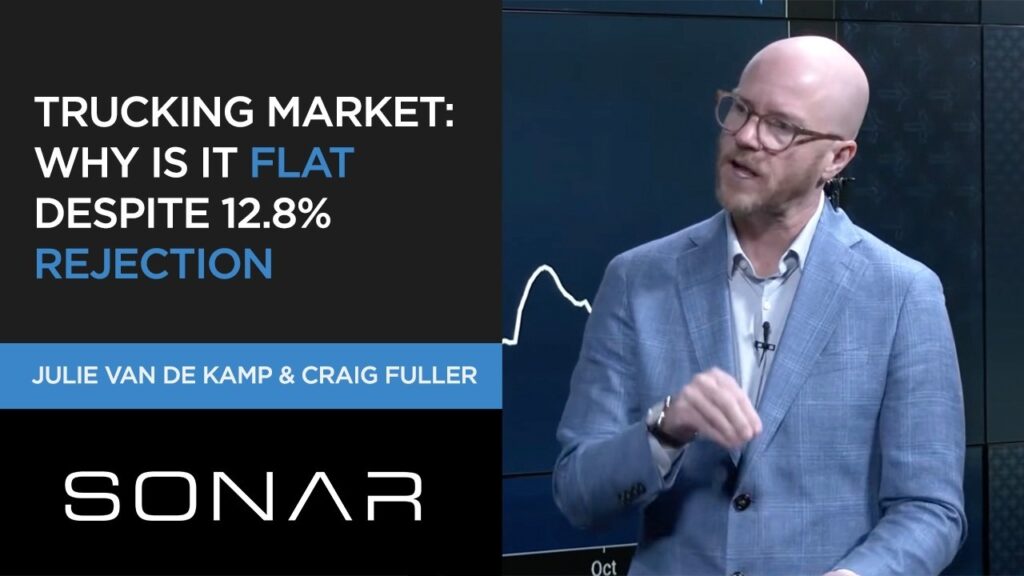
Truckload tender rejections are holding near 12.8%, roughly double the 6% recorded a year earlier, yet FreightWaves analysts Julie Van de Kamp and Craig Fuller say the market shows little of the tightening momentum normally seen ahead of peak season. The rejection index has slipped only about one percentage point in 20 days, even as November's Outbound Tender Volume Index averages 11,434, up 12% year over year and 3% from October. Refrigerated freight is the exception, with reefer rejections at 21% versus 12.6% last year, and a super El Niño could add further pressure on reefer capacity this winter.

Welcome Back!

Login to your account below

Create New Account!

Fill the forms below to register

Retrieve your password

Please enter your username or email address to reset your password.

Scan to share via WeChat

Open WeChat and scan the QR code to share

QR Code

Add New Playlist