Amazon’s Large-Scale Robot Rollout: A Major Labor Experiment
=====================================================================
By Jason Del Rey

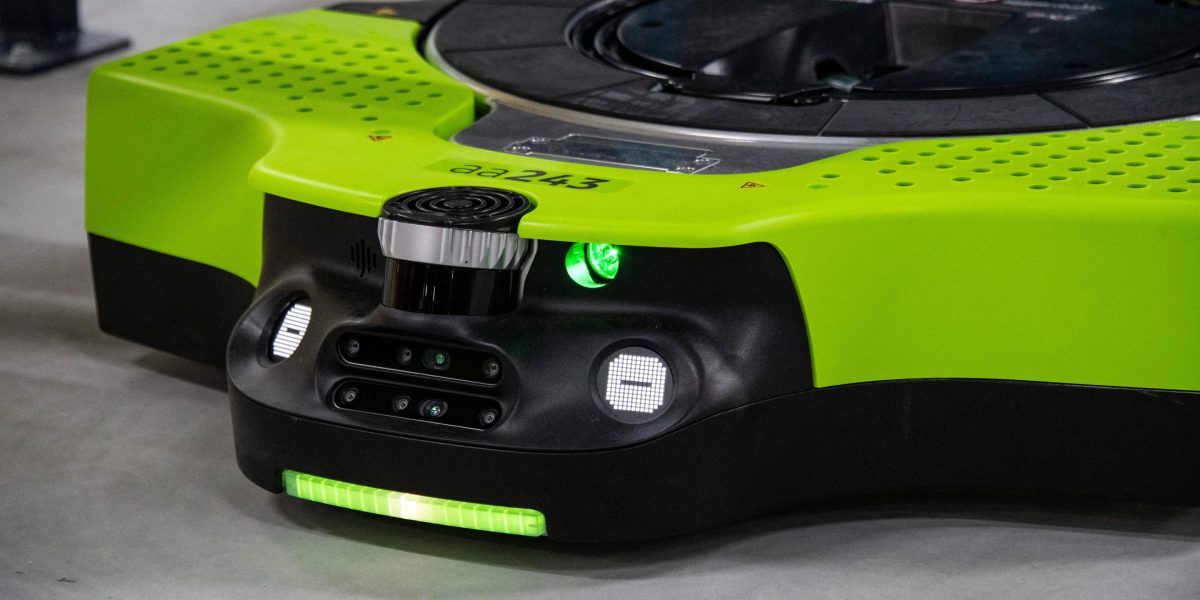
An Amazon “Proteus” robot.
Before our team visited one of Amazon’s new robot-driven warehouses, we were reminded that artificial intelligence would play a significant role: due to a malfunctioning robot, staff were making repairs and our visit was delayed. Eventually, human problem-solving skills prevailed. Journalists and over ten other visitors entered the MQY1 warehouse in Mt. Juliet, Tennessee – Amazon’s second-largest logistics facility globally, spanning 36 million square feet. However, what Amazon showcased that day wasn’t just the vastness of the warehouse but how hundreds of robots were enhancing operations by lifting, moving, and sorting goods, each with unique names.
From Pegasus and Proteus to Cardinal and Robin, these robots appear as large mechanical pucks or robust robotic arms. Some mobile units transport individual packages while others carry cages filled with dozens of orders – all for delivery to the rear docks. Many robots can operate autonomously without needing isolation from humans to ensure safety; they slow down when encountering workers or curious visitors.
This visit coincided with a surge in demand for industrial robots, partly driven by the rise of artificial intelligence and support from notable billionaires. On Thursday evening, Elon Musk unveiled the latest prototype of Tesla’s humanoid robot Optimus, wearing cowboy hats, serving drinks, playing games, and interacting with crowds at a Hollywood event. However, Musk’s Optimus is still far from commercial release. While Amazon has tested humanoids made by Agility Robotics and invested in the startup, the robots currently deployed in its facilities resemble efficient utility devices rather than glamorous sci-fi butlers. Notably, autonomous mobile robots resembling large pucks are equipped with small “eyes” to “look” at workers, a feature added based on employee feedback who were unsure if the robots detected their presence when approaching.

Tesla’s humanoid robot Optimus is still under development
In a cordoned-off area, massive yellow “Robin” robots with elephant-trunk-like mechanical arms suctioned envelope-sized packages one by one from below. After grabbing each order, Robin places it on top of multiple large Roomba-like devices – the Pegasus units. Each loaded Pegasus then swiftly heads to the outbound docks where human workers load orders onto trucks.
The Mt. Juliet warehouse is Amazon’s 11th generation logistics center and not even the most recent. The first 12th-generation facility, SHV1, launched this month in Shreveport, Louisiana, marking the first time eight different robot systems work together in a single building.
One of these, named Sequoia, is a multi-story structure capable of storing 30 million items, thanks to thousands of mobile robots that can instantly retrieve goods from its vast inventory. Another AI-driven robotic arm called Sparrow operates within SHV1, demonstrating human-like flexibility when handling over two billion different items.
Amazon executive Udit Madan told journalists last week: “The most exciting part is we’re just getting started.”
Since acquiring robotics startup Kiva in 2012, Amazon has become “one of the world’s largest collaborative robot deployments,” added Madan. Today, more than 75% of Amazon’s customer orders come from robot-driven facilities. In this process, Amazon has quietly transformed into “the world’s largest industrial robot manufacturer and operator,” according to the executive.
From one perspective, we may be witnessing history’s most extensive experiment in human-robot collaboration. The only question is whether, like any experiment, the full results are still unknown. But its significance lies in ultimately determining how future physical work will be executed.
Human-Machine Collaboration?
—————————————
Currently, Amazon, one of the world’s most influential and important employers with over 1.5 million employees, acknowledges that jobs are changing. Yes, some human tasks might become automated. However, new positions are also being created. During a visit, journalists witnessed an employee using a joystick to control a malfunctioning puck-like robot.
The tasks taken over by robots, such as handling the heaviest items and performing repetitive work – these are precisely some of the most strenuous jobs.
Amazon’s robotics director Tye Brady told Fortune that “the myth” of human-machine competition is just that. He also dismissed the fantasy of Amazon operating “dark warehouses” where only robots work without any other presence.
“That’s not my goal at all,” Brady said. “Far from it.”
“We build machines to extend human capabilities.” he added.

The commercial reasons for increasing automation to replace some human tasks are clear – such as a 25% increase in order processing speed and a 25% reduction in customer service costs, without dealing with personal issues or bad moods. However, Amazon also promises a safer work environment, which it claims is being realized: according to the company, injury rates in robot warehouses were 8.5% lower than non-automated facilities in 2023.
Amazon says that the Sequoia system is more ergonomically friendly for employees, delivering items between their mid-thigh and chest level, reducing strain from bending or reaching up high. The Sparrow robotic arm outperforms a 50-year-old’s rotator cuff when handling repetitive tasks.
It remains to be seen whether new robots like Sequoia and Sparrow will deliver the benefits Amazon claims as clearly as described. Similarly, it is yet unknown what unforeseen compromises may accompany such changes.
Four years ago, investigative reports suggested that Amazon’s robot facilities actually led to higher injury rates. Amazon refuted these claims, stating that its record-keeping of accidents was more proactive than competitors and later claimed the comparison group differed from those being compared.
Undeniably, some robots introduced in earlier stages created new challenges for employees. The initial Kiva robots transported portable shelves filled with goods to workstations, reducing the need for workers to walk 10 to 20 miles across warehouses to retrieve items. Some disliked that part of their job and welcomed the change.
However, once freed from walking across the warehouse, the company required these workers to remove more items per hour from robot-delivered shelves. Increased repetitive motions, especially when improperly executed, could lead to muscle strains or other injuries.
Regardless of internal recognition levels, Jeff Bezos saw enough in his 2021 [last CEO letter to shareholders](https://www.aboutamazon.com/news/company-news/2020-letter-to-shareholders) to commit Amazon to a “better vision” for employee success.
Three years later, Amazon hopes the world – and investors – will believe that more robots, collaborating with each other and human colleagues, will create a better Amazon for its customers and employees.
This is an important moment in the history of modern industrial work. So many people’s lives are intertwined with it.
—
Source: Fortune