According to Robotics & Automation News, Path Robotics has raised $300 million in Series E financing at a post-money valuation of $2.45 billion, with the round led by AI-focused growth equity firm Georgian.
The Cleveland-based developer of physical AI for manufacturing said existing investors Addition, Drive Capital, IronArc Ventures, Tiger Global, Yamaha Motor Ventures and its affiliates joined the round, alongside new backers D. E. Shaw Ventures and NAVER Ventures. Emily Walsh, a partner at Georgian, will join Path Robotics’ board of directors.
The raise follows sharp commercial momentum: annual recurring revenue grew 17-fold over the past 18 months as the company scaled deployments with major industrial customers across North America, according to the announcement.
Capital to widen physical AI beyond welding
Path Robotics said the new capital will accelerate deployment of its physical AI platform across industries tied to US industrial capacity, support expansion beyond welding into new manufacturing tasks and robotic form factors, and fund heavier investment in AI model training.
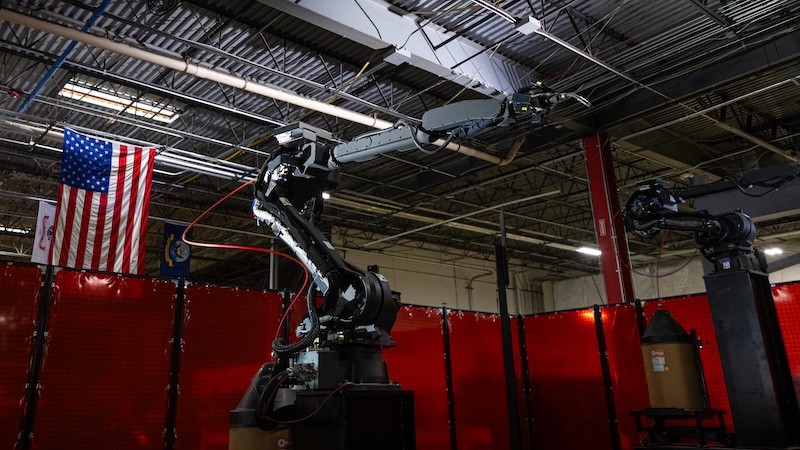
The company entered the market through welding, which it describes as one of the hardest factory tasks to automate. Its physical AI welding model, Obsidian, uses real-world welding data so robots can identify weld joints, plan and execute welds, and adapt to changing conditions on the floor.
Path has since extended the same models to new hardware. It recently introduced Rove, a mobile welding system that places Obsidian’s capabilities on a quadruped robotic platform — evidence, the company says, that its models can operate across different robotic form factors.
“We started with welding because it is one of the hardest jobs on the factory floor to automate, and we’ve proven that our technology can succeed in real production environments.” — Andy Lonsberry, CEO and co-founder, Path Robotics
Lonsberry added that demand is accelerating from manufacturers that need more production capacity but cannot reach it with traditional automation, and that the funding lets the company scale welding alongside customers while investing in the data, compute and model development needed for tasks before and after welding. “Our goal isn’t to automate one step, but to automate the entire factory,” he said.
Customer base spans defense, shipbuilding and energy
Path Robotics said manufacturers in shipbuilding and defense, heavy equipment, and energy infrastructure are turning to physical AI to overcome production constraints. Its customer roster includes large US manufacturers such as HII, Lockheed Martin and Saronic, plus mid-sized firms including EK Machine, Millerbernd Manufacturing Company, TransAmerican Power Products and TYCROP.
Earlier this year, Path announced a $600 million performance-based production agreement with HII to accelerate deployment of physical AI across US Navy shipbuilding programs.
To meet demand, Path Robotics has expanded its workforce by 97 percent year-over-year and plans to reach 400 employees by year-end, the company said.
“As demand for critical defense systems continues to grow, scaling production requires innovative approaches.” — Chris Moran, vice president and general manager, Lockheed Martin Ventures
Moran said the work with Path advances manufacturing solutions that can help expand capacity, calling the investment an important milestone for Path and the broader industry.
“By partnering with leading physical AI technologies, like Path Robotics, HII will continue to grow the maritime industrial base and advance adaptive automation solutions in the shipbuilding fabrication processes that support increased throughput and acceleration of production.” — Eric Chewning, executive vice president of maritime systems and corporate strategy, HII
Investor bet on data and model advantage
Georgian’s Walsh said Path is well positioned to become one of the defining companies in industrial physical AI, pointing to proprietary models and a growing base of real-world production data that improve with each deployment.
“The team has built a strong foundation in welding, and we see enormous potential for Path Robotics to extend that intelligence to new manufacturing applications and industries.” — Emily Walsh, partner, Georgian
The company argues that traditional industrial robots, which rely on rigid programming and predetermined paths, limit what manufacturers can do with complex, variable tasks. Path’s models are designed to let robots perceive their environment, reason and adapt actions in real time — a capability the company is now pushing into new form factors, with the fresh capital earmarked for compute and model training.
Source: Robotics & Automation News
Compiled from international media by the SCI.AI editorial team.