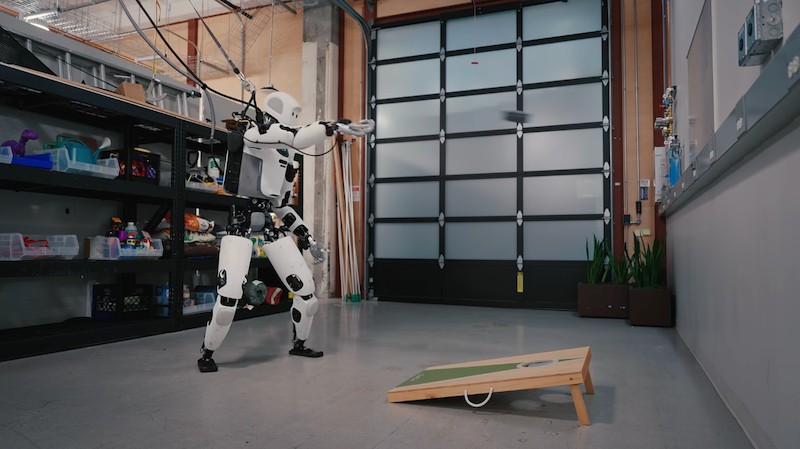
Google DeepMind has shown that its Gemini 4 Argon model can learn a physical task from raw video and transfer it to Apptronik's Apollo humanoid, which then landed seven consecutive cornhole shots in a real-world trial. The company calls the method a Video-to-Sim-to-Real pipeline and says it compresses weeks of manual simulation modeling into a few hours. Argon also scored 87 percent on Google's ERQA embodied reasoning benchmark, and the model is now available through Google's AI products and the Gemini API.
According to Robotics & Automation News, Google DeepMind has demonstrated a robotics training technique in which its Gemini 4 Argon AI model watches raw video of a physical task and transfers the learned behavior to Apptronik‘s Apollo humanoid robot, part of the launch of Google’s latest frontier model.
The demonstration was published on October 22, 2026 and centers on a single task: cornhole. Argon was shown unedited footage of a person throwing beanbags, then analyzed the environment, mapped spatial coordinates and calculated the whole-body joint movements the task requires.
From that input the model autonomously generated simulation code, and the resulting behavior was transferred to the Apollo humanoid for a real-world trial. Google DeepMind says the robot then landed seven consecutive shots.
A pipeline that compresses weeks into hours
Google DeepMind describes the method as a “Video-to-Sim-to-Real” pipeline and says it can compress a robotics simulation process that would ordinarily require weeks of manual work into a few hours. The claim is the central efficiency argument behind the demonstration.
“This ‘Video-to-Sim-to-Real’ pipeline compresses weeks of manual simulation modeling into a few hours, transforming ordinary videos into a scalable, infinite training ground for robotics.” — Google DeepMind
The company frames the work as evidence that general-purpose AI models could cut the volume of manual engineering needed to teach robots new physical skills. In the cornhole test, the model handled environment analysis, spatial mapping, joint-movement calculation and code generation before any hardware was involved.
Argon scores 87 percent on embodied reasoning benchmark
Google DeepMind also tested Argon on its Embodied Reasoning benchmark, known as ERQA, which measures a model’s ability to reason about physical and spatial problems in 3D environments. According to the company, Argon achieved a score of 87 percent.
The benchmark result and the cornhole trial address different capabilities: ERQA tests reasoning about physical and spatial problems, while the Apollo demonstration required the model to convert visual understanding into executable simulation code and then into robot motion.
Google positions Gemini 4 Argon more broadly for complex engineering, scientific, coding and business tasks, and says it has already applied the model to projects spanning large software codebases, quantum computing, nuclear fusion and life-sciences research.
Availability through Gemini API and Google products
Gemini 4 Argon is now being made available through Google’s AI products and the Gemini API. Google presents the robotics work as part of a wider effort to apply advanced AI reasoning to physical systems.
The Apptronik demonstration follows earlier collaboration between the two organizations, including a partnership announced in 2024 to accelerate humanoid robot development and the 2026 launch of Gemini Robotics 2, demonstrated on Apptronik’s Apollo 2 humanoid with whole-body autonomous control.
Google DeepMind’s stated aim for the pipeline is to turn ordinary video into a scalable training source for robots, reducing reliance on hand-built simulation models for each new physical skill.
Source: Robotics & Automation News
Compiled from international media by the SCI.AI editorial team.