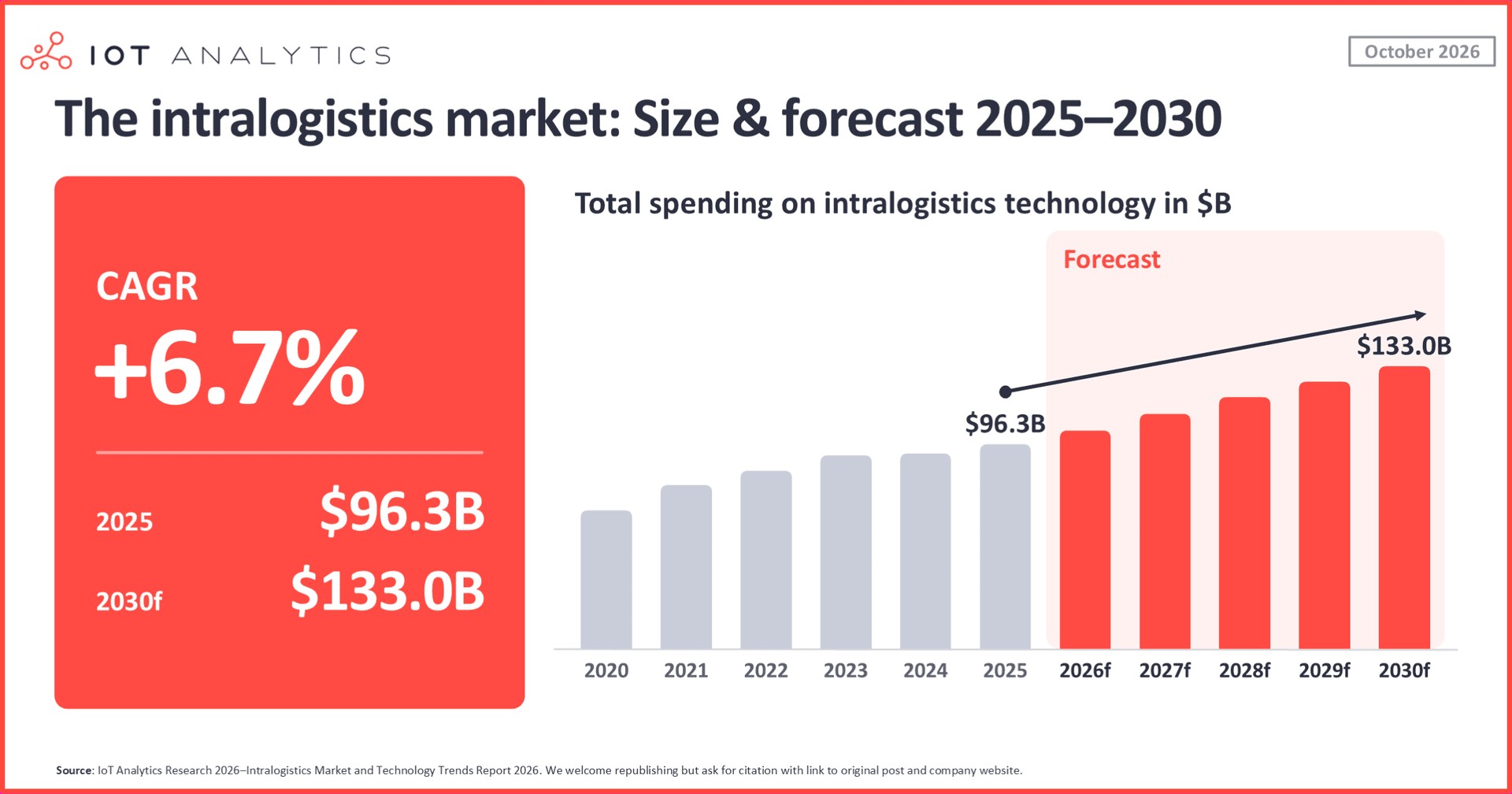
The intralogistics market hit $96 billion in 2025 and is forecast to reach $133 billion by 2030, growing at a 6.7% CAGR, according to IoT Analytics’ 2026 report. Software will surge to $10.8 billion by 2030 (11.4% CAGR), while mobile robot spending doubles to $8.4 billion. Labor shortages—driving 200–300% annual turnover—and safety concerns, including workers walking over 10 km daily, are key automation catalysts. Three trends include AI agents for control tasks, vendor-agnostic orchestration layers, and integrated AMMRs.
According to iot-analytics.com, the global intralogistics market reached $96 billion in 2025 and is projected to grow at a 6.7% compound annual growth rate (CAGR) to $133 billion by 2030, per its 97-page Intralogistics Market and Technology Trends Report 2026, published in October 2026.
Market Composition and Growth Engines
The intralogistics market encompasses hardware, software, connectivity infrastructure, and services used to move, store, identify, control, and optimize goods within a facility. It excludes inter-site transport. IoT Analytics segments it into six categories: mobile material handling systems (45% of total market), fixed material handling systems, identification and sensing hardware, software, controls and connectivity, and integration and consulting services.
Software emerged as the fastest-growing segment, valued at $6.3 billion in 2025 and forecast to expand at an 11.4% CAGR to $10.8 billion by 2030. Mobile robots—including autonomous mobile robots (AMRs) and automated guided vehicles (AGVs)—are set to nearly double spending from $4.3 billion in 2025 to $8.4 billion in 2030, representing a 14% CAGR—outpacing the broader mobile material handling segment’s 5.7% CAGR.
Five Key Market Drivers
Labor shortages top the list of five persistent drivers accelerating automation. Warehouses with labor-intensive picking operations report annual staff turnover of 200–300%. As Mattias Allring, Director Strategic Innovation at Toyota, stated in March 2026:
“When we talk to our customers about what keeps them awake at night, the one theme that keeps coming up again and again is a lack of skilled workers… The outflow into retirement is accelerating while at the same time the inflow from kids to working age is diminishing.” — Mattias Allring, Director Strategic Innovation, Toyota
Flexibility needs are rising due to tariffs and supply chain disruptions, prompting operators to favor modular automation over rigid projects costing more than $20 million. Cost pressures—including high interest rates—are driving vertical expansion in existing facilities. Speed requirements—especially same-day or next-day fulfillment across tens of thousands of SKUs—make goods-to-person systems and automated storage and retrieval systems (AS/RS) essential. Safety concerns also drive adoption: warehouse workers walk more than 10 km daily while lifting heavy cases, increasing injury risk.
Emerging Technology Trends
IoT Analytics highlights three of 23 identified technology trends: first, AI agents assuming recurring control-desk tasks; second, vendor-agnostic orchestration layers emerging between warehouse management systems (WMS) and automation hardware; and third, autonomous mobile material handling robots (AMMRs) integrating both transport and handling capabilities.
These trends reflect structural shifts in vendor strategy. For instance, Skild AI acquired Zebra Technologies’ robotics automation business—including Symmetry Fulfillment software and AMRs—in April 2026. Meanwhile, Chinese OEMs like HELI and Hikrobot are entering Western markets by adapting products to local regulations, adding certified European safety laser scanners, and competing on technology—not just price. Western vendors such as Locus Robotics and Cognex emphasize software orchestration to differentiate themselves.
Source: iot-analytics.com
Compiled from international media by the SCI.AI editorial team.