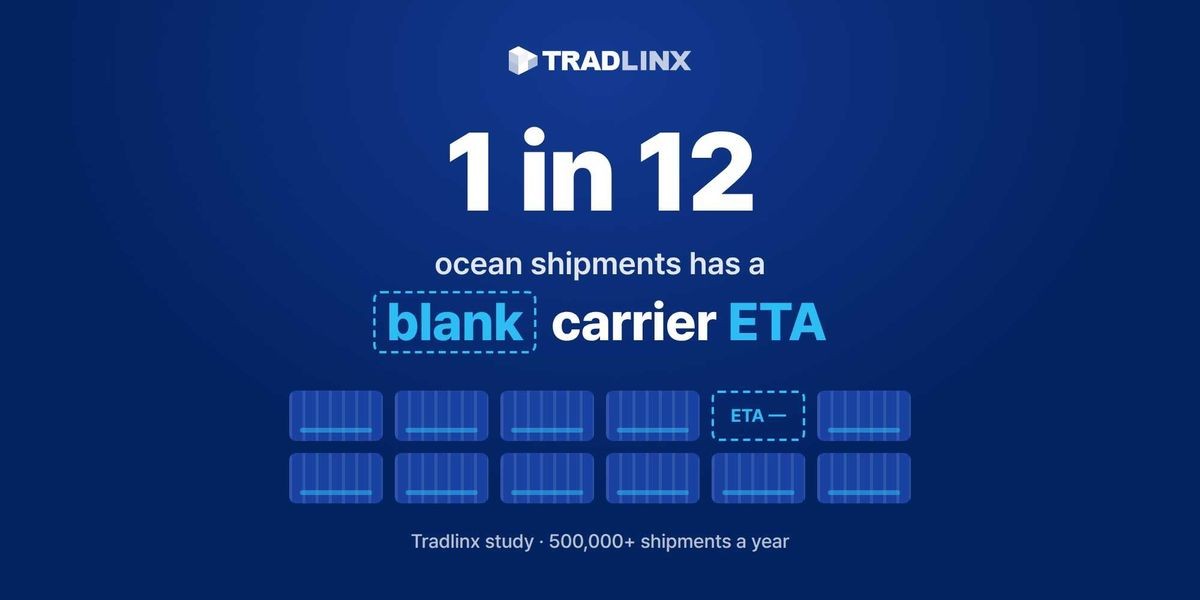
According to DC Velocity, an analysis of more than 500,000 shipments per year by Tradlinx — a supply chain data platform headquartered in South Korea — reveals that ocean carrier estimated time of arrival (ETA) fields are frequently blank or inaccurate.
Widespread ETA Gaps Concentrated at Transshipment Ports
The report found carriers left the ETA field blank in 42,832 cases, representing 8.43% of all shipments analyzed. Nearly three-quarters of these gaps occurred at transshipment ports: the intermediate transshipment port ETA was missing in 30,929 cases (6.09%), the final-destination ETA for transshipment cargo in 6,168 cases (1.21%), and the destination ETA for direct shipments in 5,735 cases (1.13%). Transshipment cargo accounted for 87% of all ETA gaps.
Average Delay and Severe Errors
Across the validation sample, the mean absolute error between carrier-provided ETAs and actual arrival times was 15.4 hours. In the worst-performing 5% of shipments — totaling 25,341 shipments (4.99% of the sample) — carrier ETAs missed actual arrival by 48 hours or more. For this group, the average error ballooned to 90.0 hours.
Operational Impact of Blank Fields
Tradlinx emphasized that the issue is not merely accuracy but basic data completeness.
“Most of the industry conversation is about how accurate carrier ETAs are. Our data points to a more basic gap: for roughly one in twelve shipments, the ETA simply goes missing somewhere along the way.” — Tradlinx
The company noted these blanks cluster precisely where planners need visibility most — at transshipment ports — and that empty fields rarely trigger automated alerts, forcing manual checks, slowing customer updates, and undermining trucking and warehouse scheduling.
Source: DC Velocity
Compiled from international media by the SCI.AI editorial team.