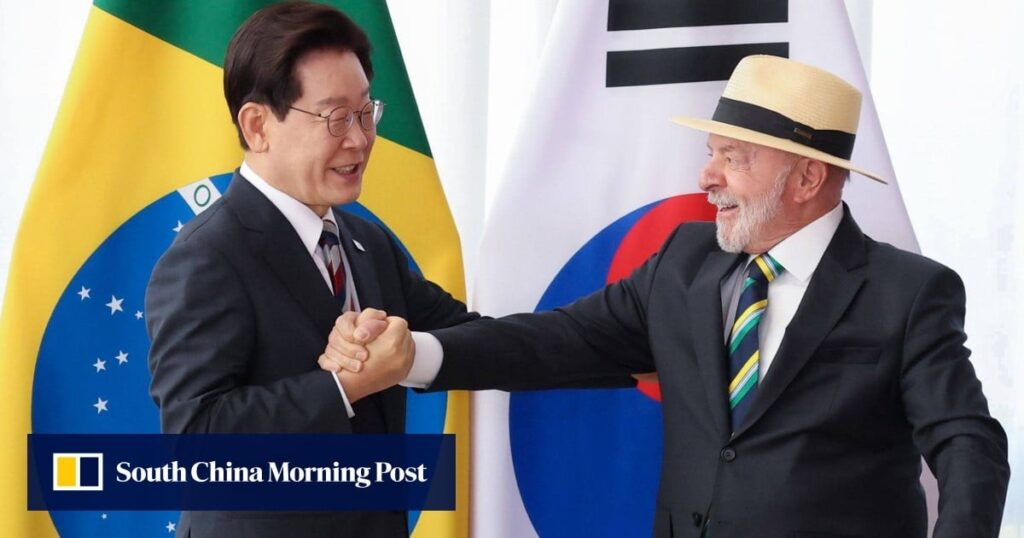
According to www.gurufocus.com, on September 23, 2026, South Korean President Lee Jae-myung announced an initiative to double the country’s semiconductor production capacity and safeguard the artificial intelligence (AI) supply chain against external disruptions — a move unveiled at the “Korea Investment Summit” in New York.
Strategic Timing and Geopolitical Context
The announcement follows the South Korean government’s broader investment plan, unveiled on June 29, 2026, aimed at strengthening domestic semiconductor and AI infrastructure. This coordinated effort reflects growing concern over supply chain fragility, particularly as global demand for AI accelerates. The initiative explicitly calls for increased American investment in South Korea, positioning the country as a secure node in the U.S.-aligned tech supply network.
President Lee Jae-myung’s address emphasized resilience:
“Double the country’s semiconductor production capacity and safeguard the artificial intelligence (AI) supply chain against external disruptions” — President Lee Jae-myung, South Korea
The statement underscores how geopolitical volatility has reshaped national industrial strategy, moving beyond export competitiveness toward sovereign capability.
With memory chips and AI hardware becoming foundational to cloud computing and national security, South Korea’s push targets both scale and strategic autonomy — a shift validated by immediate market response and concrete fiscal commitments.
Funding Architecture and Scale
South Korea is establishing a ₩5 trillion, roughly $3.52 billion, semiconductor fund focused on materials, equipment, components, and fabless chip companies. An additional ₩5 trillion is earmarked for trade financing across the semiconductor supply chain — signaling support not only for R&D and fabrication but also for liquidity and logistics resilience.
These figures, while substantial, are described in the source as “almost pocket change” relative to the overarching megaproject led by Samsung Electronics and SK Hynix. The dual-fund structure reveals a deliberate segmentation: one targeting upstream enablers (materials, tools), the other ensuring working capital flows across tiers of suppliers — a design directly addressing bottlenecks exposed during recent global disruptions.
The total financial commitment reflects South Korea’s prioritization of vertical integration: from silicon wafers to high-bandwidth memory modules essential for AI servers, all anchored domestically to reduce exposure to export controls or shipping interruptions.
Corporate Impact and Market Response
Samsung Electronics (SSNLF) surged approximately 6.7% in Wednesday’s South Korean trading session following the announcement. With a market capitalization of $1.38 trillion, Samsung generates over 70% of its revenue and profit from mobile phones and semiconductors — making it the primary beneficiary of the state-backed expansion.
Meanwhile, SMCI, a company designing and manufacturing data center infrastructure, carries a market capitalization of $27.22 billion. Its modular, open-standard architecture aligns with South Korea’s emphasis on interoperable, scalable AI hardware — suggesting downstream synergy beyond memory chips alone.
The surge in Samsung’s stock signals investor confidence not just in near-term capacity growth, but in sustained demand: the source notes that Samsung still requires AI servers, high-bandwidth memory, and advanced computing systems to absorb future output — implying multiyear tailwinds if AI adoption continues accelerating globally.
Source: gurufocus.com
Compiled from international media by the SCI.AI editorial team.