Skip to content

Manufacturing

Analysis

BYD to launch ETT 44 e-truck in Europe by Q2 2026

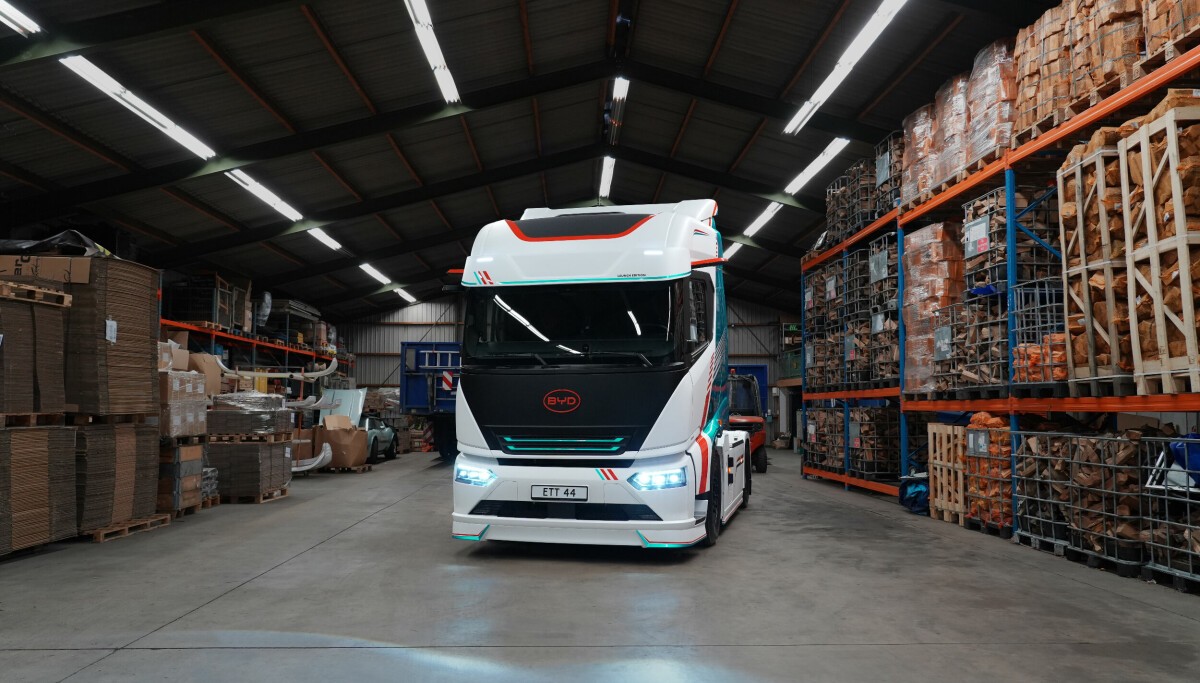
BYD plans to deliver its ETT 44 electric tractor unit to Europe by Q2 2026 and pursue local manufacturing to become 'a European company.' The truck offers up to 372 miles of range and charges 20–80% in 20 minutes. With current EU tariffs on Chinese EVs reaching up to 45%, local production — potentially in Hungary or via acquisition — aims to mitigate duties. BYD already operates bus and battery facilities in Hungary and holds partnerships with Forvia and Voestalpine. ACEA reports €1.3bn in EU imports of Chinese commercial vehicles in 2025.

Original source: Source information pending

BYD to launch ETT 44 e-truck in Europe by Q2 2026

According to automotivelogistics.media, BYD plans to deliver its first heavy-duty electric truck for the European market in the second quarter of next year and is pursuing local manufacturing to embed itself in the region.

ETT 44 specs and IAA debut

BYD unveiled the ETT 44 4×2 electric tractor unit at the IAA Transportation trade show in Hanover, engineering it specifically for long-haul transport across Europe. The vehicle features a 651 kWh battery offering an estimated range of up to 372 miles (600km), with charging from 20% to 80% achievable in just 20 minutes using BYD’s 1.5 MW charging technology — adding up to 250 miles of range per session.

Local production and supply chain strategy

Stella Li, executive vice-president and head of international business at BYD, stated at IAA:

“For the long term, we will produce everything we sell in Europe here locally. Once you move everything produced locally, it’s okay. We become a European company.”

While BYD has not disclosed the location or start date for European truck production, it already operates a factory for electric buses and commercial vehicles in Komárom, Hungary, plus two battery-related facilities in the same country.

The OEM announced a $1 billion plant in Manisa, Turkey in 2024, but paused those plans this June while evaluating a second European manufacturing site — potentially via acquisition. It has disclosed strategic partnerships with Forvia in France and Hungary, and supply agreements with steel and technology provider Voestalpine in Hungary.

Tariff avoidance and market context

Local production could help BYD avoid or limit tariffs on Chinese imports: current duties stand at 10% on imported Chinese vehicles, trucks, and electric trucks, with an additional China-specific duty of 7% to 35% for EVs — bringing total duties to between 17% and 45%. Though Chinese electric trucks currently lack that extra duty, industry calls for its enforcement are growing — including from Traton’s MAN brand and the European Automobile Manufacturer’s Association (ACEA).

In its May 2026 EU-China trade fact sheet, ACEA reported that the EU imported €1.3bn worth of commercial vehicles and buses from China in 2025. BYD’s end-to-end ecosystem plan includes charging infrastructure, energy storage, energy management, and financing — aiming to ease adoption by supplying vehicles, energy, and infrastructure from a single provider.

Source: automotivelogistics.media

Compiled from international media by the SCI.AI editorial team.
Ask SCI.AI Finished reading? Continue with SCI.AI. Explore the related policy, route, company and historical context. Continue asking
Maersk tops intra-Asia capacity with 340,000 TEU
Manufacturing

Maersk tops intra-Asia capacity with 340,000 TEU

Maersk has overtaken Cosco Shipping to become the largest container shipping line in the intra-Asia market, with deployed capacity exceeding 340,000 TEU as of mid-August 2026. The intra-Asia fleet grew 6.2% year on year to nearly 2.6 million TEU — outpacing global fleet growth of over 5%. Mainline operators control 63% of capacity despite fewer ships, leveraging larger vessels averaging 2,699 TEU versus regional carriers’ 1,338 TEU. Cosco’s capacity rose by just 500 TEU, while CMA CGM added 15,000 TEU and Gold Star Line expanded 72% (11,000 TEU). Fleet age averages 12 years, ranging from TS Lines’ six-year fleet to MSC’s 21-year fleet.

India’s Semiconductor Sector Raises $1.4B, Half Since 2025
Manufacturing

India’s Semiconductor Sector Raises $1.4B, Half Since 2025

India’s semiconductor sector has secured $1.4 billion in equity funding across 281 companies, with $701 million raised since 2025. Funding surged from $49 million in 2021 to $473 million in 2025, posting a 36% CAGR. Tessolve Semiconductor leads with $213 million; Electronic Manufacturing Services captured $313 million since 2025. Bengaluru hosts 626 firms (18% of 3,557 total) and accounts for 40.1% of funding. Acquisitions (62) outpace IPOs (42), with eInfochips’ $282 million exit the largest on record.

Air Cargo Rates Ease to $3.13/kg, Down 3% MoM
Manufacturing

Air Cargo Rates Ease to $3.13/kg, Down 3% MoM

Global air cargo spot rates fell to $3.13 per kilogram in August 2026 — down 3% month-over-month and marking the third straight monthly decline. Year-over-year growth slowed to 24%, from 28% in July, 38% in June, and a 41% peak in May, according to Xeneta. Shippers are opting for short-term capacity purchases amid budget pressures, while airlines aim to stabilize rates ahead of the peak season. Niall van de Wouw, Xeneta’s Chief Airfreight Officer, confirmed the trend aligns with expectations and noted no signals of near-term demand acceleration.

Welcome Back!

Login to your account below

Create New Account!

Fill the forms below to register

Retrieve your password

Please enter your username or email address to reset your password.

Scan to share via WeChat

Open WeChat and scan the QR code to share

QR Code

Add New Playlist