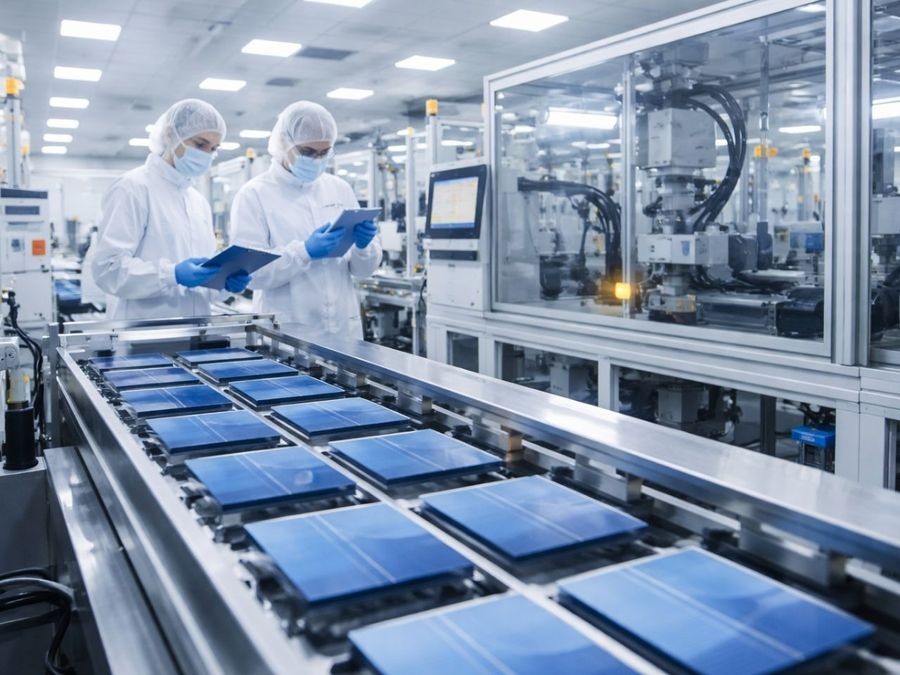
According to ieefa.org, India’s solar module factories are operating at just 35–40% utilisation — well below the 50–65% threshold required for sustainable operations — despite holding 233 gigawatts (GW) of module manufacturing capacity as of June 2026.
Overexpansion at the Module Stage
A joint report by the Institute for Energy Economics and Financial Analysis (IEEFA) and JMK Research finds India’s rapid scaling has been overwhelmingly concentrated in module production. Module capacity now stands at nearly 7x cell capacity and 116x ingot-wafer capacity, exposing severe upstream gaps. As a result, the domestic supply chain remains heavily dependent on imported inputs — predominantly from China — and lacks integration across polysilicon, wafers, and cells.
The report notes that India moved from over 90% import dependence on solar PV modules to becoming the world’s second-largest manufacturer in under a decade. Yet this shift has not been matched by parallel growth in domestic demand or upstream capacity, creating structural imbalance.
With around 135 GW of additional module capacity already planned or under construction, the pressure on factory utilisation, margins, and returns is intensifying. According to Prabhakar Sharma, Senior Consultant at JMK Research and lead author of the report:
“India has added module capacity faster than the market can absorb it. With around 135GW more already planned or under construction and factories running at 35–40%, the pressure on utilisation, margins, and returns will only intensify. Standalone module manufacturers face a real risk of stranded assets.” — Prabhakar Sharma, Senior Consultant, JMK Research
Export Reliance and Market Shifts
Exports are critical to absorbing excess capacity, but India’s export base remains dangerously narrow: the United States absorbed 97% of Indian module export volume in financial year 2026. That channel has since collapsed — US duties exceeding 200% on most Indian manufacturers have cut exports to the US by 44–47% from their FY2024 peak.
The European Union now represents the most structured medium-term alternative, given its recent supply-chain rules that explicitly reward geographic diversification. However, success there hinges on competitiveness beyond market access alone.
Charith Konda, Lead Energy Specialist at IEEFA and contributing author, states:
“India may have the opportunity to unlock new export markets, provided Indian solar PV manufacturers can effectively compete with Chinese manufacturers by investing in R&D and the manufacturing of polysilicon, ingots, wafers, and cells. But market access alone will not be enough. Sustained export growth depends on closing the cost and technology gap with China through scale, integration, and operational efficiency.” — Charith Konda, Lead Energy Specialist, IEEFA
Toward Upstream Integration and Policy Reform
The report forecasts that the capacity-demand gap will persist through 2030, even with strong domestic deployment growth. New demand sources — including data centres, green hydrogen and ammonia production, and exports — could add an incremental 17–22 GW by 2030, with green hydrogen offering the largest near-term upside due to its dedicated renewable energy requirements.
Industry consolidation is expected: smaller, non-integrated module makers will face mounting pressure, while vertically integrated players are better positioned to absorb shocks and control input costs. Domestic manufacturing is also projected to move upstream — into cells, wafers, and eventually polysilicon — reducing reliance on foreign inputs.
Chirag H. Tewani, Senior Research Associate at JMK Research, emphasizes policy recalibration:
“The challenge is no longer building capacity; it is using it well and deepening the value chain. That means spreading incentives evenly across cells, wafers, and polysilicon rather than rewarding modules alone, strengthening industry-research collaboration, and giving exporters targeted, time-bound support.” — Chirag H. Tewani, Senior Research Associate, JMK Research
Pulkit Moudgil, also of JMK Research, adds that India’s entry into the Pax Silica coalition presents a concrete opportunity to diversify silicon sourcing and reduce dependence on China.
Source: ieefa.org
Compiled from international media by the SCI.AI editorial team.