According to www.saurenergy.com, India’s solar photovoltaic (PV) module manufacturing capacity reached approximately 233 GW by June 2026, yet manufacturers operate at just 35–40% capacity utilisation — well below the 50–65% threshold generally required for sustainable operations, per the Institute for Energy Economics and Financial Analysis (IEEFA).
Overcapacity Risk Mounts Amid Rapid Module Expansion
The report identifies a pronounced imbalance between supply and demand, particularly at the module level. Around 135 GW of additional module capacity is backed by firm investment commitments and near-certain commissioning schedules — raising a clear risk of further overcapacity in the near term. As domestic demand catches up only gradually, standalone module manufacturers face mounting pressure on utilisation rates, profit margins, and investment returns, increasing exposure to stranded assets.
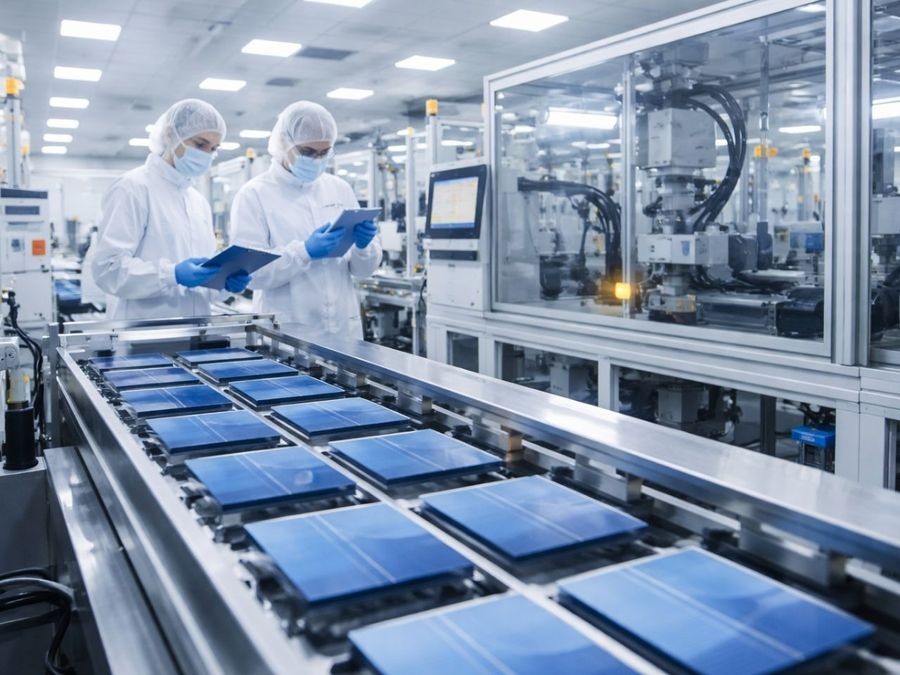
Module assembly remains the most accessible segment due to relatively modest capital requirements, shorter commissioning timelines, and lower process complexity. In contrast, upstream segments — including cells, wafers, and polysilicon — require significantly larger investments, longer build-out periods, and specialised expertise. This structural gap has left India heavily reliant on imports for critical inputs, undermining vertical resilience.
The IEEFA analysis underscores that this mismatch is now one of the sector’s central challenges. While India has emerged as a major global solar manufacturing destination, its value chain remains skewed toward final assembly rather than integrated production — limiting cost competitiveness and long-term scalability.
PLI Incentives Need Upstream Refocusing
India’s current Production Linked Incentive (PLI) framework rewards integration across multiple stages — such as Polysilicon, Wafer-Ingot, Cell & Module (PWCM), or Cell and Module (CM). However, capacity additions have been highly uneven: module manufacturing has surged while upstream segments lag. IEEFA recommends restructuring future PLI iterations to provide meaningful, component-level incentives — especially for PWCM manufacturing — lowering entry barriers for firms specialising in single value-chain stages.
This targeted approach would distribute supply-side support more evenly, encouraging broader participation across the chain and fostering a more resilient domestic industry. Without such recalibration, module overcapacity risks intensifying while upstream gaps persist.
The report notes that India’s heavy reliance on the US — which absorbs the bulk of its solar exports — heightens exposure to trade-policy volatility. Europe represents the most structured medium-term alternative, given its policy frameworks increasingly prioritising supply-chain resilience and diversified sourcing. Yet market access alone is insufficient; Indian producers must also close persistent cost and technology gaps.
Competitive Window Opens Amid Chinese Financial Stress
A narrowing price gap — down roughly 28.6% from its 2024 level — and sustained financial stress among top Chinese producers are creating a strategic window. The top five Chinese module makers reported combined net losses exceeding USD 4–4.7 billion (approximately ₹37,800–44,415 crore) in 2025. Meanwhile, Indian manufacturers remained profitable through 2025 and the first quarter of 2026, supported by domestic policy protection and higher export margins.
However, Indian modules remain more expensive than Chinese equivalents. Further investments in cell and wafer manufacturing — alongside greater upstream integration — are expected to reduce import dependence and improve cost competitiveness over time. These efforts could strengthen India’s position in overseas markets and make exports a more critical outlet for its rapidly expanding 233 GW capacity.
Source: saurenergy.com
Compiled from international media by the SCI.AI editorial team.