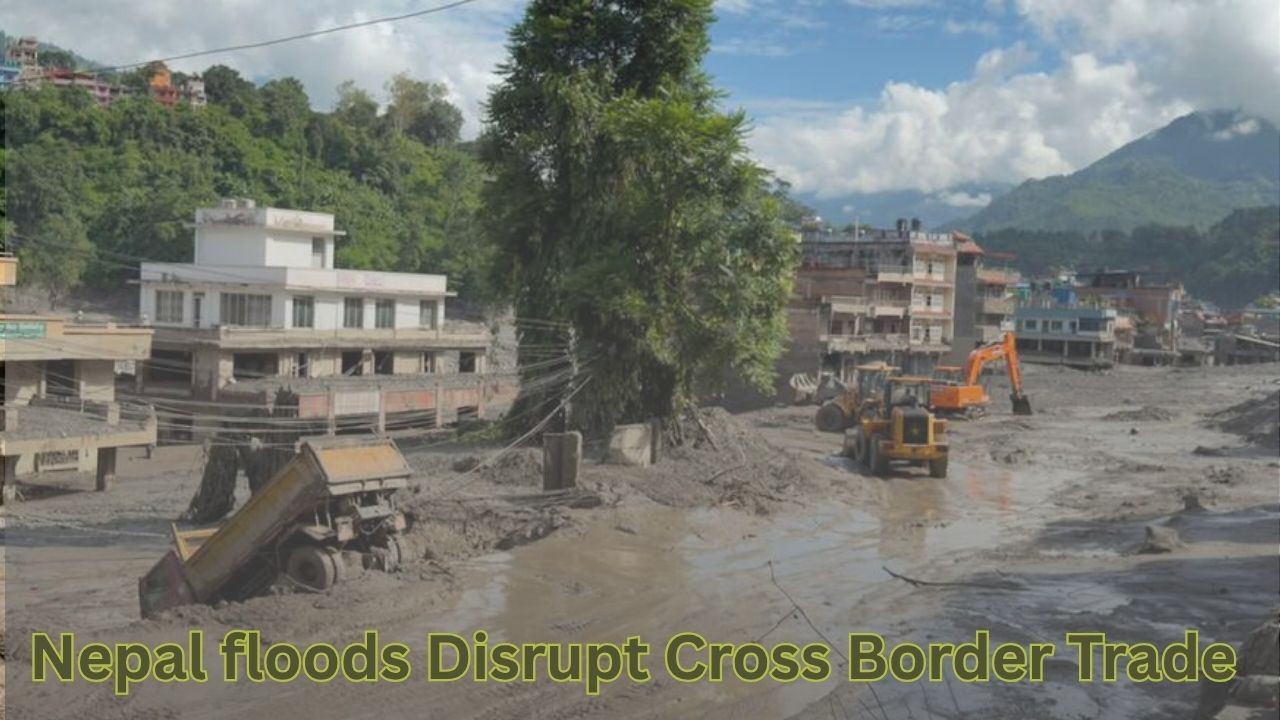
According to www.logisticsinsider.in, devastating flash floods in Nepal have severely disrupted India-Nepal supply chains, with a queue of approximately 16 km of Indian cargo trucks stranded at the Sonauli border crossing in Uttar Pradesh.
Trade Volume and Structural Vulnerability
Bilateral merchandise trade between India and Nepal reached $9.38 billion in FY2025–26 — representing over 60% of Nepal’s total external goods trade. Nepal exports more than 80% of its goods to India, underscoring the asymmetry and concentration of trade flows. This dependency is amplified by Nepal’s landlocked geography: surface transport dominates, with the Raxaul-Birgunj corridor alone handling roughly two-thirds of Nepal’s trade.
The Bhairahawa-Sunauli gateway serves as a critical route for heavy machinery, automobiles, and consumer goods. Although the Sonauli crossing itself was not directly flooded, damaged roads and severed connectivity deeper inside Nepal have delayed shipments toward Kathmandu and other destinations — turning a localized weather event into a systemic bottleneck.
India currently operates two rail freight routes into Nepal — through Raxaul-Birgunj and Jogbani-Biratnagar — and integrated check posts (ICPs) are operational at Birgunj, Nepalgunj, and Biratnagar. An ICP at Bhairahawa remains under construction. Yet rerouting large volumes from disrupted road corridors requires time-consuming adjustments to customs processes, truck repositioning, and cargo transshipment.
Sector-Specific Impacts
Five sectors face acute exposure due to high import dependence, time-sensitive delivery requirements, or inventory sensitivity. Petroleum products — India’s largest export category to Nepal — were valued at over $2.2 billion in 2025. Prolonged road disruption threatens fuel distribution unless alternative routes absorb diverted volume.
India exported approximately $724 million worth of iron and steel to Nepal in 2025, vital inputs for ongoing infrastructure projects. Delays risk halting construction activity. Similarly, vehicle exports totaled $479 million and machinery exports $506 million in the same year — categories vulnerable to border congestion because of high-value cargo, strict dealer inventory schedules, and inland market access dependencies.
Cereals — valued at around $410 million in 2025 — and pharmaceuticals — at $250 million — represent categories where delays translate rapidly into market shortages. Pharmaceutical supply chains are especially sensitive, requiring predictable replenishment for hospitals and pharmacies.
Operational and Strategic Consequences
For Indian exporters, immediate impacts include longer transit times, higher inventory carrying costs, truck detention fees, and potential delivery penalties. For Nepal, persistent impairment risks shortages of fuel, food, industrial inputs, and consumer goods. With bilateral goods trade already approaching $9.4 billion annually, maintaining corridor functionality during natural disasters has become operationally essential — not merely logistical but strategic.
The floods therefore highlight a structural challenge: trade diversification remains constrained by physical infrastructure concentration. Multimodal connectivity, resilient border infrastructure, and pre-validated contingency routes are no longer optional upgrades but foundational requirements for the India-Nepal trade network.
Source: logisticsinsider.in
Compiled from international media by the SCI.AI editorial team.