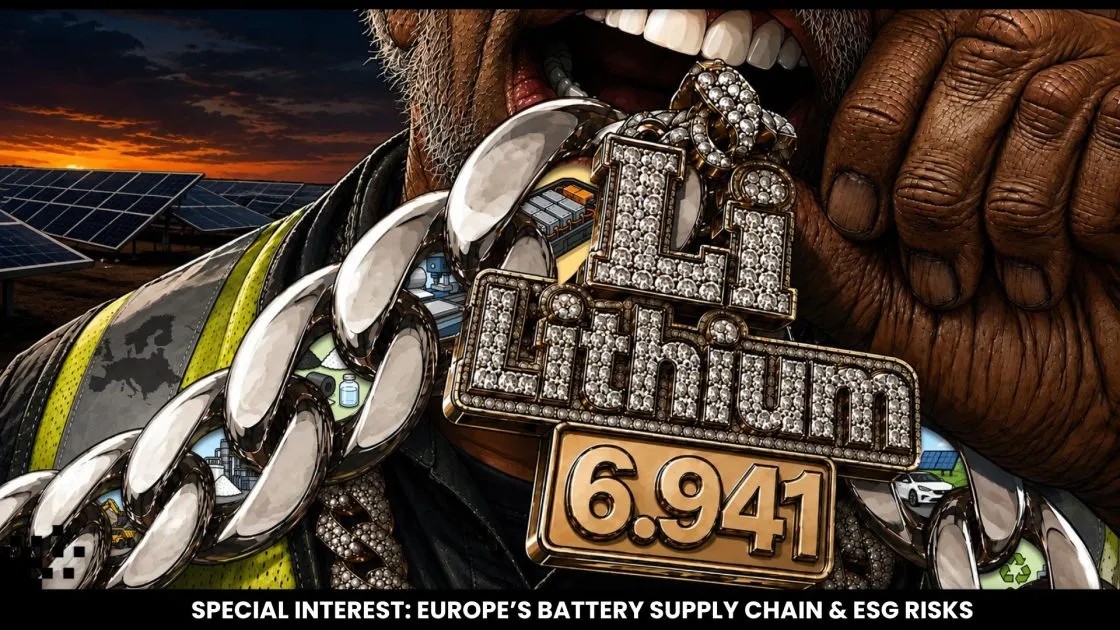
According to mining.com.au, Europe’s accelerating battery production is intensifying scrutiny of upstream ESG risks — particularly in lithium extraction and cobalt mining — even as regulatory frameworks like the EU Battery Regulation and Critical Raw Materials Act (CRMA) take shape.
Upstream Risks Dominate the Value Chain
Arthur D. Little’s report ESG Risks in Lithium-Ion Battery Supply Chains identifies the most severe environmental, social, and governance exposures at the mining and material processing stages. These include greenhouse gas emissions, water consumption, pollution, unsafe working conditions, forced and child labour, and adverse impacts on local communities. Philipp Seidel, Principal at Arthur D. Little, emphasizes that relocating parts of the battery value chain to Europe does not eliminate these risks:
“Lithium extraction can create significant water and ecosystem pressures, while cobalt and other mining activities can expose companies to human rights, worker safety, and community risks.” — Philipp Seidel, Principal, Arthur D. Little
He adds that expanding European processing and cell manufacturing introduces new challenges — especially around energy use, water consumption, and local acceptance. Though Europe has relatively strong regulatory foundations, the practical gap remains wide: the EU Battery Regulation’s due diligence obligations have been postponed until August 2027, highlighting the difficulty of enforcing standards across complex, multi-tier global supply chains.
The next critical step, Seidel notes, is turning regulation into actionable outcomes — namely reliable supplier data, end-to-end traceability, independent verification, and effective mitigation strategies across all tiers.
ESG as Commercial Differentiator
For mining firms targeting European markets, ESG performance is evolving from compliance burden to competitive advantage. According to Arthur D. Little, responsible mineral production — verified, traceable, and aligned with sustainability thresholds — now directly influences market access, financing terms, and competitive positioning. This shift is especially acute given that EU rules for placing batteries on the market will soon mandate specific carbon footprint limits, minimum recycled content thresholds, and full product information disclosures — all backed by due diligence obligations starting in 2027.
Elementos (ASX:ELT) Managing Director Joe David frames ESG expectations as foundational to earning trust — not an add-on. He points to the Guadiato Valley in Andalucía, Spain, where coal and base metal mines operated until closures between 1990 and 2012. That legacy means residents understand both economic benefits and post-closure consequences — and many now support a return of responsible mining. Elementos’ Oropesa Tin Project aims to exceed local expectations through transparency and community engagement.
Latitude 66 (ASX:LAT) Managing Director Grant Coyle echoes this, citing Finland’s high regulatory bar as an opportunity: “Europe has high environmental and regulatory standards, which provides an opportunity for well-designed projects to demonstrate what responsible mining can look like.” His company’s Kuusamo Schist Belt (KSB) Project in Finland is being developed alongside local cobalt refining infrastructure — enabling a fully traceable, European mine-to-market supply chain.
Traceability as the New Currency
Traceability — maintaining auditable records from extraction through processing to delivery — is rapidly shifting from ESG preference to commercial necessity. Dalaroo Metals (ASX:DAL) CEO John Morgan states that European manufacturers will increasingly demand verifiable data on origin, production methods, carbon footprint, and adherence to environmental and human rights standards. The European Commission’s melt-and-pour proposal, effective 1 October 2026, requires importers to submit mill test certifications proving country of melt-and-pour — compelling mining companies to embed traceability systems long before production begins.
Morgan stresses that establishing robust systems early is far easier than retrofitting them later — a principle guiding Dalaroo’s Blue Lagoon Project in Southern Greenland, where environmental baselines, stakeholder engagement, and auditable supply chain documentation are already being formalized. Latitude 66’s KSB Project leverages Finland’s status as the largest cobalt refiner outside China to build a domestic, high-integrity supply chain — one that satisfies both regulatory mandates and growing buyer demand for transparency.
Source: mining.com.au
Compiled from international media by the SCI.AI editorial team.