According to www.thescxchange.com, a Swiss Re Corporate Solutions report warns that supply chain disruptions increasingly originate not from within companies’ own operations—but from vulnerable suppliers, infrastructure providers, and logistics partners.
Hidden dependencies drive rising business interruption risk
The Zurich-based insurer’s report, titled “Emerging Risks: Hidden Dependencies in Global Supply Chains,” identifies a critical gap in enterprise risk management. While 43% of Fortune 500 companies in Europe assess physical risks to their own facilities, only 7% publicly disclose extending those assessments to supplier facilities—and fewer than 2% assess the wider infrastructure they rely on, such as power grids, ports, or transport hubs.
This data asymmetry leaves organizations exposed: when disruption strikes a third-party node—like a port closure, regional power outage, or geopolitical incident—the ripple effects can halt production or delay deliveries far beyond the initial incident location. As Adrian Hall, US CEO of Swiss Re Corporate Solutions, stated:
“Businesses have become much better at understanding the risks to their own facilities. The next challenge is understanding the dependencies beyond their own operations that can determine whether they recover quickly or face prolonged disruption.” — Adrian Hall, US CEO, Swiss Re Corporate Solutions
Geopolitical and climate shocks compound dependency risk
The report situates this vulnerability within an intensifying global risk environment. According to the source, the ongoing Middle East conflict represents the fourth major global supply shock in six years. Each event—whether pandemic-related port congestion, Red Sea shipping reroutes, or sanctions-driven logistics fragmentation—exposes how tightly coupled modern supply chains have become.
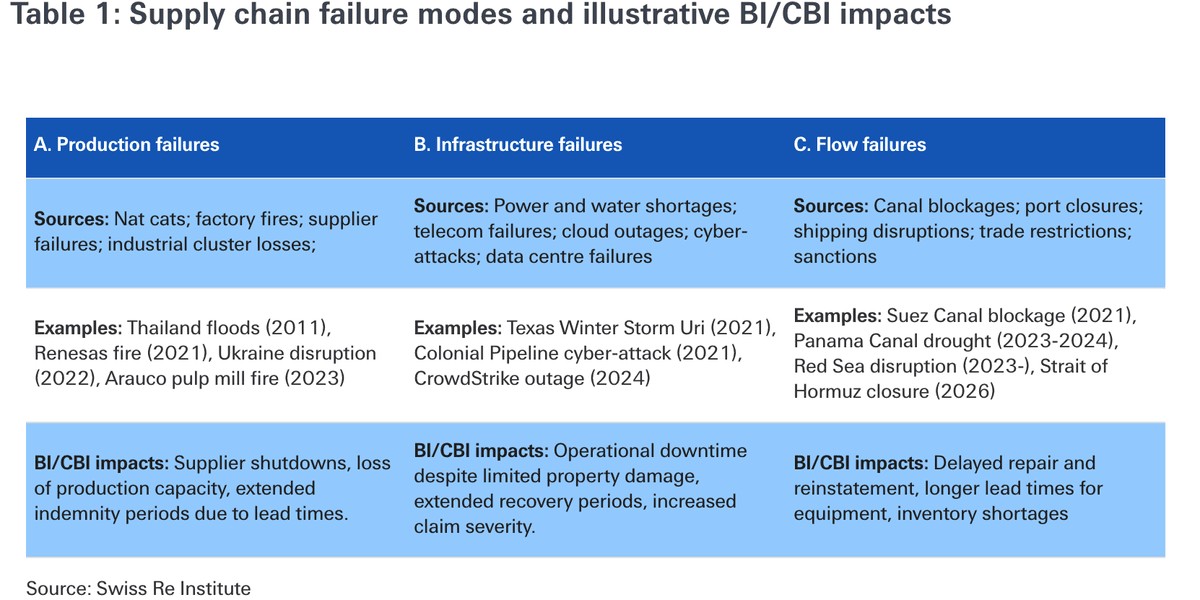
Infrastructure failures, logistics bottlenecks, shipping delays, and trade restrictions don’t merely delay shipments; they directly impede recovery by delaying repairs, replacement equipment, or critical inputs. That delay magnifies insured business interruption (BI) and contingent business interruption (CBI) losses—making accurate dependency mapping essential for actuarial modeling and insurance underwriting.
Data gaps hinder resilience-building tools
Companies are increasingly adopting advanced digital tools—including network mapping software and AI-driven scenario modeling—to quantify downtime exposure across tiers of suppliers and infrastructure dependencies. However, Swiss Re cautions these models are only as reliable as their input data. The report found that many enterprises still lack foundational visibility: structured, verified data on Tier 2+ supplier locations, utility interconnections, regional road-rail-port handoffs, and customs clearance timelines.
Without granular, real-time intelligence on these dependencies, even sophisticated modeling yields misleading outputs. For example, a model may assume redundancy in air freight capacity—yet fail to account for the fact that 2026 saw three major cargo hub outages due to concurrent extreme weather events across Southeast Asia, the EU, and North America—each uncorrelated but collectively straining global air capacity.
Practitioner implications: From compliance to operational intelligence
For supply chain professionals, the report underscores a shift from facility-centric risk audits to ecosystem-wide mapping. This means integrating procurement, logistics, and ESG teams—not just to meet disclosure standards like CSDDD or Scope 3 reporting, but to enable faster response when disruption hits. A manufacturer sourcing semiconductors from a single fab in Taiwan, for instance, must now map not only that fab’s power provider but also the substation’s flood-risk rating, backup generator fuel contracts, and regional road access during typhoon season.
Such granularity transforms risk management from retrospective insurance claims into proactive operational planning. It also redefines vendor scorecards: financial health and delivery performance are no longer sufficient without validated infrastructure resilience metrics—such as 98.7% uptime over the past three years for a key logistics partner’s primary distribution center.
Source: thescxchange.com
Compiled from international media by the SCI.AI editorial team.