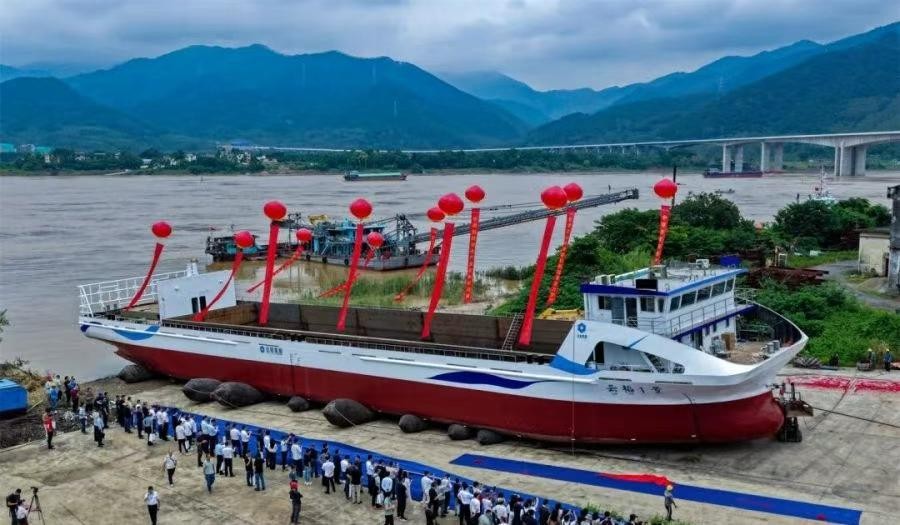
According to splash247.com, China has launched the Yun Tao No 1, its largest hydrogen-powered inland cargo vessel to date — a 2,000-tonne capacity ship designed for commercial deployment across the Pearl River basin.
Technical Specifications and Operational Design
The Yun Tao No 1 entered the water in early July 2026 at Zhaoqing in Guangdong province. Developed by Guangdong Yuntao Hydrogen Energy Technology in partnership with China State Shipbuilding Corporation (CSSC), the vessel was constructed by CSSC’s Guangzhou Shipbuilding Industry unit. At 69.3 meters long, it carries up to 2,000 tonnes of cargo — equivalent to approximately 140 containers or bulk commodities such as ore, grain, and coal.
The ship is engineered for operation on Guangdong’s Beijiang river network. Its propulsion system comprises three domestically built 260 kW hydrogen fuel-cell generator sets, supplemented by lithium batteries. An intelligent energy-management system dynamically allocates power between fuel cells and batteries. The vessel achieves a reported operational range of 760 km on a single refuel — a key metric for inland freight viability.
Economic and Deployment Roadmap
Yuntao estimates that fuel costs for the Yun Tao No 1 will be 25% to 30% lower than those of a comparable diesel-powered vessel. However, the company cautions that this advantage depends critically on hydrogen pricing, bunkering infrastructure availability, and long-term operational reliability.
The firm has committed to deploying 100 standardized hydrogen-powered vessels across the Pearl River system within four years. To support this scale-up, new hydrogen refuelling infrastructure is being developed in parallel. Yuntao aims to achieve subsidy-free commercial operations by 2028.
National Hydrogen Shipping Expansion
China’s hydrogen maritime initiative extends beyond Guangdong. In May 2026, the 64 TEU Dong Fang Qing Gang entered commercial service on the route between Jiaxing and Hangzhou. Separately, a 2,000-tonne hydrogen internal-combustion and electric hybrid vessel is scheduled for launch in Wuhan in 2028. These projects reflect a deliberate national strategy to test multiple hydrogen technologies — fuel cells, hybrids, and combustion — while simultaneously building integrated production, storage, and distribution networks.
This coordinated effort signals a shift from isolated demonstration units toward routine zero-emission freight operations on inland waterways. According to the report, the goal is to move inland shipping from prototype validation to regular, economically sustainable service — beginning with high-density corridors like the Pearl River and Yangtze tributaries.
Industry Context and Supply Chain Implications
Unlike deep-sea decarbonization efforts — where ammonia and methanol dominate near-term fuel discussions — China’s inland focus prioritizes hydrogen due to shorter voyage lengths, existing industrial hydrogen supply chains in provinces like Guangdong, and proximity to renewable electricity sources for green hydrogen production. This aligns with broader national targets under China’s 14th Five-Year Plan, which designates hydrogen as a strategic priority for heavy transport sectors.
For supply chain professionals, the Yun Tao No 1 and its planned fleet represent more than a technology milestone: they introduce a new node in multimodal logistics planning. Vessel scheduling must now integrate hydrogen refuelling windows, battery charging cycles, and port-side energy management systems — all requiring updated digital twin models and real-time data sharing between shippers, terminals, and energy providers. As Sam Chambers, East Asia Editor for splash247.com, notes in his reporting, “the economics hinge not on the ship alone, but on the entire ecosystem — from electrolyser uptime to barge-to-barge transfer efficiency.”
Source: splash247.com
Compiled from international media by the SCI.AI editorial team.