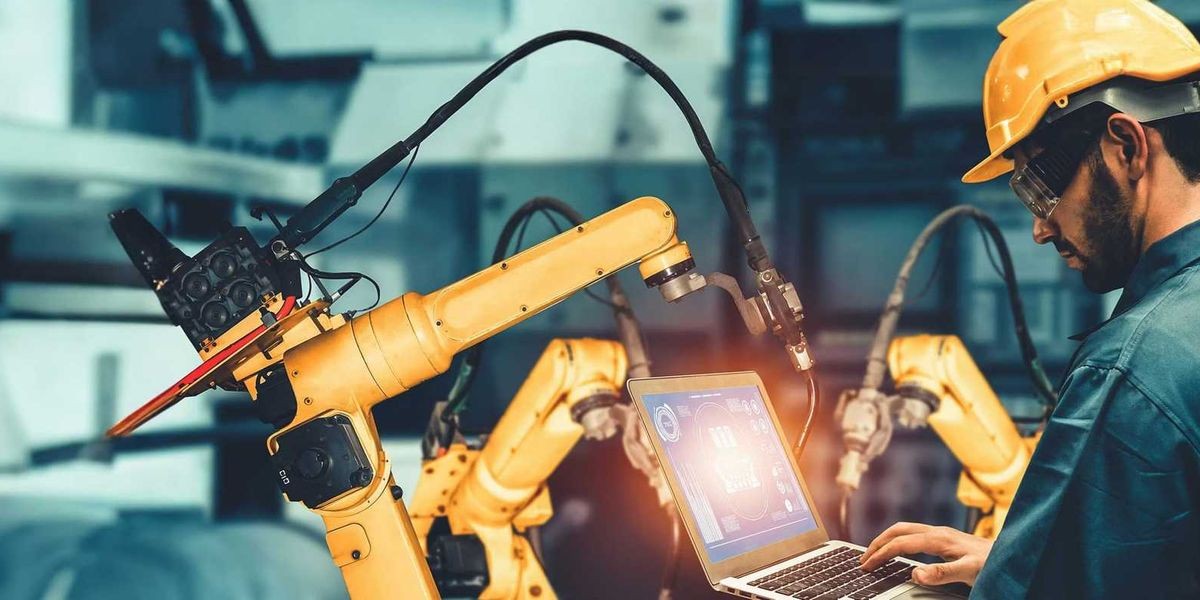
According to www.thescxchange.com, a Tata Consultancy Services (TCS) study finds that 77% of manufacturers anticipate significant or transformational impact from Physical AI in warehouse operations — the highest among all functional areas surveyed.
Human-plus-AI Operating Model Gains Traction
Rather than pursuing workforce replacement, manufacturers are increasingly adopting a Human + AI Operating model — one that augments employees with intelligent systems to improve safety, efficiency, and productivity. This shift reflects a broader strategic pivot from isolated automation pilots toward integrated physical AI ecosystems across factories, warehouses, logistics networks, maintenance operations, and quality management environments.
The approach is detailed in TCS’s Future-Ready Manufacturing: TCS Physical AI Readiness Report 2026, based on a survey of CXOs and vice presidents from 300 manufacturing companies across North America and Europe. Fieldwork was conducted between March and April 2026.
Investment Commitment and Timeline Realism
The report confirms strong financial commitment: no surveyed organization plans to reduce Physical AI investment, while 26% plan to increase spending. This signals sustained capital allocation beyond experimental phases.
Manufacturers are also adjusting expectations around value realization — preparing for longer timelines and prioritizing enterprise-scale transformation over short-term wins. As Anupam Singhal, President, Manufacturing, at Tata Consultancy Services, stated in the report:
“Physical AI is taking intelligence beyond the screen and onto the shop floor, where machines sense, adapt and act in real time. The manufacturers that scale it successfully will define the next era of manufacturing.”
Functional Impact Distribution
Impact expectations vary by function but remain consistently high. Beyond warehouse operations (77% anticipating significant or transformational impact), assembly and manufacturing operations follow closely at 75%, and logistics and material movement at 72%.
Workforce augmentation is another key outcome: 42% of respondents expect significant augmentation through Physical AI — particularly in complex, hazardous, or repetitive industrial settings. This includes applications such as real-time ergonomic guidance, predictive fatigue detection, and automated hazard response protocols.
Adoption Stage and Barriers to Scale
Despite growing momentum, adoption remains early-stage. 68% of manufacturers are still in non-deployment or experimental stages. Legacy system integration, data infrastructure maturity, and workforce skills gaps were identified as the top three barriers to enterprise-scale deployment.
Governance readiness lags further: 44% report unclear or no formal accountability structure for Physical AI failures, and 40% admit they are unprepared for emerging regulatory requirements — underscoring critical gaps in operational governance frameworks.
Industry Context and Practitioner Implications
This trend aligns with broader industry shifts. For example, Siemens has deployed AI-powered digital twins across 12 European factories since 2024 to optimize energy use and predictive maintenance, while Bosch reported a 30% reduction in unplanned downtime after scaling AI-assisted visual inspection systems in its Stuttgart plant in Q2 2025.
For supply chain professionals, the findings imply urgent need for cross-functional upskilling — especially in data literacy, human-machine interaction design, and AI governance. Procurement teams must now evaluate vendors not only on hardware specs but on embedded safety logic, explainability features, and compliance documentation. Meanwhile, operations leaders face dual mandates: deploying AI tools that integrate with existing MES platforms (only 23% of manufacturers have scaled their MES, per a related Supply Chain Xchange analysis) while simultaneously redesigning workflows to keep human judgment central to decision loops.
Source: thescxchange.com
Compiled from international media by the SCI.AI editorial team.