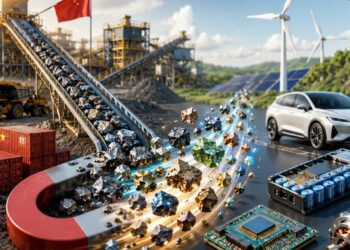
According to www.indianarrative.com, China controls 60–70% of global rare earth mining and 80–90% of refining capacity — a dominance India confronts as it seeks strategic autonomy following the 2020 Galwan clash.
China’s Siege-Style Economic Warfare
Beijing has shifted from conventional trade tools to what the source describes as “siege-style” economic warfare — deploying regulatory tweaks, export controls, and domestic compliance mandates not merely to retaliate but to compel dependent nations back to the negotiating table. The foundation of this strategy is China’s October 2020 Export Control Law, which has since expanded into broad restrictions on gallium, germanium, graphite, antimony, and advanced rare-earth processing technologies. These metals are indispensable for compound semiconductors, high-frequency communications systems essential to 5G and 6G, defense infrastructure, and lithium-ion batteries. While Beijing frames these measures as reciprocal responses to U.S. policies — including the Foreign Direct Product Rule and the CHIPS and Science Act — the collateral damage is strategically calibrated, with countries like India bearing acute pressure during active supply chain diversification efforts.
India’s Post-Galwan Measures and Their Limits
In response to the 2020 Galwan Valley incident, India banned 59 Chinese mobile applications — including TikTok and WeChat — under Section 69A of the Information Technology Act and imposed prior government approval requirements for power supply equipment imports from land-border countries. Yet these steps have not yielded full resilience. Instead, India’s pragmatic recalibrations — such as relaxing visa processes for Chinese professionals in late 2025 and permitting certain entities from land-border countries to invest up to 10% via the automatic route — reflect coercive constraints rather than renewed trust. As the source states:
“Without urgent, comprehensive, and time-bound action to build robust domestic manufacturing and integrate frontier technologies, India risks trading Chinese dependence for a more insidious long-term subordination — becoming a massive consumer market for advanced goods while ceding leadership in the industries that will shape the global economy for decades.”
PLI Scheme: Progress and Persistent Gaps
Launched in 2021, India’s Production Linked Incentive (PLI) scheme now spans 14 sectors and has attracted investment and boosted output in targeted areas. However, after more than five years, critical shortcomings persist. The scheme has not been meaningfully extended to the micro, small, and medium enterprises (MSME) sector — which constitutes the backbone of the Indian economy, employs tens of millions, and drives grassroots innovation. Compliance remains excessively complex and bureaucratic, deterring participation especially among smaller players. Implementation is heavily concentrated in just three states — Gujarat, Tamil Nadu, and Maharashtra — leaving eastern and central regions largely untouched. This geographic imbalance prevents optimal utilization of national capacity and exacerbates regional disparities.
Execution Deficit and Strategic Urgency
The absence of robust state- and district-level strategies compounds implementation failures. Manufacturing and supply chain development cannot succeed as a top-down, Delhi-centric endeavor. Last-mile execution demands active involvement from state governments, district administrations, and local industry clusters — including tailored incentives, skill development programs, infrastructure upgrades, and simplified single-window clearances. India entered global supply chain diversification relatively late compared to Southeast Asian nations that built capabilities over decades. This late start makes every delay costlier: while India focuses on widening basic manufacturing, competitors are advancing into advanced manufacturing techniques, comprehensive digitization of production, and green transformation aligned with sustainability imperatives. The source warns that without deliberate integration of quantum technologies, advanced AI, machine learning for predictive supply chain management, and automation, India may master mid-tier production only to import tomorrow’s high-value components — from electric vehicles and semiconductors to renewable energy systems.
Source: indianarrative.com
Compiled from international media by the SCI.AI editorial team.