According to www.thescxchange.com, 55% of U.S. retailers now use last-mile carriers outside the traditional trio of UPS, FedEx, and USPS — a record high in the 14th annual AlixPartners Home Delivery Survey — as consumer expectations for free, rapid home delivery intensify.
Consumer Expectations Now Set the Floor
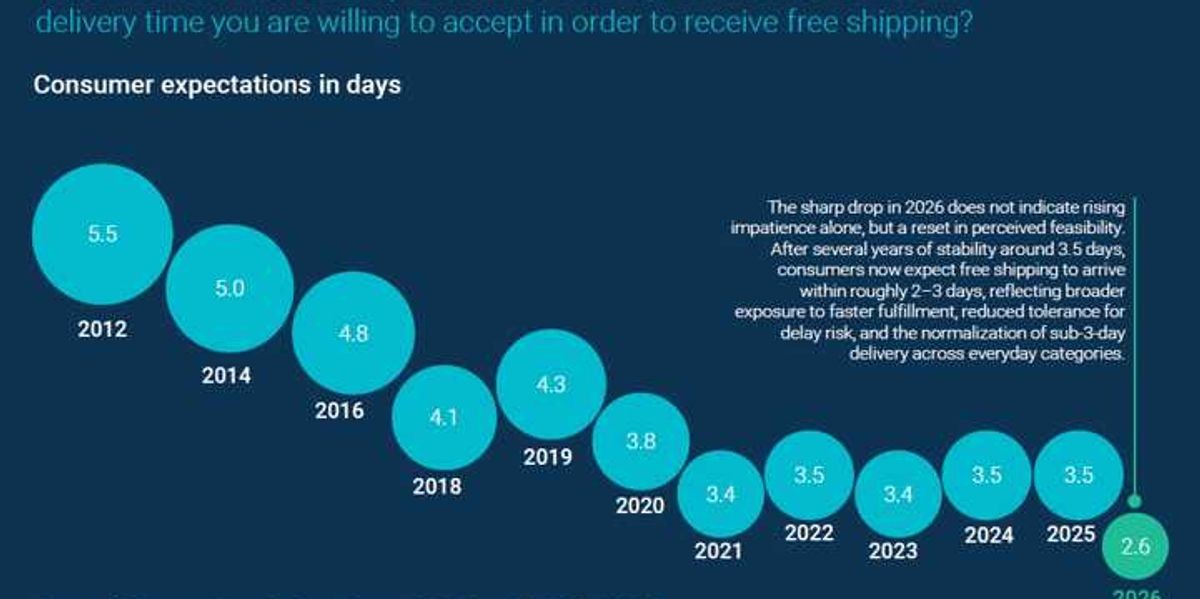
Shoppers no longer treat fast, free delivery as a premium perk but as table stakes. 94% of consumers say free shipping influences their purchase decisions, with nearly 70% rating its impact as ‘great’. Two in three abandon carts when shipping fees exceed approximately $10, and more than 25% expect $0 shipping as a baseline. Speed expectations have also tightened: consumers now demand free delivery in an average of 2.7 days — down from over 3.5 days in prior years. Category-specific expectations vary sharply: grocery and food orders carry the strictest timeline at 0.9 days, while large general merchandise allows 3.2 days.
Loyalty at Risk, Profits Under Pressure
Failure to meet these benchmarks carries steep consequences. 52% of consumers will boycott a retailer after just one or two botched deliveries. More than 20% of demand is estimated to be at risk when timing expectations are unmet. Meanwhile, home delivery remains financially unsustainable for most: 64% of supply chain executives report it is not yet profitable — compared with in-store transactions — and 83% report year-over-year cost increases for home delivery between 2025 and 2026. To offset losses, 56% of retailers enforce a minimum order value for free shipping; half raised that threshold within the past year. A further 22% now require both a minimum order and paid membership to unlock free delivery.
Carrier Selection Shifts From Cost to Resilience
In response, retailers are re-evaluating their carrier portfolios. For the first time in the survey’s history, reliability has displaced price as the primary criterion for selecting a lead carrier. The long-standing UPS–FedEx duopoly is eroding: 55% of retailers now use carriers beyond UPS, FedEx, and USPS, and more than a third have actively shifted volume away from traditional incumbents in the past year. FedEx has overtaken UPS as the most-cited primary carrier, used by 38% of retailers — up from UPS’s 35% peak in 2023. On the consumer side, Amazon leads all carriers in overall delivery preference, topping rankings for timeliness and package condition, while USPS ranks lowest on both timeliness satisfaction and technology investment alignment.
Carrier Choice Is Now a Brand Decision
Consumers increasingly factor carrier identity into purchasing behavior: 84% say their past delivery experiences — including which carrier was used and whether the driver was a gig worker — directly influence where they choose to shop. This transforms carrier strategy from a back-office cost decision into a front-line brand lever.
“The speed and free shipping expectations consumers hold today were once reserved for Amazon Prime members. They are now the floor — not the ceiling — for every category of retail.” — Marc Iampieri, Global Co-Leader of Logistics & Transportation and Partner & Managing Director at AlixPartners
“Carrier diversification used to be a cost play. It is now a resilience and brand play.” — Chris Considine, Partner in AlixPartners’ Retail practice
Retailers gaining ground are those building multi-carrier architectures that enable real-time rerouting around service failures — and who recognize that for premium customers, the carrier badge on the box is part of the product experience.
Source: thescxchange.com
Compiled from international media by the SCI.AI editorial team.