American energy exports reached a historic milestone Wednesday as federal regulators approved the construction of a $5 billion offshore liquefied natural gas (LNG) export platform.
Federal regulators license first-ever offshore LNG export terminal
The project, spearheaded by Houston-based Delfin Midstream, was licensed by the Maritime Administration and received Department of Energy export approval for a total of three planned vessels.
Located 40 miles off the coast of Cameron Parish, Louisiana, the South Korean-built platforms are projected to begin production by 2030, eventually ramping up to an export capacity of 1.8 billion cubic feet of natural gas
The approval marks the first federal licensing of an offshore LNG export terminal in U.S. history. According to federal regulators approved the construction of the facility following a multi-year environmental review and interagency coordination involving the Federal Energy Regulatory Commission, the U.S. Coast Guard, and the National Oceanic and Atmospheric Administration.
LTL market cools panic over Amazon’s point-to-point expansion
Industry analysts are urging calm after Amazon announced it was expanding its less-than-truckload service to all businesses on Wednesday.
The announcement sent shares of publicly traded LTL carriers 5% lower, though experts point out that Amazon’s asset-light model poses no immediate threat to established LTL giants that possess specialized, heavy-pallet infrastructure.
Analysts suggest the ecommerce giant’s container-pool model is more akin to a brokerage play, primarily competing in the economy three-to-four-day subsegment rather than premium service lanes. This contrasts with legacy carriers such as Old Dominion Freight Line and XPO Logistics, whose networks rely on dedicated terminals, cross-dock facilities, and proprietary line-haul equipment.
Counter duties proposed to protect US trailer manufacturers
The U.S. Commerce Department threw a lifeline to embattled domestic van trailer manufacturers last week by determining that China and Mexico have unfairly subsidized their trailer export sectors.
Washington has responded by imposing preliminary countervailing duties of up to 100.7% on Chinese imports and up to 2% on Mexican imports. US Customs and Border Protection will now require importers of both finished and semi-finished dry vans to post immediate cash deposits at these preliminary rates.
This is expected to bring relief to U.S. builders like Wabash National, Great Dane, and Stoughton Trailers. The decision follows a petition filed in November 2025 by the Trailer Manufacturers Association, citing a 27% decline in domestic van trailer shipments between Q3 2024 and Q3 2025.
Overhaul warns of 30% jump in organized cargo fraud
Deceptive pickup and identity-theft schemes surged more than 30% year-over-year in the first quarter of 2026, latest cargo theft report from Overhaul.
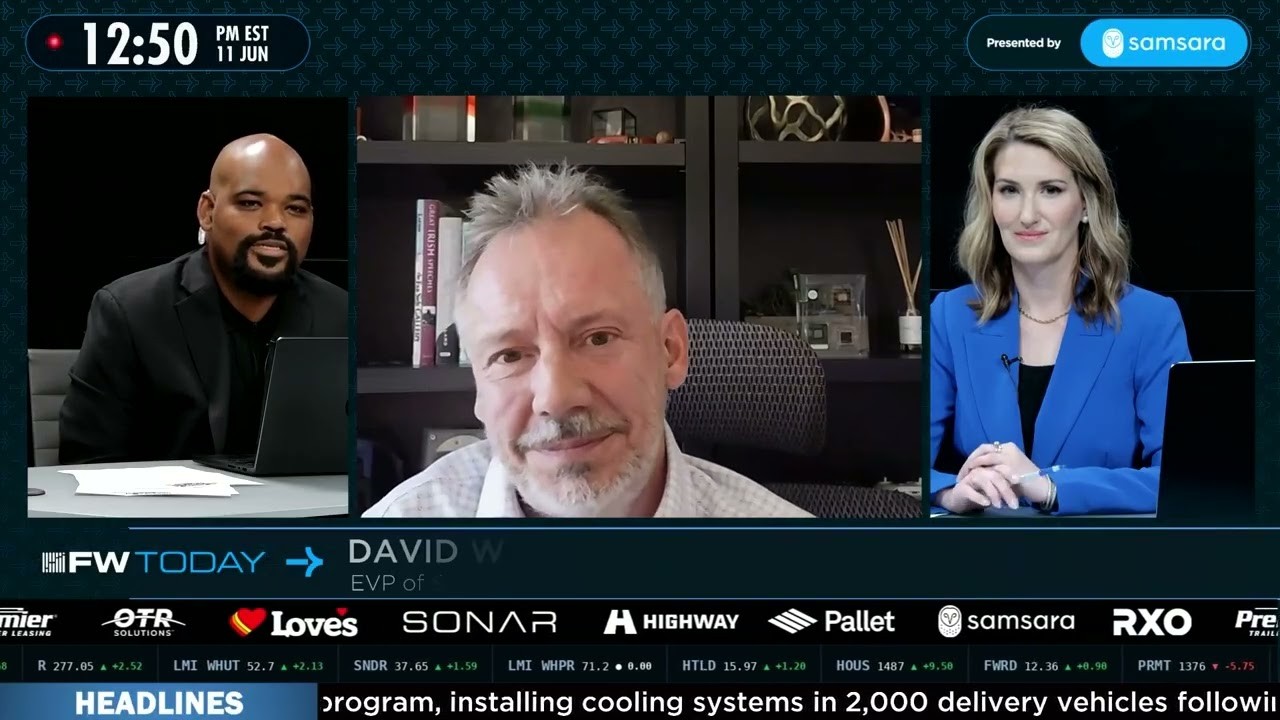
David Warrick, Overhaul’s executive vice president of strategy, joined the show to emphasize that these cyber-enabled hijackings are highly coordinated operations run by international cartels using carrier impersonations and forged credentials.
“The full scale of the cargo fraud epidemic is severely underreported, estimating that for every single reported supply chain theft, an additional four to six crimes go completely unrecorded.” — David Warrick, executive vice president of strategy, Overhaul
Warrick noted that fraud patterns increasingly involve cloned carrier websites, spoofed email domains, and deepfake voice authentication to bypass standard verification protocols used by shippers and third-party logistics providers.
Keep up with the latest news on FreightWaves Today
FreightWaves Today livestreams weekdays at noon ET at http://tv.freightwaves.com/.
The program features live analysis of freight market data, regulatory developments, and supply chain technology deployments. Recent episodes have covered the Q1 2026 surge in port congestion at Savannah and Long Beach, the $1.2 billion investment by Maersk in AI-powered vessel routing, and the implementation timeline for the U.S. Customs and Border Protection’s new Automated Commercial Environment (ACE) Phase III requirements.
Source: FreightWaves
Compiled from international media by the SCI.AI editorial team.