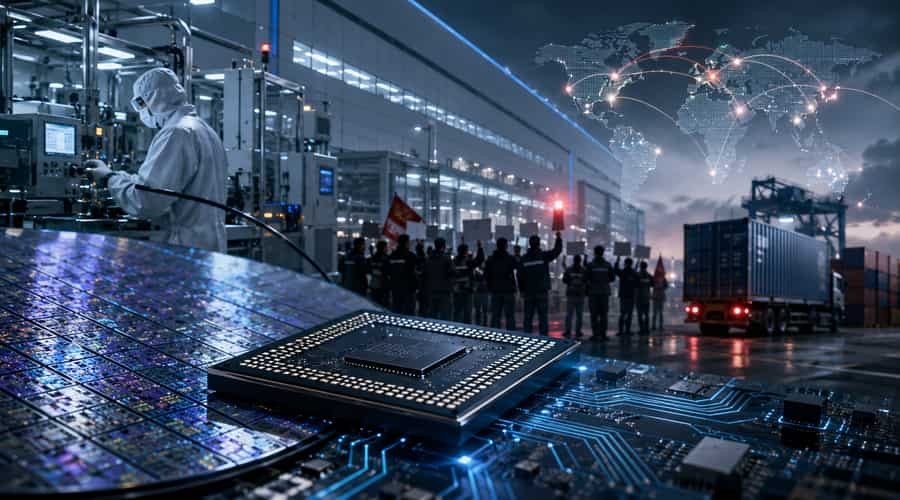
According to startupfortune.com, nearly 48,000 Samsung Electronics workers are preparing to strike after wage negotiations collapsed, threatening production at the company’s semiconductor fabrication plants just as global demand for AI-optimized memory remains acute.
Strike timing amplifies AI supply chain risk
The walkout is scheduled to begin on Thursday, May 21, 2026, and could last 18 days — making it the largest labor action in Samsung’s history. The dispute directly impacts Samsung’s memory fabs, where tightly synchronized production cycles mean even short disruptions ripple across data centers, device OEMs, and AI hardware startups reliant on high-bandwidth memory (HBM) and DRAM. According to the report, Samsung has already initiated pre-emptive mitigation steps, including reducing wafer intake and executing warm-down procedures at memory facilities — a concrete signal of operational concern.
Court intervention narrows but doesn’t resolve conflict
A South Korean court has granted Samsung a partial injunction restricting union activities such as facility occupation, entrance blockades, and interference with safety or production systems. While this lowers the likelihood of a full plant shutdown, it shifts the confrontation into a legally complex arena involving courts, government mediators, and corporate leadership. Prime Minister Kim Min-seok has warned that a single day of suspended chip production could cause direct losses of 1 trillion won — approximately $668 million.
Supply impact quantified: DRAM and NAND at risk
Analysts cited by Reuters estimate that an 18-day strike would disrupt 3% to 4% of global DRAM supply and 2% to 3% of global NAND supply. These figures reflect Samsung’s share of total industry output — not hypothetical exposure. For AI infrastructure builders, this translates into tangible cost pressure and roadmap uncertainty: longer lead times, volatile pricing, and constrained access to HBM, the memory type most directly tied to large-language model training workloads.
Bonus dispute reveals structural tensions
At the core of the labor conflict is a disagreement over bonus distribution tied to operating profit. The union seeks broader sharing of gains from Samsung’s AI-driven memory business, while management resists setting a precedent that could inflate costs across divisions — especially as Samsung races to close a yield gap in its foundry operations. As the source states: “Memory has been the company’s stronger business, helped by AI-driven demand, while the foundry side has faced a tougher road.” This asymmetry makes equitable compensation structurally difficult and operationally urgent.
Practitioner implications for supply chain teams
For supply chain professionals managing AI hardware procurement, the episode underscores three hard constraints: first, geographic concentration — over 70% of HBM capacity resides in South Korea, with Samsung and SK Hynix controlling ~90% of global output; second, process fragility — semiconductor manufacturing requires uninterrupted cleanroom operations, meaning labor stoppages cannot be offset by overtime or shift rotation; third, pricing inflexibility — memory contracts often lock in volumes and prices months ahead, leaving little room to absorb sudden supply shocks. As one procurement lead at a U.S.-based AI accelerator told Startup Fortune off-record: “We’re already allocating 20% more budget to memory than last quarter — now we’re re-scoping Q3 board designs around HBM availability.”
Source: startupfortune.com
Compiled from international media by the SCI.AI editorial team.