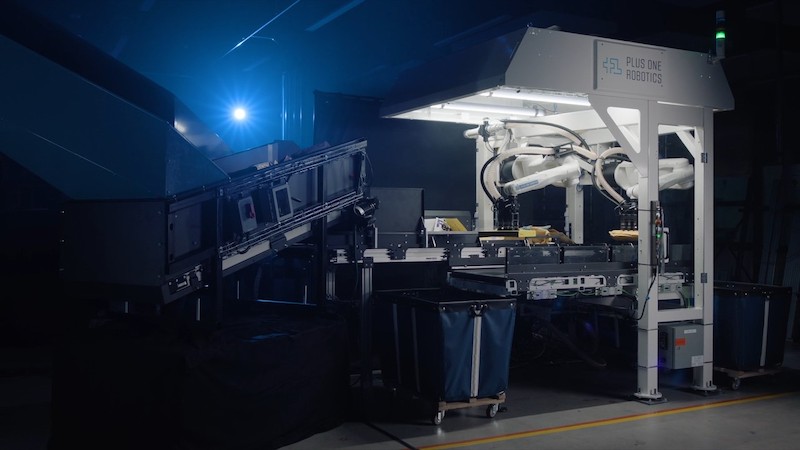
According to roboticsandautomationnews.com, Plus One Robotics completed an eight-hour live stream of its AI-powered parcel induction system on May 22, 2026 — the longest publicly documented continuous operational demonstration of a robotic parcel-handling system to date. The event was broadcast simultaneously on the company’s YouTube and LinkedIn channels and drew more than 950 viewers during the session.
Real-Time Metrics and Performance Benchmarks
The livestream captured live operational metrics from a production-intent workflow environment. Over the full eight-hour duration, the system executed 19,784 parcel picks, achieving a sustained throughput of 2,488 picks per hour. Each pick averaged 1.45 seconds per parcel, a figure reflecting performance across heterogeneous package types — including varying sizes, weights, materials, and surface conditions — without manual intervention or staged resets.
Engineering Transparency and Operational Rigor
Applications and Testing Engineer Jose Luis Hotema opened the demonstration with a technical overview of the hardware-software stack, including the company’s proprietary vision-based AI software running on industrial-grade robotic arms and conveyor-integrated sensors. Unlike short-form promotional clips common in physical AI marketing, this test emphasized unedited, uninterrupted operation — a deliberate response to industry skepticism about real-world reliability. As Erik Nieves, founder and CEO of Plus One Robotics, stated:
“The livestream was our way to answer a question many people have: ‘How do my packages get to me?’ Robots combined with AI are the reason these parcel companies can handle so much volume and such a wide variety of packages.”
Context: Labor Shortages and E-Commerce Pressure
Parcel induction systems sit at a critical bottleneck in modern fulfillment centers. According to Logistics Management’s 2025 benchmark report, U.S. e-commerce parcel volumes grew 12.3% year-over-year in Q1 2026, while warehouse labor vacancy rates remained at 9.7% — above the five-year average of 6.8%. Plus One Robotics’ technology is deployed in applications including depalletizing, sortation, and trailer unloading; the company has shipped systems to seven North American third-party logistics (3PL) providers since 2022. Its founding year — 2016 — aligns with the first wave of venture-backed AI-vision startups targeting material handling, preceding broader market adoption by over four years.
Industry Shift Toward Measurable Validation
This demonstration reflects a wider trend among industrial robotics vendors: shifting from prototype showcases to verifiable uptime and ROI metrics. A 2026 ARC Advisory Group survey found that 74% of warehouse automation buyers now require ≥72 hours of documented continuous operation before issuing purchase orders — up from 31% in 2021. Competitors including Locus Robotics and Berkshire Grey have published multi-shift reliability reports, but none have conducted a public, real-time, eight-hour livestream with live metric overlays. The move also responds to increased scrutiny from Fortune 500 retailers, which now mandate SLAs covering minimum hourly throughput (≥2,200 picks/hour) and maximum mispick rate (≤0.08%) — thresholds Plus One’s system met throughout the test.
Source: Robotics & Automation News
Compiled from international media by the SCI.AI editorial team.